


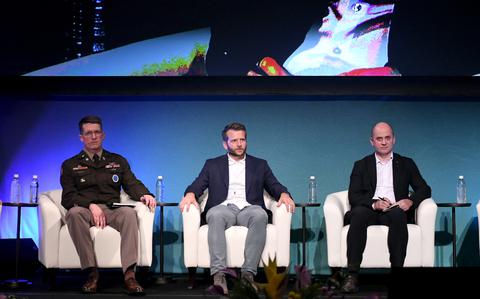
U.S. Army Col. Matthew Skaggs, left, director of intelligence for United Nations Command; Tom Goter, center, chief AI and data officer for Govini; and Mihkel Tikk, deputy commander of the Estonian Defence Forces' Cyber Command, discuss AI's role in warfare during the Land Forces Pacific symposium in Waikiki Beach, Hawaii, May 12, 2026. (Alex Wilson/Stars and Stripes)
WAIKIKI BEACH, Hawaii — The Army is testing artificial intelligence tools that track ammunition, fuel and other supplies across the battlefield, a shift officials say could transform one of warfare’s slowest processes into a tactical advantage.
Army leaders and defense technology experts, during an hourlong panel discussion Tuesday, described AI as a way for commanders and logistics officers to move faster in future wars by replacing cumbersome paperwork and written requests with technology that monitors — and even predicts — when supplies are needed.
The panel — part of the three-day Land Forces Pacific, or LANPAC, symposium — highlighted how the Army’s near-term AI push may be less about futuristic weapons than about simplifying complicated battlefield tasks.
“To compete in the 21st century, we need to move beyond 20th-century tools and 20th-century processes, and that’s where AI and machine learning can be leveraged,” said Tom Goter, chief AI and data officer for Govini, a defense software company developing logistics tools for the military.
One application the Army is exploring is Govini’s flagship product, Ark, a suite of AI-enabled applications. Its logistics application uses live data, Army doctrine and tracking software to monitor supplies such as ammunition for real-time inventory and logistics awareness.
“As we learned in lessons from Ukraine and other regions in the world that are in conflict, things move quick — they move in seconds,” Army Col. Matthew Skaggs, director of intelligence for United Nations Command, said on the panel. “And the data latency that we have on our legacy mission command systems is hours, and sometimes days.”
Skaggs, who serves as director of intelligence for U.S. Forces Korea and deputy director of intelligence for Combined Forces Command, clarified Wednesday that AI command-and-control systems in development are not designed to let AI make targeting decisions. Instead, he said, they reduce the manual and cognitive workload for soldiers and commanders.
Skaggs described the complexity of manual logistics requests — something he experienced during his early career as a tank officer.
“We would fill out these handwritten, little reports estimating how many rounds I shot, how many rounds I would need,” he told Stars and Stripes in a follow-up interview. Those estimates would then be passed through numerous steps in the chain, “and then we would get what we get,” he said.
Using AI for logistics, however, means fuel, ammunition and other supplies are automatically scheduled for delivery “at the right level and the right type,” he added.
Skaggs compared the emerging military applications of AI to major inventions such as the machine gun, tanks, fighter planes and drones, noting that each of those “totally changed how war was fought and how the enemy viewed us.”
AI continues that trend, he said.
“It’s just part of a big evolution,” he told Stars and Stripes. “But I think, as AI permeates through all the different warfighting functions, the speed of evolution is going to be exponentially faster.”
Sign up to receive a daily email of today’s top military news stories from Stars and Stripes and top news outlets from around the world.
Sign Up Now