


Born in Vichy in 1969, I grew up during the Apollo era, inspired by space exploration, nuclear energy, and major scientific discoveries. Early on, I developed a passion for quantum physics, relativity, and epistemology, influenced by thinkers like Russell, Popper, and Teilhard de Chardin, as well as scientists such as Paul Davies and Haroun Tazieff.
I studied particle physics at Blaise-Pascal University in Clermont-Ferrand, with a parallel interest in geosciences and paleontology, where I later worked on fossil reconstructions. Curious and multidisciplinary, I joined Futura to write about quantum theory, black holes, cosmology, and astrophysics, while continuing to explore topics like exobiology, volcanology, mathematics, and energy issues.
I’ve interviewed renowned scientists such as Françoise Combes, Abhay Ashtekar, and Aurélien Barrau, and completed advanced courses in astrophysics at the Paris and Côte d’Azur Observatories. Since 2024, I’ve served on the scientific committee of the Cosmos prize. I also remain deeply connected to the Russian and Ukrainian scientific traditions, which shaped my early academic learning.
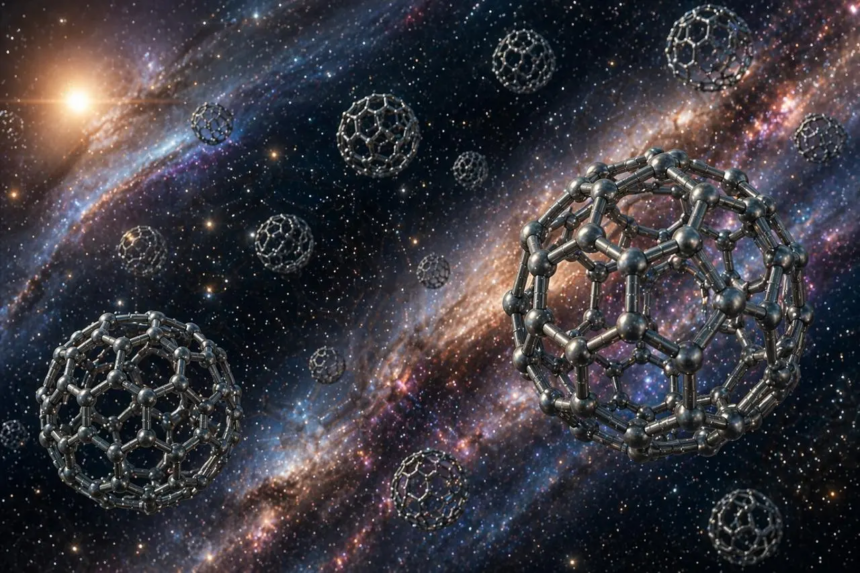
Buckminsterfullerenes are carbon molecules shaped like footballs (or soccer balls, depending which side of the Atlantic you’re kicking from). Astronomers had long predicted these molecules could form in space after certain stars reached the end of their lives, shrinking down to become white dwarfs. Still, these strange molecular structures hold secrets related to how stars form and evolve—secrets researchers are just beginning to crack with the help of the James Webb Space Telescope (JWST).
Back in the day, when Sir Harry Kroto—joined by Bob Curl and Rick Smalley—managed to synthesize C60 fullerenes (think: a molecule made up of exactly 60 carbon atoms), their unique football-like structure captured the scientific imagination worldwide. Kroto believed that such molecules, later named buckminsterfullerenes after the geodesic domes of American architect Richard Buckminster Fuller, must exist somewhere out in space too. A bit of trivia: these fascinating molecules were first predicted by Japanese chemist Eiji Osawa in 1970. Around the same era, Kroto started a research project aiming to find carbon chains in the vast regions between stars, suspecting these molecules might form in the atmospheres of carbon-rich stars.
His curiosity led him to the work of Rice University’s Richard Smalley and Robert Curl, who were experimenting with laser spectroscopy at the time. Kroto teamed up with them to recreate those stellar atmospheres in the lab and hunt for the elusive C60 molecules. The big breakthrough was published in Nature in 1985, and their Nobel-worthy achievement ultimately won the trio the 1996 Nobel Prize in Chemistry.
Since then, scientists have spotted other carbon molecules shaped like footballs, with both more and fewer than 60 carbon atoms. All these structures are grouped under the name “fullerenes.”
Fullerenes, also playfully known as buckyballs, are quite the show-offs: they vibrate, absorb, and emit infrared light in a distinctive pattern. For instance, emission lines from C60 (shown as purple arrows) and C70 (blue arrows) have been detected by the Spitzer Space Telescope in the planetary nebula Tc 1 (that’s “Tc One,” for fans of astronomical naming conventions).
As one researcher put it:
“This wasn’t part of our original investigations, but when we saw certain spectral signatures, we instantly knew we were seeing one of the most sought-after molecules.”
These C60 buckyballs settle at the nebula’s ambient temperature, which means they hardly move and their infrared signatures become particularly easy to identify.
The astronomer Jan Cami, from Western University (Ontario, Canada), and his team discovered fullerenes floating in space—remarkable, considering these football-shaped molecules were first synthesized on Earth.
When the discovery was published in Science, Sir Harry Kroto—a freshly knighted scientist—shared his excitement:
“This particularly exciting breakthrough provides compelling evidence for what I have long suspected. Buckyballs have existed since time immemorial in the darkest corners of our Galaxy.”
Astronomer Jan Cami of Western University and his team of researchers have discovered fullerenes in space – football-shaped molecules originally created in a laboratory on Earth. © Western University
On our own planet, scientists have found fullerenes in soot, in certain rocks, and they’ve become the subject of extensive nanotechnology research. Possible uses? Everything from hydrogen storage and delivering active substances directly into cells in nanomedicine, to creating superconducting materials and even—no joke—armor stronger than steel.
Fast forward fifteen years: Jan Cami, now a professor of physics and astronomy at Western University in Canada, revisited the planetary nebula Tc 1, formed by a dying star more than 10,000 light-years from the Sun in the constellation Ara (Latin for “the Altar”). But this time, he and his colleagues had a huge advantage: access to ultra-detailed observations thanks to JWST’s Mid-Infrared Instrument (MIRI).
Now, with these new tools, we have a much finer image showing wispy filaments and glittering shells of gas. The colors in these photos are artificial (since they’re taken in the mid-infrared), but they reveal a busy nebula: hot gas glows blue, colder gas takes on red hues.
This image of planetary nebula Tc 1 was captured by JWST’s MIRI, which combines nine filters across wavelengths from 5.6 to 25.5 microns—a spectrum way beyond what human eyes can see. Blue tones highlight the hottest gases at the shortest infrared wavelengths, while the reds point to colder matter at the longest wavelengths. Image processing was handled by Katelyn Beecroft using the PixInsight software. The JWST observations offer not only awe-inspiring imagery but also rich spectroscopic data—detailed chemical fingerprints of gases and molecules all around the nebula. (Several scientific papers on this are already in the works.)
Tc 1 is what’s left after a star similar to our Sun exhausts its nuclear fuel and blasts away its outer layers as expanding shells of gas and dust. The glowing heart that remains—a white dwarf—drenches its surroundings in ultraviolet radiation, causing the expelled gas to glow. Over tens of thousands of years, this process sculpts the complex structures we can now see, thanks to JWST. (NASA, ESA, CSA, Western University, J. Cami)
In a statement from Western University, Jan Cami remarked:
“Tc 1 was already extraordinary, as this object revealed the existence of fullerenes in space. But this new image shows we had only scratched the surface. The structures we see now are stunning and bring as many questions as answers.”
His colleague, Els Peeters—also a professor of physics and astronomy at Western—added:
“When we proposed these observations, we knew Tc 1 was a special object. But what JWST has revealed far exceeds our expectations. We already understand the nature of fullerenes themselves, and why they shine so intensely in this object, much better—questions that have intrigued us for fifteen years. This is one of those data sets that will keep us busy for years.”
Dries Van De Putte, a postdoctoral researcher at Western, put it this way:
“The discovery of fullerenes in space is important because it helps scientists like us study carbon chemistry, explain mysterious signals, and understand how organic matter evolves in extreme environments. Their discovery also challenged traditional ideas about space chemistry and provided clues about the possible origins of life. I hope to determine if these fullerenes formed the same way as on Earth—or by a completely different process.”
So, whether you’re fascinated by chemistry, obsessed with the cosmos, or just love the idea that there are glowing cosmic footballs out there, one thing is clear: we’ve only just begun to decipher the secrets floating in the galactic dark.
Scientists stunned by mysterious “football-shaped molecules” glowing in a distant nebula – Futura, le média qui explore le monde



Leave a Comment