


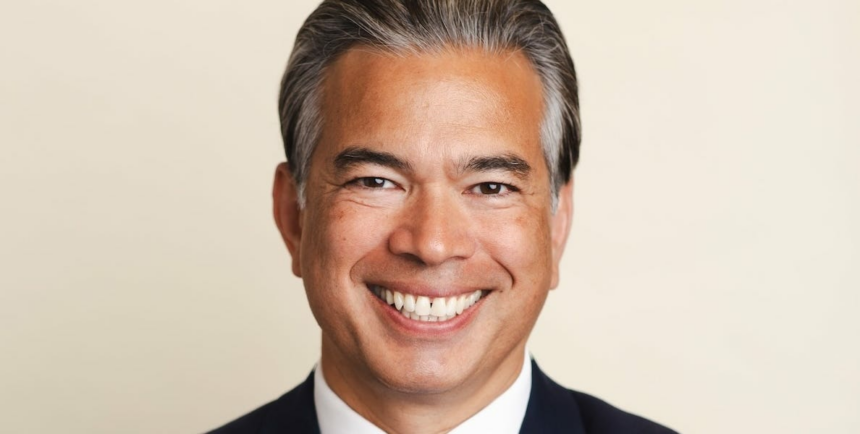
State attorneys general have been playing an increasingly important role in American law and politics in recent years, as I discussed in my recent podcast interview of former New Jersey attorney general Matthew Platkin. Continuing the conversation on this interesting evolution, last week I interviewed Rob Bonta, the 34th attorney general of our nation’s largest state, California.
We began by discussing Rob’s early life, including how he immigrated to California with his family as an infant, and his legal career, including his service in the San Francisco City Attorney’s Office and the California State Assembly. We then turned to current events, including the Supreme Court’s recent ruling in Louisiana v. Callais; the 67 lawsuits his office has filed against the Trump administration since January 2025, including election-related cases; and Rob’s own future plans, including whether he might run someday for the U.S. Senate or governor of California.
I’ve known Rob for decades, ever since we were members of an informal (and very small) group of Filipino-American students at Yale Law School. Rob is now the first person of Filipino descent to serve as California’s AG—making him an especially fitting guest for May, which is Asian American, Native Hawaiian, and Pacific Islander (AANHPI) Heritage Month.
Thanks to Rob for reconnecting with me and for sharing his thoughts on a wide range of timely topics.
Show Notes:
Rob Bonta bio, Office of the Attorney General of the State of California
Rob Bonta bio, Wikipedia
Sponsored by:
NexFirm helps Biglaw attorneys become founding partners. To learn more about how NexFirm can help you launch your firm, call 212-292-1000 or email careerdevelopment@nexfirm.com.
Three quick notes about this transcript. First, it has been cleaned up from the audio in ways that don’t alter substance—e.g., by deleting verbal filler or adding a word here or there to clarify meaning. Second, my interviewee has not reviewed this transcript, and any errors are mine. Third, because of length constraints, this newsletter may be truncated in email; to view the entire post, simply click on “view entire message” in your email app.
DL: Welcome to the Original Jurisdiction podcast. I’m your host, David Lat, author of a Substack newsletter about law and the legal profession also named Original Jurisdiction, which you can read and subscribe to at davidlat.substack.com. You’re listening to the ninety-seventh episode of this podcast, recorded on Thursday, May 7.
Thanks to this podcast’s sponsor, NexFirm. NexFirm helps Biglaw attorneys become founding partners. To learn more about how NexFirm can help you launch your firm, call 212-292-1000 or email careerdevelopment@nexfirm.com. Want to know who the guest will be for the next Original Jurisdiction podcast? Follow NexFirm on LinkedIn for a preview.
May happens to be Asian American, Native Hawaiian, and Pacific Islander Heritage Month. So I was thrilled to have on the podcast one of the nation’s most important and influential Asian-American attorneys: Robert Bonta, the 34th attorney general of the State of California, and the first person of Filipino descent to serve in the role.
Before Governor Gavin Newsom appointed him as AG in 2021, Rob spent more than eight years serving in the California State Assembly. Prior to his time in the legislature, he worked in the San Francisco City Attorney’s Office and in private practice. He graduated from Yale College and Yale Law School—where he and I represented around a third of the Filipino-American contingent at YLS. So I’ve known Rob for around 30 years—and I was delighted to have the opportunity to catch up with him, shortly after he celebrated five years of service as AG. Without further ado, here’s my conversation with Attorney General Rob Bonta.
Attorney General Bonta, thank you so much for joining me.
RB: My pleasure. Good to see you, David.
DL: So tell us about your background and upbringing. Where did you grow up?
RB: Well, I was born in the Philippines, and that’s kind of where my story starts. My mom’s an immigrant from the Philippines. My mom and dad met in grad school in Berkeley, California, in the 1960s, and then went on to serve as missionaries in the Philippines and have my sister first, then me. It was a really important moment in my life when my parents made a decision about me—probably the most important decision ever made about me was made by them about me, not by me, about my own life—and it was whether they could raise me in the Philippines then. Martial law was around the corner, the dictatorship of Ferdinand Marcos was about to commence, and they wanted me to have democracy and freedom and the rule of law and due process and civil rights. And they thought those things would be taken away in the Philippines. And they were right: they were. Eventually, exactly a year from the date of my birth, martial law was declared, and free and fair elections were over; democracy as it was known was over.
So they brought me to California when I was two months old, and I grew up in California. I started in L.A., and my parents started working for the United Farm Workers of America. They believed that you can’t just put your chin on your elbow, look out the window, and hope and wait for the things that you want; you’ve got to go fight for them and work for them. So they decided to work for the UFW to fight for the people who were feeding our state, feeding our nation.
We got invited to go to the headquarters at La Paz as a family to serve with the United Farm Workers of America. And so we did that, just outside of Bakersfield. We lived in a trailer, and my dad worked in the front office, setting up healthcare clinics for farm workers. And my mom worked in the preschool. And then eventually, by first grade, I was in the suburbs of Sacramento. My parents both were working for the state, my dad doing the same thing for the state that he did for the UFW, setting up health clinics for underserved communities. And I went to public schools in a suburb of Sacramento called Fair Oaks. I graduated from high school there and ultimately went away to college on the East Coast.
DL: I was familiar with your Filipino-American heritage because we were members of the very small group of Filipino-American law students….
RB: Very small.
DL: … at Yale. So I do know that you wound up at Yale for law school. But tell me, what led you to go to law school in the first place?
RB: Growing up in the suburbs of Sacramento, growing up a son of an immigrant, being in another country, having two working-class parents, I always dreamed about having a role to play in our society. It was not a specific, super targeted dream, but just that I wanted to have a say; I wanted to have a voice. I wanted to help write whatever the next chapter was in what happens in California, in our country. I wanted to be part of it. I read To Kill a Mockingbird and loved who Atticus Finch was and what he stood for. I had just a young boy’s unsophisticated, maybe romanticized ideal of what a lawyer was, but I thought, “If that’s what an attorney is, sign me up; I want to be one.” I want to be the person fighting for justice. I want to be the person standing for what’s right, even if that means standing alone at times. I want to be the person that guides people through a complicated, intimidating process on the journey to justice. That’s what I want to do.
So I just had this view that I wanted to go to law school. I had the privilege of being a college athletic recruit, and I was recruited by multiple colleges to play soccer in college, and it helped me go to Yale College, and I got a scholarship to study in England for a year after that, and I applied to law school. And my dream was to go to Yale Law School—and law school generally, but when I was at Yale College, I came to love New Haven, Yale University, what it meant, what it stood for. I met my wife, Mia—your small-group classmate, and our classmate in law school—when I was 17 years old, in an orientation program before college started at Yale, and she was in New Haven. So when I was applying to law school, that was a big reason I wanted to go to Yale Law as well. I wanted to learn. I wanted to grow. I wanted to learn the tools that would allow me to do what I always wanted, which is have a say in what happens next in our society.
DL: So you’ve spent much of your career in public service and government service. And I believe that’s your first job out of law school too, right?
RB: I clerked right out of law school for a judge in Connecticut, Judge Alvin Thompson, in federal district court. Mia and I got married in law school and we had just had our first child, Reina, who was born in Yale New Haven Hospital. Because Mia took three years off in between college and law school and I took only two, we were off by a year in law school. And so we were young parents, Mia was in her third year at the law school, and we were raising our first child. So while Mia finished law school, I clerked in Hartford, and it was an amazing experience.
Then after that, I worked for a private law firm in San Francisco. We moved to California, to the East Bay, and I worked at the great law firm of Keker & Van Nest. At the time, they considered themselves sort of the West Coast version of Williams & Connolly in D.C. (where I had summered): a trial boutique, sort of gun-slinging trial attorneys who can try any case on any issue and feel confident and comfortable and win. I was there for almost four years, just under four years.
And then I went to the San Francisco City Attorney’s Office and worked there for almost a decade. I tried my own cases, argued appeals, argued en banc in front of the Ninth Circuit, and had an incredible set of litigation experiences. And then I became a lawmaker and I ran for the California State Assembly, and I served in the Assembly for just over eight years. And then Governor Gavin Newsom changed my life when he appointed me attorney general, and I pinch myself to this day. Some days I don’t believe that I am the attorney general of the great state of California, the state that gave me so much. And secretly, I’ll confess to you, I go on the website sometimes to see if my name and my photo are really there, on the website of the Office of the Attorney General of California, and I’m very excited when I do see them there.
DL: So let’s double back, because you’ve had such an interesting career. When you were working in the San Francisco City Attorney’s Office, did you cross paths with Kamala Harris?
RB: She was right on her way out when I was on my way in; she had just been elected district attorney of San Francisco. And I remember I took over her office, and she came back to take some items that she needed that she hadn’t retrieved since she became DA. And so it was an amazing moment, that we sort of crossed over in that way at the City Attorney’s Office. And then later I was able to occupy the incredible attorney general’s offices that she had occupied as well. So we didn’t overlap, but we were very much in the same sort of space, and I had known her and supported her since she was DA of San Francisco, including when she ran for AG, when she ran for the U.S. Senate, when she ran for president. All those times, I’ve been proud to support her.
DL: That’s great. They should put a plaque in that office in the City Attorney’s Office; it’s a lucky office. One other bit of trivia: did you overlap at all with now-Judge Vince Chhabria, who also spent time in the City Attorney’s Office? He’s a former podcast guest of mine.
RB: Absolutely. We were there together, we were at Keker & Van Nest together as well, and we remain friends, good friends. I have the utmost respect and admiration for Judge Chhabria. He’s a wonderful human being, in addition to being an incredible jurist and just a brilliant legal mind, and I like him very much. I’m a big fan. I’m grateful he’s on the bench, and we did overlap in the City Attorney’s Office and worked on some cases together.
DL: I just love fun things like this, because you just never know where the people you meet early in your career are going to end up. So as you mentioned, you are now the Attorney General of California, and I did just check your website—you still are. And, in fact, last month you actually celebrated your fifth anniversary as AG. So you’ve been in the role quite a while; congratulations. Based on your tenure so far, which at five years is significant, is there an achievement or achievements that you’re particularly proud of?
RB: The thing I’m so proud of is that anytime a Californian has an issue that is the most important thing in their life that affects them, that they’re worried about, that they’re struggling with, whether it be crime or housing or access to healthcare or the environment or being treated fairly at work or being the victim of some scam as a consumer, we have something to do or say about it. So I love our breadth. I love our reach. I love that we can do so much to help people. Anytime you open the newspaper, anything that’s on the front page that’s top of mind, we have something to do about it and say about it, not just with suggestion, but with power and potency and impact, because we are the largest state department of justice in the nation. So I love that. And that’s the reason I got into public service: to help people, to make their fights my fights, to be by their side and make their lives better and deliver opportunity and justice and equity and inclusion when it’s being taken away from them.
In particular, I am very proud of my team and the work we’re doing together in this moment, a moment where so much is on the line, where it feels like we need to meet the moment, to rise to the occasion when it comes to what’s coming out of the Trump administration: attacks on the rule of law, trampling of our constitution, attacks on rights and freedoms, attacks on California’s future, our people, our values, our funding. We have brought 67 lawsuits against the administration, with the north star of, “If the facts demonstrate that he’s violated the law and hurt our state, we’ll take him to court.” We will never go to court if all we have is political grievance or political or ideological or policy difference. But if we have the receipts and he has broken the law, it’s important—it’s really important that the president follow the law.
So I’ve been proud of what we’ve accomplished in this moment. We’ve protected $200 billion worth of funding. We’ve protected constitutional rights, like voting rights and birthright citizenship. We’ve pushed the unlawfully federalized and deployed National Guard out of our cities. We’ve helped strike down unlawful tariffs that were making people’s lives more unaffordable. I’m so proud of that in this moment because the stakes are so high, and so much is on the line. We’ve been able to be an important voice and have an important role in this critical moment.
DL: You alluded to recent events, which I like to focus on in these podcasts, and you alluded to voting rights. We’re speaking very shortly after the Supreme Court issued its opinion in Louisiana v. Callais, a major election-law ruling that you described as “deeply disappointing.” Acknowledging that the full impact is still uncertain, what is your initial take as to the significance of the damage? Is Section Two of the Voting Rights Act all but a “dead letter,” to quote Justice Kagan’s dissent?
RB: I think so, unfortunately. I wish it wasn’t so, but that’s where I am today. Maybe there will be some facts and developments that change my mind going forward, but I think so, unfortunately. The focus on discriminatory intent as opposed to discriminatory impact, the inability when there’s been voter dilution for a racial-minority voting group to have a majority-minority district as part of the cure and the solution, is very problematic. It takes us backwards and undermines the right of voters from certain communities to have that right to vote that’s so fundamental. So it’s very disappointing. I think Section Two is irreparably damaged—not formally or technically struck down, but rendered incredibly weak, if not useless at this point. But there could be a discriminatory-intent case under the right facts and circumstances. So it’s not completely dead, but on life support.
DL: So the public reaction to Callais has been very strong, which highlights the importance of elections in our democracy. You can think of voting rights as really the most fundamental rights because they then give rise to all these other rights of self-government. We’re now speaking in an election year, of course: 2026. The midterms are only a few months away. Speaking more broadly, going beyond Callais and the Voting Rights Act, what is your office doing in terms of election protection and protecting the right to vote?
RB: As you mentioned, the right to vote is the right from which all other rights flow, and it must be protected and defended. It is sacred. It is fundamental to who we are as a country and how we govern ourselves. And it is under attack, unfortunately. And we’ve seen what I call some early skirmishes, which I think seek to socialize certain conduct which should not be socialized. Seizing of ballots in Fulton County, Georgia. Deployment by the federal government of monitors into California’s elections, when it’s a state election only, and there’s no purported rationale or justification for them being there. Having military, including the National Guard or the Marines, in our cities, and perhaps near our elections, our polling stations, in the next set of coming elections. So all those are dangerous developments. And they come at a time when Trump is at historic lows in his voter approval. He’s dangerous in normal times, but when he’s fighting historic unfavorability, I think he becomes desperate and even more dangerous.
We’ve seen some of that danger manifested in some of his executive orders where he tries to do something the Constitution absolutely prohibits him from doing, which is to try to determine the time, place, and manner of our elections. The Elections Clause says that’s for the states and for Congress to do, not the executive branch. He has zero role in that. So we’re preparing for all the different scenarios. We’re doing tabletop exercises. We’re gaming out what happens if the military, the National Guard, ICE are at polling stations. If they’re armed, that’s already a violation of federal law, but what would we do? We would get a court order immediately to enforce that federal law and have them removed to an appropriate radius or boundary away from polling stations. We’re worried about interference through the U.S. Postal Service and the vote-by-mail ballots—California is universal vote by mail.
We’re worried about misinformation and disinformation. We just recently had a press conference with the Secretary of State here to talk about what people’s rights are and what law enforcement’s duty is to protect and secure our election. So we’re going through all of the different scenarios and trying to game out what could happen. Seizure of ballots is another potential scenario we’re concerned about. We had an incident here where a sheriff—not the Trump administration, but a sheriff who supports Trump and is a self-declared “MAGA sheriff”—seized ballots from last November’s Proposition 50 election here in California. And we believe that there was an inadequate affidavit supporting the search warrant, and it’s unlawful to remove the ballots from the registrar of voters. He did remove them and take them offsite. So we are fighting for the protection, security, integrity of our elections. We’re trying to preview and be able to predict the potential threats and have a plan. We think we owe our Californian constituents readiness, preparedness, and a plan of action, should any of these attacks on our elections come to pass.
DL: You alluded to Trump’s attempt to get involved in elections, and of course you and California are playing a leading role in a coalition of AGs that are challenging some of these executive actions pertaining to what Trump calls election integrity. Can you describe, in a nutshell, what the litigation is about, and maybe also just give us an update on where it stands right now?
RB: Sure. So there have been a number of attempts by the White House and by the Trump administration to, in my view, unlawfully attack our elections. They try to say that they’re the ones that are promoting “election integrity,” but we know that there’s no reliable evidence of widespread voter fraud: every count and recount and hand count and court case and audit has all shown that. But nonetheless, Trump has issued two executive orders. The first one, on elections, sought to create a voter ID requirement and also prevent vote-by-mail ballots that were cast timely on or before Election Day but arrived after Election Day from being counted. And this is clearly in violation of the Elections Clause of the U.S. Constitution. The president’s executive-branch, Article-Two authority does not exist in this space; Congress and the states have the authority. We secured a temporary restraining order and then a permanent injunction, so that executive order is enjoined; it is not being implemented right now.
And then recently, just a couple of weeks ago, he issued another executive order, which tried to create a citizenship list and to enforce that citizenship list by having the U.S. Postal Service essentially filter out vote-by-mail ballots traveling through the Postal Service, when the individual who would receive that vote-by-mail ballot or who cast that vote-by-mail ballot is not on the citizenship list. The U.S. Postal Service is an independent entity that the president does not control or dictate what they do. And again, this is the president trying to exercise authority that he doesn’t have. So we recently filed a motion for summary judgment. Based on the law and the facts, and our experience in that case involving the first executive order, we feel we’ll prevail. But we’ll wait, of course, to see what the judge decides.
And then there have also been multiple attempts by the Trump administration to seek unprecedented amounts of data from our voter rolls, in California and other states. We have a slightly different role here in California when it comes to that—our client is the Secretary of State in such a case—but I will say that Trump has been losing in court and is zero for six in his attempts to get that data. But these two executive orders and those six attempts to seek such data show what he’s willing to do and the type of actions that he will take. We’re grateful that we’ve been able to act and that courts have sided with us so far in these cases.
DL: Are you the managing partner of a boutique or midsize firm? If so, you know that your most important job is attracting and retaining top talent. It’s not easy, especially if your benefits don’t match up well with those of Biglaw firms or if your HR process feels “small time.” NexFirm has created an onboarding and benefits experience that rivals an Am Law 100 firm, so you can compete for the best talent at a price your firm can afford. Want to learn more? Contact NexFirm at 212-292-1002 or email betterbenefits@nexfirm.com.
As you mentioned, you have filed around 67, almost 70 lawsuits, just in this one-plus year of the second Trump administration. But as you alluded to in the biographical discussion, you’re a former legislator; you understand the role that legislatures play in shaping policy. So maybe this question’s a little inchoate, but at what point does litigation, including multistate AG litigation, become a substitute for political action that Congress should be taking instead? And I’ll offer the flip side here: I think maybe many progressives might be very sympathetic to what you and other blue-state AGs are doing now, but what about all of the red-state AG lawsuits that were filed against the Biden administration? So again, this is a very general question, but I’m sure you’ll have something smart to say about it.
RB: The way we see our role—and I say “our” meaning the Democratic attorneys general, when we work in a multistate way in these 67 cases and counting—is we just try to be straight up, applying the law to the facts. And our north star is, “Did Trump violate the law and hurt our state?” Meaning do we have standing, do we have an injury that can get remedied in a court of law? If the answer is yes, then we sue him. If he’s done something that is fully within his authority, and we just don’t agree with it or don’t like it, we won’t act, we can’t act, and we shouldn’t act; we’ll get thrown out of court. He won an election; he’s allowed to be the president of the United States and to do things that are within his presidential authority. We just stand at the outer boundaries of authority and say, “You can’t cross this line. You can’t do the things that a president can’t do.”
He tries to cross lines, time and time again, and we think that that’s wrong. He tries to be Congress by exercising the power of the purse, and half our cases are about him trying to withhold funding that Congress has already appropriated to California, and we protected $200 billion in that regard. So I know that there’s sometimes talk about “lawfare” and weaponizing the litigation process, and I think it has been weaponized in the past; I think some of the Democratic presidents have been victims of that. But if it’s a frivolous case, it should be thrown out by the judges, if not at one level of the process, then perhaps at an appellate level. We bring cases based on just the facts and the law. We think we’re going to win them. We’ve won 80 percent of them so far, securing 40 different types of restraining orders or preliminary injunctions, 15 final judgments—and multiple times, Trump has just waved the white flag and given up when we brought a lawsuit.
So these are substantive, well-founded cases, based on the law and the facts, and we think it’s an appropriate role for us to play in this moment. Is there overlap between legislating and what Congress might do? Yeah; they’re interested in a lot of spaces that we’re involved in. They could take some actions that address some of these issues. The way that the Congress is currently constituted and with the filibuster, you don’t see a lot of major actions moving through the process and becoming law, unfortunately. But I do think it’s really important that in this litigation space, what we’re doing as Democratic attorneys general and what any other attorneys general might do in the future—say if there’s a Democratic president in the future, what Republican attorneys general do—that it just be based on the law and the facts. And Republican AGs should bring cases if a Democratic president has violated the law, and they have the facts to show it; they should. No president should exercise authority that’s not theirs and break the law. Unfortunately, this president’s doing it a lot—consistently, frequently, blatantly, brazenly. And so we don’t want to have had to bring 67 cases. I wish we brought zero, because that would mean he’s following the law, which is what we want. And so we bring the cases when he doesn’t, and we feel they’re very justified, and I think the results show that as well.
DL: That 80% statistic is actually very telling because this means that impartial judges who are not Republicans or Democrats—maybe they were appointed by a Republican or a Democrat, but they themselves are not partisans—independent judges have validated your theories. But let me ask you this. This is maybe a little bit, I don’t know, odd or something, but it’s kind of funny: you’re the attorney general, so your name winds up in the captions of these cases, and some cases involving California have made it to the U.S. Supreme Court. So there was Americans for Prosperity v. Bonta; more recently, there was Mirabelli v. Bonta. How does it feel to have your name in the captions of these Supreme Court cases? Law students someday might be reading these cases—or law students probably are reading these cases today, actually.
RB: I’m still getting used to it. When I had the honor and privilege of being appointed to this job and then winning a full term after an election, there were quite a few things I was excited about, looking forward to, expecting. This wasn’t one of them; I wasn’t focused on that. And Judge Chhabria, to reference him again, he reached out to me one time and said, “I’m seeing your name on all these cases that come into my courtroom. It’s nice to see a familiar name.” But I’m like, “I don’t know if I love it. I’m not used to it. I accept it as part of the job, and it just comes with the territory.”
DL: Fair enough. Your name would also be in a lot of captions if you were the governor of California. And we’re recording this on the day after a gubernatorial debate, which I guess you could say was… lively. So as you mentioned, you’re running for a reelection as AG. You decided not to run for governor, despite a kind of attempt to draft you, I guess. I know you’re very focused on serving the people of California in your current role, but can you tell us about your future plans?
RB: Yeah, thank you for that. I love this job. I thought really long and hard about running for governor a couple times. I had made a decision to not run for governor and then there was a drafting effort or multiple people reaching out to me to say, “Are you sure? Don’t you want to reconsider?” And I gave it another look, and I landed again where I was the first time, which is I love this job. I wasn’t looking for another job. I can do things that even governors can’t do. It’s particularly important in this moment. We were one year in on the Trump administration with three to go. I had built up a lot of institutional knowledge and momentum and experience in this space. And there’s a lot on the line, and I want the people of my state to know that their AG is completely focused on them and giving my energy, my passion, my time, my commitment to that work, not being distracted by a campaign for another job.
So I love this job. I’m hoping that I’ll get reelected to another term. I’m going to run on my record and share with the voters what I’ve done for them. I believe I have been successful in achieving my goal most of the time to make their fights my fights, to fight for them, to make their lives better, to deliver on the issues that matter most to them. And I’ll share my record on that, and they can decide. This is my four-year job review, and my boss is giving me the review. My boss is the people of the state. So I hope it’ll be favorable and they’ll give me another four years. Should that happen, I will give all my energy to this role, and I don’t think it’s my last stop. I have more to give. I’ve got more gas in the tank. I’m full of energy.
I’m ready to roll. I’m ready to see out this Trump term of presidency to the end and play my role throughout firmly, fairly, and appropriately, on behalf of the people of California. And we’ll see what happens next. I’ve never planned my career in elected office. Things have happened. Dumb luck is one of my greatest assets; it’s probably my greatest asset. Things just work out for me sometimes, and I’m grateful for that. And I think the best audition for something next is to do the best you can in the role you’re in. And people will hopefully recognize it and see it. So I’m going to be the best AG I can, and if there’s a Democratic president and there’s an interest in having me be part of a team that can be helpful, I would be honored and privileged to consider that.
Maybe I’ll run for another statewide office in California. I love the state. It’s my home. It’s given me so much. It’s given me a place to be when we fled the Philippines from a dictator, a great public-school education, a place to raise my family and build my careers with my wife and my kids, and I want to give everything I have to it. So I hope there’s another opportunity in the future. It’s worked out up to now, and I’m a glass-half-full guy: I just think it’s going to work out, and I’m going to serve and do my best, and hopefully I’ll have other opportunities going forward.
DL: So you have served in the legislature—you’ve worn that hat—and you have served in the executive branch. And again, we don’t know what the future is going to hold or what would open up. But in the abstract, do you believe that you are more temperamentally or intellectually suited to the role of legislator—as in, say, U.S. Senator from California—or executive, as in governor? And again, you’re not running for either of these jobs. But they’re different jobs, and you’ve been in both branches. Do you have a preference? Do you think your skills play better to one rather than the other?
RB: I definitely have a preference: I love being in the executive branch. I’m a huge fan of the executive branch. You can move swiftly, decisively, especially if you have a role in the executive branch that has a great deal of authority and ability to make people’s lives better and to address the biggest issues of our day. The Attorney General’s Office definitely has that.
There was a time when I first got into the AG’s Office, which kind of exemplifies my transition from legislator to the executive branch. My staff wanted to present to me on an issue that was sensitive and nuanced, and had some nuanced political and policy components to it, and they didn’t agree. And they said, “We have an internal disagreement. We want to present to you both our sides, and then we want you to decide.” So I listened carefully, I asked questions, we had a really good dialogue, and then I decided. And I said to our staff, “What do we need to do now to take the action that I want to take? Who else do we have to get on board? Who else has to sign off on this, be part of the coalition?” And there was silence. And I said, “Am I on mute? Did you guys hear?” And then someone said, almost sheepishly, “Sir, we don’t understand the question.” I said, “Who else needs to agree to this?” And someone else said, “Sir, you just say yes.” And I said, “I love this job.”
I had lived for eight years where I couldn’t do anything without 60 other people agreeing with me. I needed to get majority votes out of a committee, and off the assembly floor, and then on the Senate floor and Senate committee. And then I had to write a really nice note to the governor, asking the governor to sign my bill. It was all in coalition. And I feel I am well suited to the coalition. I’m a team guy. I played team sports. I like to work with others. I like to find common ground and work together. I like to benefit from others’ ideas and thoughts to make my imperfect idea better. I like that. So I do like the legislative branch.
But I really like the executive branch, just because you can move quickly, decisively, and authoritatively, in ways that really deliver massive impact—now. When I would pass a piece of legislation, it would take a whole year to get it passed and signed. It wouldn’t go into effect for a few months after that. And so there was always a delay. And so I feel I can put in a really strong effort into either role, executive or legislative, but I have a preference for executive.
DL: And I think there’s probably an argument that in light of what you alluded to earlier as the current moment and the current challenges, maybe it is important to have strong executive action, governor or attorney-general action, to counteract a very strong executive coming out of Washington.
Turning to my speed round, these are four standard questions; they’re the same for all my guests. And my first question is, what do you like the least about the law? And this can either be the practice of law or it can be law as a more abstract system of governance.
RB: I have a couple answers to that. I don’t love billable hours. I’ll say that. I understand it. I think a system based on results and delivering for a client, regardless of how much time it takes, would be better. But I understand why we have it.
I don’t love the sometimes inaccessibility of the law to everyday people. The law is affecting everybody in many ways, whether they know it or not. And sometimes it’s jargon-y and hard to understand. So I spend a lot of time trying to do the translation, if you will, trying to help people understand what it is, why it is, how it impacts their life.
I don’t like what I would call sort of the gaps in the law, problems that are susceptible to a legal solution, including legislation that hasn’t been created yet—say, all of the different threats posed by AI. We’re catching up; we need to do more.
And then the laws that remain on the books that visit harm on people, that are discriminatory, or that may have had a purpose at one point that was righteous, but with unintended consequences. Or maybe the law was enacted with discriminatory intent, and it needs to be taken off the books.
So this is all sort of acceptable—I don’t expect perfection—but there are imperfections in the law, laws that continue to hurt people, like discriminatory zoning or other types of laws like that, and then laws that haven’t been created yet. And then the inaccessibility of the law: it should be more universal, more accessible to more people. It’s hard to, because by definition, it is complex. It is nuanced. We had to go to law school to understand a lot of the law, and there are still many parts we don’t understand. But I wish more people were able to see its impact on their lives and understand it in ways that are impactful in their own lives.
DL: I think that your current role, in which you really are the people’s lawyer, is a way of addressing that inaccessibility.
So speaking of going to law school and understanding the law and all of its complexity, what would you be if you were not a lawyer? I know you were a very talented soccer player. I don’t know if you thought about going pro or something?
RB: My high-school, Filipino-American, basketball-loving self would say I’d be in the NBA, until I faced the stark reality of being 5’9” and three-quarters.
Maybe professional soccer player in another world. There was sort of a fork in the road at one point in my life, where I made a decision about going to law school versus pursuing that dream. And I was able to do both for a while: I studied for the bar while playing soccer with the San Francisco Bay Seals out here in the Bay Area. I played two seasons with them, one after my first year in law school, and loved it. But there was a world where maybe I’d be overseas trying to pursue my dream and chase my dream in Europe or something like that.
But most likely, I’d be in some other type of public service, in government, maybe not an elected official. I believe in government, government’s ability to make people’s lives better, to serve them, to fix their problems, address their problems, and make tomorrow more fair and just than today. Or I’d be at a nonprofit that’s doing similar public-interest work to uplift people and tackle some of our most pressing problems.
DL: And certainly you have that in your background, in terms of the work your parents did, to circle back to the beginning.
My third question is—and I’ll be interested because you and Mia have three kids, and you have a very demanding day job—how much sleep do you get each night?
RB: I used to have a saying when I was in college, and it was something that inspired me and excited me: “I’ll sleep when I’m dead.” It was this idea that you just keep grinding, you keep working. You don’t need sleep. If you sleep, those are hours when you’re not being productive. And now I don’t agree with any of that anymore. I try, unsuccessfully, to get eight hours. Usually between six and eight is good. Sometimes it’s less than that—and it’s less than that with some frequency, especially if we’re moving through time zones, going to the East Coast and waking up early, or sometimes if there’s international travel, if I’m visiting my daughter in Brazil or my other daughter in Spain, where she’s doing a semester abroad. But sleep is more and more important. And I think I need to be at my best for the people I’m serving, thinking sharply, thinking clearly, having all the energy that’s required for a full day of service to the people of this state. So between six and eight is the goal—not always achieved, but I have evolved in appreciating its importance.
DL: I’ve had a similar evolution, which is why I ask this question. I like to hear successful legal professionals tell me that they do at least aspire to a decent amount of sleep.
My last question is, any final words of wisdom such as career advice or life advice for my listeners?
RB: Yeah. I’ve said this before to people who are considering going to law school and just folks who are not sure about what they’re going to do in their lives. So for folks who are considering going to law school, my answer is always, “You should do it.” I understand that there are worries that you have to decide for yourself around our improperly funded higher educational system. People are most likely to do what I did—take on a bunch of loans that saddle you with debt for years after you graduate—and that’s a reality, and each person needs to decide for themselves. But do I think it is worth it? Yes. Do I think it’s one of the most valuable types of education you can get? Absolutely. It teaches you how to think and understand this world and analyze and synthesize and express yourself in writing and orally in ways that you would never get if you didn’t go to law school. It’s a special skill, a special talent. And especially if you want to make this world better and understand the system that we’re in and where the pressure points are and the points of leverage to make that difference, law school is incredible. So I encourage folks to go to law school if that’s something that they’re thinking about. If they’re wondering if it’s worth it, the answer is absolutely 100% yes.
And then more broadly—I don’t want this to sound trite, but it’s true—do what you love. Do what you love, if you can. I understand not everyone can. Sometimes you’ve got to grind, and you’ve got to do something that’s not your ideal. But you have a life to live. It’s your life. And whenever I say this, I think about the parents who are going to be mad at me, who have a certain dream for their son or their daughter. They might want you to do something, or your friends might want you to do something, or you might think you want to do something, or you’re told that you should do something.
Like at Yale Law School, there was a lot of focus on law firms. I went to one; it was really easy to go to a law firm, and they’d come and recruit you on campus. There was a lot of interest in academia and also clerking. And those are all great careers and things to do, if you want to do them—but you shouldn’t do them if you don’t want to do them. You should do the thing that you want. So I think about Cory Booker, who was a third year when I was a first year, and Stacey Abrams, who was there as well. They knew exactly what they wanted to do, and it wasn’t doing those things—law firms or teaching or clerking. They wanted to serve in other ways. They wanted to go back to their communities and serve, New Jersey for Cory and Atlanta and Georgia for Stacey. And I just encourage that.
If you have an idea of what you want to do, do it. It’s the right thing to do. If it makes you happy and your gut is telling you it’s the right thing, it’s probably the right thing. And also, nothing has to be forever. If you start something and you’re like, “I thought this was going to be great, but it’s not really what I love. It doesn’t make me happy. In fact, maybe it makes me sad, or it’s disappointing in different ways,” you can change, and have the courage and the conviction to acknowledge that. Listen to yourself, give yourself some self-care, some grace, and say, “Maybe this isn’t what I thought it was. It’s not working out the way I hoped it would, and I should make a change.” And make that change.
I did that. The firm was not the place I was going to be at forever. I learned a lot, I grew a lot, but in the end it wasn’t the place where I would be for the long term, and I knew that. And so I made a change, and then I made another change from lawmaking, and then from the legislative branch to the executive branch. One great thing about the law is you can have incredibly diverse sets of careers all within the law. And so I encourage people to explore those, to find their happy place where they’re satisfied and fulfilled and happy—if you can, despite what others make you feel you should do or tell you that you should do.
DL: Well, you have certainly had a very diverse and fascinating career, and I can tell from our conversation that you clearly love what you do. Attorney General Bonta, thank you so much for joining me.
RB: Thank you, David. It was an honor to be with you. Thanks for having me.
DL: Thanks so much to Attorney General Bonta for joining me, and thanks to him for his dedication to public service—both in the past, and in the years ahead.
Thanks to NexFirm for sponsoring the Original Jurisdiction podcast. NexFirm has helped many attorneys to leave Biglaw and launch firms of their own. To explore this opportunity, please contact NexFirm at 212-292-1000 or email careerdevelopment@nexfirm.com to learn more.
Thanks to Tommy Harron, my sound engineer here at Original Jurisdiction, and thanks to you, my listeners and readers. To connect with me, please email me at davidlat@substack.com, or find me on Twitter, Facebook, and LinkedIn, at davidlat, and on Instagram and Threads at davidbenjaminlat.
If you enjoyed today’s episode, please rate, review, and subscribe. Please subscribe to the Original Jurisdiction newsletter if you don’t already, over at davidlat.substack.com. This podcast is free, but it’s made possible by paid subscriptions to the newsletter.
The next episode should appear on or about Wednesday, May 27. Until then, may your thinking be original and your jurisdiction free of defects.
From Litigation To Legislation And Back Again: Rob Bonta – Original Jurisdiction | David Lat



Leave a Comment