


Our Privacy Statement & Cookie Policy
By continuing to browse our site you agree to our use of cookies, revised Privacy Policy and Terms of Use. You can change your cookie settings through your browser.
Pan Deng
Copied
CFP
Editor’s note: Pan Deng is a special commentator on current affairs for CGTN. The article reflects the author’s opinions and not necessarily the views of CGTN.
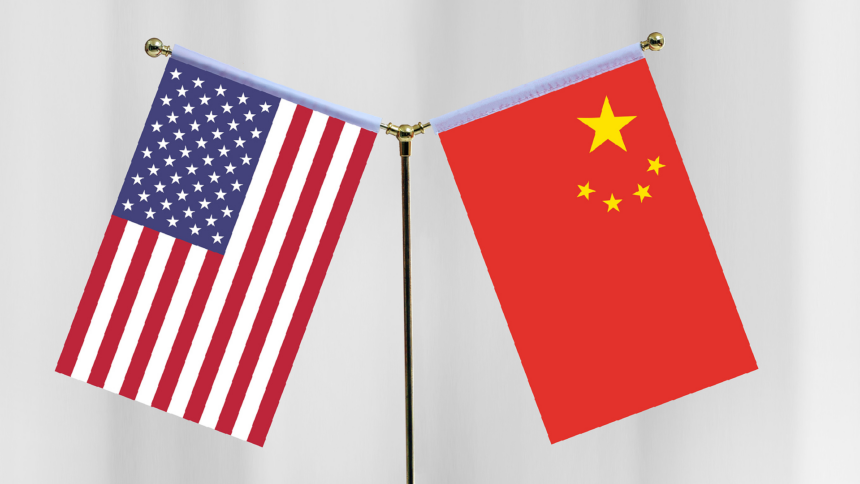
The contemporary international system is undergoing a period of profound structural entropy. For decades, the interactions between the United States and China have been viewed by many through the reductive lens of a zero-sum struggle for primacy. This perspective assumes that one state must eventually yield to the other in a linear fashion. Such a framework often ignores the complex interdependencies and the dense network of interests that define modern statecraft.
However, as the world navigates the complexities of 2026, it is becoming increasingly evident that the spillover effects of China-US ties have triggered a phenomenon far more significant than a mere bilateral interaction. The global community is witnessing the gradual dissolution of the unipolar architecture that defined the late twentieth century. This is being replaced by a global landscape that is increasingly non-linear and multi-aligned. It is a world that remains resistant to the traditional mechanics of hegemonic containment.
The internal erosion: The political economy of American institutional friction
To understand the current trajectory of global affairs, one must first look inward at the source of the consistency gap currently affecting Western strategy. The United States is not merely navigating a political disagreement. It is weathering a protracted constitutional crisis rooted in deep socio-economic fractures. This polarization is not an accidental byproduct of personality-driven politics. It is the culmination of 40 years of neoliberal decoupling. During this period, global capital has drifted increasingly far from the interests of domestic labor. The hollowed-out middle class and the decline of social mobility have created a fertile ground for institutional distrust.
This internal misalignment has produced a state of affective polarization. In this environment, institutional friction between the judiciary and the executive renders the long-term continuity of American foreign policy a matter of speculation. When a global power is embroiled in a fundamental debate over its own institutional legitimacy, the capacity to enforce strategic competition abroad is naturally diminished. For the traditional partners of Washington, this internal volatility creates a strategic vacuum. The pressure to de-couple or de-risk from the East loses its persuasive force when the proposer of such policies cannot guarantee a stable political trajectory beyond the next election cycle. Consequently, a form of pragmatic autonomy is emerging among middle powers. These states now view the security guarantees of the West as a variable rather than a constant.
The architecture of inclusion: Advocacy for true multilateralism
While the West grapples with internal re-calibration, the discourse from the East has shifted toward a more integrated and structural proposition. Rather than seeking to replace one hegemony with another, Beijing has increasingly advocated for true multilateralism. This vision is anchored by the four global initiatives on development, security, civilization and governance. These are not merely diplomatic slogans. They represent a sophisticated attempt to provide the certainty that the current international system lacks. The Global Civilization Initiative, in particular, offers a vital counter-narrative to the outdated clash of civilizations theory by emphasizing the inherent value of diverse developmental paths.
The efficacy of this approach is evidenced by the recent diplomatic cadence in Beijing. The January 2026 visit by United Kingdom Prime Minister Keir Starmer secured £2.2 billion in export agreements and a significant liberalization of travel protocols. This demonstrates a clear-eyed prioritization of economic stability over ideological alignment. Similarly, the engagement of Friedrich Merz on behalf of Germany in February 2026 highlights a rejection of protectionist fragmentation in favor of tactical stabilization.
Britain’s Prime Minister Keir Starmer visits Yuyuan Gardens in Shanghai, January 30, 2026. /CFP
The data supports this trend. In the first quarter of 2026, the trade between China and the European Union grew by nearly 15%. ASEAN remains the largest trading partner of China with sustained double-digit growth. These figures suggest that the appeal of a predictable and development-focused partner is outweighing the pressures of strategic containment. By positioning itself as a provider of global public goods, China is offering a path toward a multipolar equilibrium that transcends the binary choices of the past.
Reshaping the core: The quest for global equity
From a theoretical perspective, the current global friction can be analyzed through the World-Systems Theory of Immanuel Wallerstein. For centuries, the global order has functioned on a core-periphery model. In this system, a small group of core nations maintained dominance through the control of high-value production and technological monopolies. This model was sustained by exclusive club multilateralism, which often prioritized the security and economic interests of the core at the expense of the periphery. The rhetoric of a new cold war is an attempt to preserve this aging hierarchy by forcing the world into rigid security blocs.
China maintains a firm and repeated opposition to a new cold war. This stance represents a fundamental challenge to the traditional Wallersteinian logic. The strategic spillover seen today is the beginning of a move toward a polycentric model. By advocating for a global community with a shared future, the objective is to deconstruct the core-periphery divide.
Through the democratization of technology and the diversification of supply chains, the goal is to create a more just and equitable distribution of global agency. If the middle powers of Europe and Southeast Asia are now exploring paths of strategic autonomy, it is because they recognize that a zero-sum game offers no benefits. The historical examples of Ostpolitik and the non-aligned movement serve as reminders that middle powers flourish when they refuse to be confined by the interests of a single hegemon. The world of 2026 demands a reconfiguration of power that accounts for the rise of the Global South and the need for a more balanced developmental architecture.
The elevation of global governance
Viewed through the long lens of history, the current dynamics of the relationship between the United States and China will likely be remembered as a catalyst. This period marks the transition toward a new type of international relations. The spillover has created a space for the world to breathe. It provides a room for maneuvering that rejects the forced choices of hegemonic competition. The historical footnote of this decade will describe not a clash of major powers, but the birth of a more sustainable international system.
The call for a world that is neither unipolar nor fractured into warring camps is a call for a more mature form of global governance. As the international community looks toward the future, success will depend on the ability to move beyond the logic of the core. It requires the embrace of a truly representative multilateralism that addresses the common challenges of climate, health, and development.
The year 2026 stands as a pivotal moment. It is the moment the global landscape finally outgrew the limitations of the binary. The world is opting instead for a future defined by shared prosperity, mutual respect, and the quiet pursuit of a more equitable global order.
(If you want to contribute and have specific expertise, please contact us at opinions@cgtn.com. Follow @thouse_opinions on X to discover the latest commentaries in the CGTN Opinion Section.)
The polycentric horizon: Beyond the binary in an age of structural entropy – news.cgtn.com



Leave a Comment