


From daily news and career tips to monthly insights on AI, sustainability, software, and more—pick what matters and get it in your inbox.
Access expert insights, exclusive content, and a deeper dive into engineering and innovation all with fewer ads or a completely ad-free experience.
All Rights Reserved, IE Media, Inc.
Follow Us On
Access expert insights, exclusive content, and a deeper dive into engineering and innovation all with fewer ads or a completely ad-free experience.
All Rights Reserved, IE Media, Inc.
Messier 77 is also an active spiral galaxy with a disc rich in gas and dust.
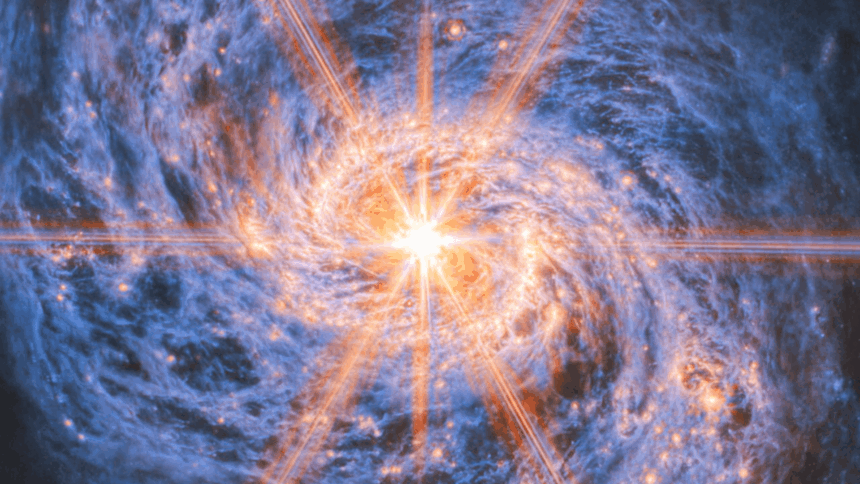
The central region of Messier 77 is dominated by an extremely compact and energetic source that outshines the rest of the galaxy combined, even challenging the sensitivity of the James Webb Space Telescope itself.
This is an active galactic nucleus (AGN), powered by a supermassive black hole at its core with an estimated mass of around eight million Suns. Gas in the surrounding region is drawn inward by the black hole’s powerful gravity, forming tight, high-speed orbits as it spirals toward the center. In the process, the material collides, compresses, and heats up to extreme temperatures, producing vast amounts of radiation.
The bright orange rays extending outward from the galaxy’s center are not actual features of Messier 77. They are optical artifacts known as diffraction spikes. These appear when the intense, unresolved light from the AGN interacts with the geometry of Webb’s hexagonal mirror segments and the support struts of its secondary mirror, slightly bending the light and creating the characteristic pattern.
The six-plus-two-pointed pattern seen in this image is a standard feature in all observations made by the James Webb Space Telescope. These patterns, known as diffraction spikes, only appear when a light source is both extremely bright and highly concentrated. That is why they are most commonly associated with stars. However, in some galaxies like Messier 77, the central nucleus is bright and compact enough to produce the same effect.
Beyond its luminous core, Messier 77 is also a highly active site of star formation. Webb’s near-infrared observations reveal a prominent bar structure cutting across the galaxy’s central region: an element that is not visible in optical images. Surrounding this bar is a bright starburst ring, formed where the inner ends of the galaxy’s spiral arms converge. These starburst regions are characterized by exceptionally high rates of star formation, making M77 a dynamic and evolving galaxy.
Messier 77 is also an active spiral galaxy with a disc rich in gas and dust, which both feeds and results from new star formation. Webb’s Mid-Infrared Instrument (MIRI) also reveals the cooler dust spread across the galaxy, glowing at longer wavelengths and shown in blue. This helps trace the structure of the galaxy beyond what visible light can show, giving a clearer picture of its ongoing activity.
The galaxy is also filled with thick clouds of dust that form a large, swirling structure of filaments and empty cavities. Along its spiral arms, bright orange pockets mark areas where new star clusters are forming, carving out glowing bubbles in the surrounding material.
Looking beyond the main structure captured by Webb, the galaxy’s spiral arms extend into a faint, wide ring of hydrogen gas stretching thousands of light-years. This outer ring is still active with star formation. Even farther out, thin streams of hydrogen reach into surrounding space, creating a delicate outer layer around the galaxy. Because of these long, tentacle-like filaments, Messier 77 is also known as the Squid Galaxy.
The latest image is based on data from observing programme #3707, which focused on surveying massive, nearby galaxies that are actively forming stars, and with a goal of building a detailed dataset that can support a wide range of scientific studies.
In this case, the high resolution of Webb’s instruments clearly reveals dense star clusters along with large reservoirs of gas and dust. These features allow astronomers to examine how stars are born, evolve, and eventually die, both in Messier 77 and in other similar galaxies across the universe.
Bojan Stojkovski is a freelance journalist based in Skopje, North Macedonia, covering foreign policy and technology for more than a decade. His work has appeared in Foreign Policy, ZDNet, and Nature.
Premium
Follow
NASA’s Webb telescope unveils stunning new view of Messier 77 – Interesting Engineering



Leave a Comment