

Courtesy of the City of Grand Junction
Courtesy of the City of Grand Junction
Locals gathered at the Historic Lowell School Building, 310 N. Seventh St., on Thursday, May 7 to discuss Mesa County’s top polluters, environmental concerns and opportunities for community advocacy.
The two-hour event was one of many stops on a statewide “Take on Toxics Tour” that GreenLatinos — an environmental justice organization — organized for the sixth year in a row.
A highlight of the discussion was the release of a new “Mesa County Environmental Justice Report & Data Analysis,” which was produced in partnership with students at the University of Colorado School of Public Health.
According to Colorado GreenLatinos Hazardous Materials and Waste Diversion Advocate Brian Loma, many businesses self-report to the Environmental Protection Agency if they exceed pollution limits, but the cumulative impacts are rarely monitored.
“The report is trying to answer who’s making the most pollution? What places are breaking the rules that protect people in nature? Are these places near neighborhoods where people already have a harder time staying healthy, and what can be done to make things safer?” Loma said.
“What we know is that there are disproportionately impacted communities in the Grand Junction area and city who are receiving more pollution than others, and that those communities have higher numbers of minorities.”
According to the report, many facilities appear to be operating despite having a terminated permit, while other permitted facilities have documented violations with the EPA for not reporting emissions at all.
One example is the salvage yard at 690 S Sixth St., Pick A Part Auto Recyclers, which reported zero emissions of any kind per year, yet boasts 12 violations between 2022 and 2025 for “reportable noncompliance” and failure to complete discharge monitoring reports.
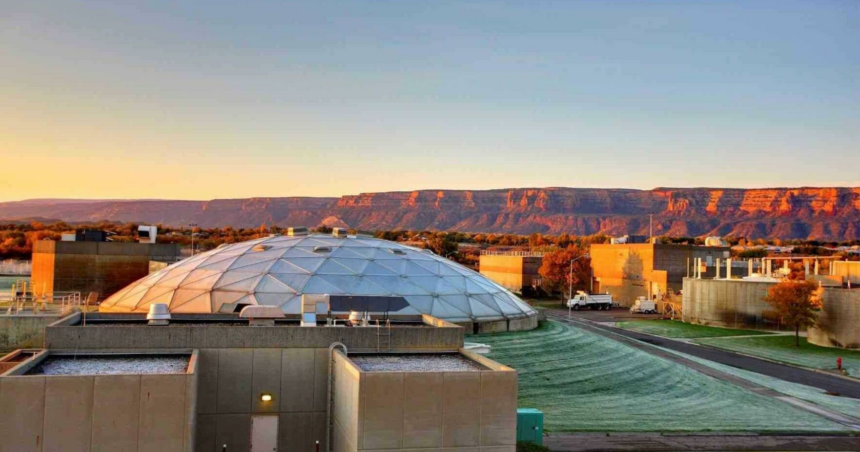
On the other end of the spectrum, the report identified facilities with the most documented emissions per year, with the top ranking going to the Persigo Water Treatment Plant at 2145 River Road.
According to the report, the facility emitted roughly 1.2 billion pounds of emissions per year, with over 19 million pounds identified as primary pollutants: total suspended solids, E. coli and metals, including arsenic, cadmium, copper, selenium and zinc.
Loma said that those pollutants could be attributed to what’s already in the water before it’s treated, which he said could be a concern for the efficacy or safety of any biosolids — a byproduct of sewage treatment often used as a compost, fertilizer or a base for natural gas — produced from the plant.
Still, the report authors added that the analysis would require significantly more data and health surveillance to prove a connection between the violations and any actual health impacts they might be causing in the community.
“Considering the gaps in reporting and monitoring of facilities and their pollutants, our first recommendation is to collaborate with the Mesa County Public Health Department to support the creation of a pollution control division that includes a health monitoring program,” the report said. “Lastly, we recommend investigating and gathering more information on the presence of pollutant emissions from facilities with significant violations and the potential health impacts.”
Those interested in reading the full report can request a copy at any Mesa County Libraries branch.
Loma added that community advocacy will be critical for any momentum on the report’s concerns, which is why the event focused equally on teaching attendees how to speak up and engage regional leaders for change.
Beyond practical advice on providing legislative testimony and attending local municipal meetings, local advocacy organizations — the Western Colorado Alliance and Conservation Colorado — were invited to speak with attendees about their missions and the opportunities to collaborate.
“It’s important for Coloradans in all four corners of our state to protect our air, our water and our soil in our communities, for our communities and for the next seven generations,” Loma said.
“It doesn’t matter whether you’re Democrat or Republican. It matters that you’re a Coloradan and that your Colorado values are to protect the environment that you live in and the health of your community.”
{{description}}
Email notifications are only sent once a day, and only if there are new matching items.
Your browser is out of date and potentially vulnerable to security risks.
We recommend switching to one of the following browsers:
Get up-to-the-minute news sent straight to your device.