




Travelweek
TORONTO — Against a backdrop of ongoing uncertainty in the global travel landscape, Travelweek once again brought the industry together for its latest virtual conference, “Future of Travel: Onwards & Upwards,” held May 6.
Timed to coincide with Travel Agent Day, the event was designed not only to tackle the most pressing issues facing travel professionals today, but also to celebrate and reward travel advisors for their resilience and dedication. Featuring an esteemed lineup of industry experts as keynote speakers, the conference offered candid insights into the current state of the sector, shaped by recent events like Cuba’s fuel shortage, violence in Mexico, rising jet fuel costs and the ongoing conflict in the Middle East.
To watch the show in its entirety, click here.
Opening the event, Travelweek publisher Devin Kinasz acknowledged the challenges head-on.
“Whenever something happens in the world, travel is the first to feel the impact, and that’s certainly the case now,” she said. “Travel advisors are definitely hearing some hesitancy from clients. But here’s the amazing thing: people are still travelling and they’re still booking trips. The pandemic taught the travel industry that we can get through anything.”
Despite the headwinds, the tone of the conference remained optimistic and celebratory. Generous prize giveaways were awarded throughout the event, including a $1,000 voucher from Air Canada and a $500 gift card from Porter Airlines, along with many more prizes aimed at recognizing the hard work and commitment of travel advisors across the country.
In addition to keynote speakers, viewers heard key messaging from sponsors like Railbookers, CIE Tours, Antigua & Barbuda, Virgin Voyages, Visit Nicaragua, Airnets International, Aruba Tourism, Princess Hotels, Iberostar Hotels & Resorts, and the Mexican Caribbean.
Here’s an overview of key issues and tips for advisors shared by keynote speakers.
Alexandra Fortier — Deputy Director, Stakeholder Relations in the Emergency Management Bureau, Global Affairs Canada
Alexandra Fortier, Global Affairs Canada
Global Affairs Canada is urging both travellers and travel advisors to rely more heavily on its travel advice and advisories as global disruptions continue to intensify across multiple regions. From fuel supply issues in Cuba and violence in Puerto Vallarta to ongoing instability in the Middle East, Fortier said the current environment makes these tools more essential than ever.
“Our travel advice and advisories are an essential resource, giving travel advisors and Canadians a comprehensive overview of what they need to know before travelling,” said Fortier. She noted the platform includes critical details such as safety and security conditions, entry and exit requirements, visa and biometrics rules, health precautions, local laws and seasonal risks like hurricanes. It also provides contact information for Canadian embassies and consular services abroad.
On the Middle East specifically, Fortier stressed that conditions remain highly unstable and warned of potential airspace closures, flight disruptions and risks to civilian infrastructure including hotels and energy sites. “The security situation could deteriorate at any time, which is why we continue to advise people not to travel to the region and encourage those there to leave while commercial options remain available,” she said. Fortier also highlighted the importance of registering with the Registration of Canadians Abroad tool, which provides real-time safety updates, and stressed that travellers should prepare for broader ripple effects.
With global instability becoming more frequent, Fortier said staying informed is key for the travel trade. She advised travel advisors to follow Global Affairs Canada’s Facebook and X platforms and sign up for daily email updates at travel.gc.ca/subscribe. She also recommended advisors complete the Safe Travel Planner program, which provides certification and practical guidance on tools such as consular services and emergency procedures abroad. And register for English and French webinars by emailing outreach.sensibilisation@international.gc.ca.
Hillary Arsenault — GPS Quebec and Atlantic, G Adventures
Hillary Arsenault, G Adventures
When asked how G Adventures is navigating these uncertain times in travel, Arsenault said the company is doing what it’s always done – leaning on its small group travel model and close destination partnerships, which allow the company to stay flexible and responsive to changing conditions.
“Since 1990 we’ve been grounded in the belief that travel is a force for good,” she said, noting that by specializing in small groups, the company is able to respond quickly to changes on the ground while staying focused on travellers and trade partners. “It gives us flexibility and allows us to make real time decisions with our local teams,” she said.
On demand trends, Arsenault said travellers are seeking more authentic, immersive experiences. “People want deeper connections with the places they visit and small groups make that possible in a way larger tours cannot.”
Bookings for G Adventures remain strong across multiple regions and travel styles, though preferences vary widely, she noted. “It is a long list because we operate globally,” said Arsenault, pointing to Japan, South Korea and Vietnam in Asia and Portugal, the Azores and Ireland in Europe. She added that Scotland and the Galapagos are performing well as part of the company’s Solo-ish travel style, while Egypt is seeing strong interest with the Geluxe Collection. “Travellers are looking for comfort with adventure, culturally immersive experiences and travel that has purpose,” she said.
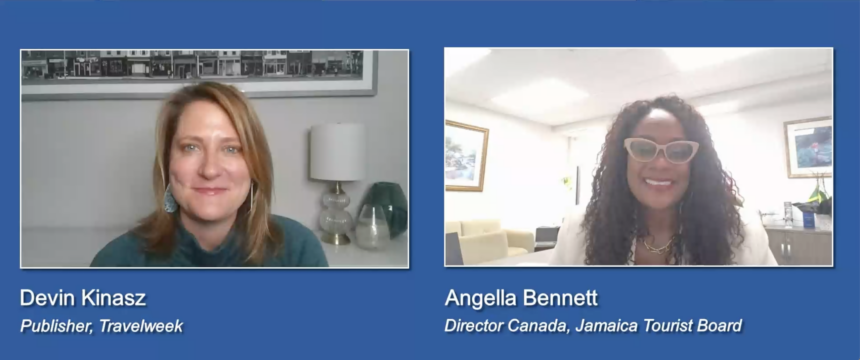
Angella Bennett — Director Canada, Jamaica Tourist Board
Angella Bennett, Jamaica Tourist Board
Jamaica is rebounding quickly following last year’s Hurricane Melissa, with strong visitor numbers and a steady return of hotel inventory, said Bennett. “We have a word in Jamaica, ‘tallawah,’ which means resilience and strength,” she said, noting that the island has already welcomed one million visitors within five months of the storm. “That speaks volumes to the speed of our recovery.” Bennett adds that approximately 80% of hotel inventory is currently open across key resort areas including Montego Bay, Ocho Rios and Falmouth, with a full return expected by year-end as rebuilding continues, particularly along the south coast.
Air access from Canada is also rebounding in step with demand. Bennett says all major carriers have resumed service, including Air Canada, WestJet, Sunwing, Air Transat, Flair Airlines and Caribbean Airlines, with flights operating into Montego Bay and Kingston. “We are projecting almost an 11% increase in capacity and connectivity to Jamaica this coming winter,” she said, with seat capacity expected to grow from 359,000 to nearly 400,000.
With airports fully operational and new airline partnerships expected to be announced soon, Bennett noted the destination is well positioned for continued growth. “All the flights have been reinstated from Canada, and we’re excited about additional partners coming on board,” she said, adding that details will be revealed in the coming weeks.
Stephen Goulding — Country Manager, Virgin Atlantic
Stephen Goulding, Virgin Atlantic
Goulding said Virgin Atlantic’s return to the Canadian market is meeting expectations, with its Toronto–London Heathrow service performing in line with strategy one year after launch. He credited the travel trade for supporting the route’s early success, adding that focus has been on building a sustainable, resilient operation rather than chasing rapid growth.
“We’re extremely encouraged by how the route has established itself,” said Goulding. “Toronto was a deliberate re-entry for us and it’s delivering exactly what we planned.” He noted the route is seeing a balanced mix of corporate premium, leisure and VFR traffic, along with strong operational performance. “We had a 100% completion ratio out of Toronto in the first year.”
Partnerships remain central to the airline’s Canada strategy, particularly its expanded relationship with WestJet. Goulding said the codeshare has already proven “incredibly valuable,” enhancing connectivity to destinations such as the Maldives, Johannesburg and Cape Town, while new reciprocal loyalty benefits allow members to earn and redeem points across both networks.
Virgin Atlantic’s multibillion-dollar fleet transformation, set for completion by 2028, will result in one of the youngest and most fuel-efficient fleets in the sky, helping reduce costs while improving environmental performance and consistency across the network.
Patrizio Iaquinandi — Manager Sales, Discover Airlines
Patrizio Iaquinandi, Discover Airlines
Discover Airlines is positioning itself as a key player in Canada’s transatlantic leisure market, offering non-stop service from Calgary to Frankfurt and Munich, and from Halifax to Frankfurt. Calling it Lufthansa Group’s “quality leisure-focused airline,” Iaquinandi said an Atlantic joint venture allows flight schedules to be seamlessly coordinated across the Group’s airlines as well as Air Canada and United Airlines. Looking ahead, the airline plans to enhance its onboard offering with its new “Ocean Blue” cabin, coming in spring 2027 and featuring upgraded seating across all classes, including “full all-aisle access seating in a 1:2:1 layout” in business class.
Despite ongoing geopolitical uncertainty and rising travel costs, demand for Europe remains strong. “We continue to see solid demand from Canada to Europe in summer 2026,” said Iaquinandi, noting that bookings are outpacing overall market growth. However, traveller behaviour is shifting. “Canadians are planning their trips more deliberately, with greater attention to value, reliability and comfort,” he explained, adding that interest in direct long-haul routes and premium cabins remains particularly strong.
Peter Ouzounov, Senior Director of Sales, Riverside Luxury Cruises
Peter Ouzounov, Riverside Luxury Cruises
Strong demand and intentional growth are shaping the outlook for Riverside Luxury Cruises, according to Ouzounov. “Sales have been really good, the trajectory that we’re on is very strong, but more importantly, it’s very intentional,” he said, noting that 2025 was a record-breaking year with double the sales over the previous year. Momentum is expected to continue with the return of a fourth ship, Riverside Mahler, in 2028.
Amid rising travel costs, Ouzounov said Riverside is leaning into a value proposition rooted in experience rather than price. “We’re very conscious of the conversation around cost, but what we’re seeing in Canada and globally is that demand for meaningful travel hasn’t softened. In fact, it’s become even more intentional,” he said, emphasizing that Riverside’s product is fully inclusive. “Value for us is not about being competitive on price. It’s about being complete in experience.”
With global uncertainty continuing to impact travel decisions, Ouzounov underscored the importance of flexibility. In response to all the recent “noise” in travel, Riverside has introduced “a relaxed cancellation policy for 2026 sailings, with extended deposit timelines, fully refundable terms within a meaningful window, and the ability to move bookings into 2027 much closer to departure.” He added that “river cruising remains one of the most stable and reassuring ways to travel,” and encouraged advisors to shift the narrative: “The opportunity for advisors is to reframe the conversation from uncertainty to possibility. Clients are still looking to travel, what they need is confidence in how to do it.”
Billy Stewart — National Trade Manager, Globus
Billy Stewart, Globus
According to Stewart, Globus is focusing on value and stability as rising costs continue to impact the travel industry. Rather than passing on excessive price increases or reducing commissions, the company is leaning into a model designed to support both travellers and advisors. “For travellers, that means a price guarantee so when they book, their price is locked in. And for advisors, it means really high commissions paid quickly,” he said. “Instead of cutting corners, we’re focused on delivering a complete, well-designed vacation that offers real value. When the value is clear, the business comes easy and confidence converts.”
Amid ongoing geopolitical uncertainty, Stewart said Globus is taking a proactive approach to managing disruptions. “We closely monitor global conditions and act as quickly as we can. That could mean cancelling, rerouting or adjusting itineraries, but every decision is centred on the safety and well-being of our travellers,” he said. Clear communication and flexibility are key, with options for rebooking or shifting plans when needed.
Looking ahead, demand remains strong across several key regions. Stewart pointed to surging interest in Italy as well as Scotland, England and Ireland, alongside continued growth in Portugal and rising demand for Spain. Japan remains a standout destination, with demand outpacing supply, while domestic travel is also gaining traction. “We’ve seen a big spike in Canadians exploring Canada, which plays to our strengths,” he said. Globus is also expanding small group and off-season offerings to meet evolving preferences. “We’re meeting travellers where they’re at, with immersive, flexible vacations that are easy for advisors to book.”
Jennifer Waver — AVP of Travel Sales, Manulife
Jennifer Waver, Manulife
Volatility in the global landscape is driving a surge in travel insurance demand, said Waver. “We’ve seen a definite increase in travel bookings and travel sales year over year, and certainly within the last few months, and even a large spike over the last few weeks,” she noted, pointing to disruptions ranging from fuel outages in Cuba to violence in Puerto Vallarta and conflict in the Middle East.
Waver stressed that understanding advisories is critical, both for safety and coverage. “Travel advisories issued by the Canadian government of Canada can affect both trip cancellation, interruption and medical coverage while they’re in destination,” she said, adding that many travellers don’t realize “there are actually four Canadian travel advisories.” She explained the levels range from “take normal security precautions” to “avoid all travel,” and emphasized that “our travel insurance policies for both trip cancellation and medical coverage are directly tied to these advisories, and they do play a significant role in determining the coverage that we do provide.”
On the trade side, Manulife’s newly launched booking platform is designed to better support advisors after decades on a legacy system. “The number one reason was that the platform that we were on was built on our legacy platform, and it was not compliant with Manulife security standards as of today,” said Waver. New features include “save our quote functionality agents were asking for” and the ability to “display all of our plan types of the clients qualified to purchase all in one screen.” She also encouraged advisors to shift their approach: “What travel advisors need to be doing differently today is leading their insurance discussions with coverage value versus price,” noting that travellers want reassurance “that their claim will be paid” and should see insurance as essential to the trip.
To watch ‘Future of Travel: Onwards & Upwards,” click here.
To read Travelweek’s special ‘Future of Travel’ issue featuring key messaging from sponsors, click here.
Lead image caption: Travelweek publisher Devin Kinasz and Angella Bennett, Director Canada at the Jamaica Tourist Board during ‘Future of Travel: Onwards & Upwards’, May 6.
Tags: Future of Travel, Lead Story
By: Travelweek
Exclusive access to Canadian travel industry news, promotions, jobs, FAMs and more.
Subscribe Now
Copyright © 2026 Concepts Travel Media Ltd.
Travelweek’s latest conference underscores strong demand despite global volatility – Travelweek



Leave a Comment

