




Eighty-one South Texas homeowners sued SpaceX in federal court in Brownsville on April 30, alleging that 11 Starship test flights between April 2023 and October 2025 have repeatedly damaged their homes through noise, vibrations, and sonic booms. The case is captioned Aguilar v. Space Exploration Technologies Corp., No. 1:26-cv-00485. It seeks more than $10 million in damages on theories of negligence, gross negligence and trespass.
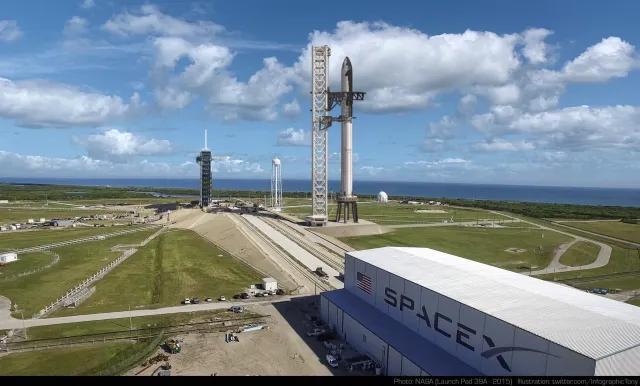
For Brevard County, the Texas filing is more than distant news. The peer-reviewed acoustic science the plaintiffs rely on has already been mapped onto the Space Coast by researchers from Brigham Young University. In the second of two papers cited in the complaint, projected their Texas sound-level measurements onto a Florida map that places Titusville, Merritt Island, Cape Canaveral and Cocoa Beach within the modeled contours. At comparable Texas distances, those readings exceeded structural damage thresholds set in FAA, NOAA, Air Force and NASA reviews.
Even the most ardent spaceflight supporter here on the Space Coast doesn’t want their property damaged by launches. The question of whether that will happen remains unclear, and if indeed that is the case, this lawsuit may well provide the legal precedents guiding any claims of noise damage made here. That makes this case worth following, no matter how you might feel about it one way or the other.
Here’s the lawsuit itself, in raw form:
The 59-page complaint was filed by lead counsel Benigno Martinez (a former US attorney) of Brownsville’s Martinez & Tijerina, joined by Guerra LLP of San Antonio, Paul LLP of Kansas City and Houston attorney Cristobal Galindo. The plaintiffs own homes in Port Isabel, South Padre Island, Laguna Vista and Laguna Heights, Texas. These Cameron County communities are clustered 5 to 13 miles from SpaceX’s Starbase launch complex.
Despite early news coverage describing the suit as a class action, the JS-44 civil cover sheet shows the Rule 23 class-action box is unchecked. The case is a multi-plaintiff joinder, not a class action. The distinction affects how damages must be proven and how any settlement would be structured.
Federal jurisdiction rests on a less-tested foundation. The complaint cites 51 U.S.C. § 50914(g) of the Commercial Space Launch Act, which channels claims arising from licensed launch activity into federal court. Diversity jurisdiction was unavailable because the complaint pleads SpaceX as a Texas corporate citizen with its principal place of business at 1 Rocket Road in Brownsville. Whether the federal forum will apply Texas tort law, or whether SpaceX will argue federal launch licensing preempts those claims entirely, is one of the case’s more consequential open questions.
Each plaintiff’s individual paragraph in the complaint recites that the home “was damaged” by each of the 11 named flight dates. The complaint does not itemize specific damage. There are no enumerated cracked walls, broken windows or repair costs. That pleading choice gives plaintiffs flexibility but leaves causation as the central battleground.
Cameron County’s coastal homes also weather hurricanes, salt air, foundation settling and humidity stress. SpaceX will likely cite those factors as alternative explanations for any cracking or window failures. The plaintiffs, on the other hand, will try to prove that it was rocket noise that caused harm to their property. Property owners in Brevard many of the same issues: hurricanes, salt air, foundation settling and humidity stress are part and parcel of homeownership here as well.
What separates Aguilar from a typical neighbor-versus-industrial-defendant suit is the depth of independent acoustic science it pulls into the pleadings. The complaint cites two peer-reviewed papers from a Brigham Young University team led by Kent Gee, chair of the BYU Department of Physics and Astronomy, published in JASA Express Letters.
BYU acoustic research
Peer-reviewed papers cited in the Aguilar complaint
Both papers led by Kent L. Gee, chair of the Brigham Young University Department of Physics and Astronomy. Citation titles link to the publisher’s DOI.
The BYU team placed measurement stations across Port Isabel, South Padre Island and Laguna Vista. Those are the same communities the plaintiffs live in. During Flight 5 on Oct. 13, 2024, peak unweighted sound levels (Lmax) ranged from 117.5 to 124.1 decibels at distances of 6 to 22 miles from the pad. During Flight 6, Lmax exceeded 120 dB at 6 to 6.5 miles.
Sonic boom overpressure from Flight 5’s booster return measured between 0.5 and 11 pounds per square foot. Station 1 at 6 miles recorded 11 psf.
The complaint pegs structural damage thresholds derived from SpaceX’s own 2021 noise assessment, the FAA’s environmental review documents, NOAA and prior Air Force and NASA analyses,
Every BYU measurement during Flights 5 and 6 cleared the 110 dB Lmax floor. Several exceeded 120 dB. The Station 1 sonic boom reading of 11 psf cleared even the elevated 10 psf threshold SpaceX itself adopted in its revised 2024 noise analysis.
BYU researchers also documented an unexpected finding embedded in the complaint. The Super Heavy booster’s 13-engine landing burn produces continuous noise comparable to the 33-engine liftoff. For booster-catch flights, that means three high-energy acoustic events per mission: the launch, the sonic boom of the returning booster and a second peak-noise landing burn. Flights 5, 7 and 8 fit that profile.
The same team’s analysis estimates a single Starship launch radiates roughly the acoustic energy of 2.2 NASA Space Launch System launches or about 11 Falcon 9 launches. That’s pretty loud, and it is something that area residents will definitely notice.
The complaint quotes a SpaceX corporate update from September 2024. In that update, the company acknowledged that, because Starship uses methalox propellant rather than the kerosene or hydrogen used in earlier programs, it faces a “gap in data” on blast and acoustic modeling. SpaceX said it is “making significant investments in scientific research” to close that gap. Plaintiffs use that language as an admission that SpaceX has been launching the most powerful rocket in history while acknowledging the science to predict its impacts is incomplete.
SpaceX’s own 2021 noise assessment, submitted to the FAA for licensing, listed Lmax thresholds in the 111 to 120 dB range as the structural damage benchmark. Its revised 2024 analysis omitted those lower thresholds and substituted higher ones at 130 to 140 dB. The complaint frames that revision as evidence the company knew the lower numbers were being exceeded.
SpaceX has not yet responded in court. A motion to dismiss is widely expected. The motion will likely argue that the FAA’s environmental review and CSLA license preempt state-law tort claims. It will also likely argue that the trespass count, premised on acoustic energy as a physical intrusion, pushes traditional trespass doctrine beyond its limits.
The FAA, in its 2022 environmental assessment, noted that SpaceX is required to carry third-party damage insurance. The agency said SpaceX would be responsible for resolving structural damage claims caused by sonic booms. That insurance backstop has not previously been litigated for cumulative-exposure claims of the type Aguilar presents.
Reader’s reference
Reading the decibel scale
Decibels (dB) measure sound on a logarithmic scale. Each 10 dB increase represents roughly 10 times the acoustic energy. A 120 dB sound carries about 1 million times the energy of a 60 dB conversation, not twice as much. Most structural damage thresholds therefore cluster within a narrow band that looks deceptively small on the page.
Reference levels drawn from CDC, OSHA and NIOSH noise hazard guidance. Damage thresholds reflect the FAA, USAF and NASA precedents and SpaceX filings cited in the Aguilar v. SpaceX complaint.
Notably, Gee himself has been careful in public statements not to assert his data establishes liability. In an interview with Talk of Titusville last year, he said Port Isabel residents about 10 km from the Texas pad “are not reporting broken windows” despite measurements above the conservative damage thresholds. Whether modeled thresholds translate into actual claims is, as Gee has put it, a question for regulators and courts rather than acoustic scientists. This lawsuit moves the question into court system, where it will be ultimately decided.
The second BYU paper went a step further than its Texas measurements. The researchers curve-fit the Flights 5 and 6 data and projected the resulting sound levels onto a Florida map centered on SpaceX’s LC-39A tower at Kennedy Space Center. The projection identified Orlando, Titusville, Merritt Island, Cape Canaveral and Cocoa Beach within the projected contours. The paper notes the projection ignores wind and temperature gradient effects, which SpaceX’s own KSC environmental documents acknowledge “may strongly influence noise levels.”
In an interview with this publication in May 2025, Gee summarized the implication directly. “Titusville, Merritt Island, Cape Canaveral, those towns are gonna see greater sound levels than what you get with the Falcon 9,” he said.
Space Coast distances
Distances from the two planned Florida Starship pads to populated areas
Distances are approximate line-of-sight from each pad. SLC-37 sits roughly 5.5 miles south-southeast of LC-39A, which brings the noise source closer to populated areas in the southern Cape. Actual sound levels at any given location depend on weather, vehicle trajectory and pad acoustic mitigations.
Distance estimates are line-of-sight from LC-39A. Texas analogs are drawn from BYU Flight 5 measurements. Actual Florida levels will depend on weather, vehicle trajectory and pad acoustic mitigations, as is the case with all launches.
Several caveats are worth stating plainly. Brevard’s launch-noise baseline is fundamentally different from Boca Chica’s. The Space Coast hosted Saturn V launches that remain among the loudest acoustic events in human history. Current residents largely bought into a community that has long understood itself as a launch corridor, and, mostly, Space Coast residents respond to launch noise with a shrug and perhaps a glance into the sky to watch the rocket fly.
Many homes in Brevard were built or retrofitted with that environment in mind. The plaintiffs in Aguilar argue, by contrast, that SpaceX transformed a quiet beach community into an industrial spaceport after they had already settled there.
The cumulative-exposure question, however, cuts the other way. Brevard’s existing acoustic load already includes Falcon 9, Falcon Heavy, Atlas V, Vulcan, New Glenn and SLS operations at cadences that vastly exceed any historical period. The BYU team estimates Starship is acoustically equivalent to roughly 11 Falcon 9 launches per liftoff. Adding it to a launch manifest that may eventually exceed 100 missions per year from Cape Canaveral and KSC combined moves the conversation from individual events to chronic exposure.
That is the precise scenario the Aguilar complaint describes for Cameron County.
The FAA released its draft Environmental Impact Statement for SpaceX Starship operations at LC-39A in August 2025. The filing opened a public comment period. It included sound and overpressure modeling for five weather conditions and contour maps for points of interest across the region. Whether the agency’s analysis is updated to reflect the BYU measurements, and whether the modeled contours align with what plaintiffs in Texas now allege actually occurred, will shape the regulatory record any future Florida claimant might invoke.
The most consequential procedural moments in Aguilar will arrive in the next several months. SpaceX’s response is due roughly 21 days after service. A motion to dismiss on preemption grounds, particularly aimed at the trespass count, is widely anticipated. The court’s handling of that motion will signal whether private property damage claims arising from licensed launch activity belong in court at all, or whether the FAA’s regulatory framework displaces them.
If the case survives motions to dismiss, discovery will turn on causation. Plaintiffs will need to tie specific damage to specific launches. SpaceX will press alternative explanations rooted in coastal weathering and home age. Internal SpaceX modeling, communications and any unreleased acoustic data will be the most contested documents in the file.
For Brevard residents, the case is worth following less for its specific Texas outcome than for the legal architecture it builds. Whichever way the court rules on preemption and trespass, the framework that emerges will apply equally to anyone claiming similar damage from Florida launches. The first Starship liftoff from LC-39A is expected within the next year. The first Florida lawsuit, if there is one, will not be far behind.
NASA kid from Cocoa Beach, FL, born of Project Apollo parents and family. I’m a writer and photographer sharing the story of spaceflight from the Eastern Range here in Florida.
Subscribe to our article alerts. and we’ll send you an email every time we publish a new article
TalkOfTitusville.com © 2025 – Founded in 2014
Subscribe now to keep reading and get access to the full archive.
Continue reading
Texas Lawsuit Over Starship Sonic Booms Foreshadows the Stakes for the Space Coast – TalkOfTitusville.com



Leave a Comment

