

The first StrictlyVC of 2026 hits SF on April 30. Tickets are going fast. Register now.
Buy one Disrupt pass, and get the second at 50% off. Ends May 8. Register now.
Latest
AI
Amazon
Apps
Biotech & Health
Climate
Cloud Computing
Commerce
Crypto
Enterprise
EVs
Fintech
Fundraising
Gadgets
Gaming
Google
Government & Policy
Hardware
Instagram
Layoffs
Media & Entertainment
Meta
Microsoft
Privacy
Robotics
Security
Social
Space
Startups
TikTok
Transportation
Venture
Staff
Events
Startup Battlefield
StrictlyVC
Newsletters
Podcasts
Videos
Partner Content
TechCrunch Brand Studio
Crunchboard
Contact Us
Alongside taking the wraps off the new Fitbit Air, a Whoop-esque fitness band, Google on Thursday said it is also rebranding its Fitbit app as Google Health and launching an AI-powered health coach as a subscription service.
The Health app will become a central part of Google’s fitness strategy, capitalizing on its 2021 acquisition of Fitbit, which saw the tech giant delving into fitness wearables to supplement its more general-purpose Android smartwatches.
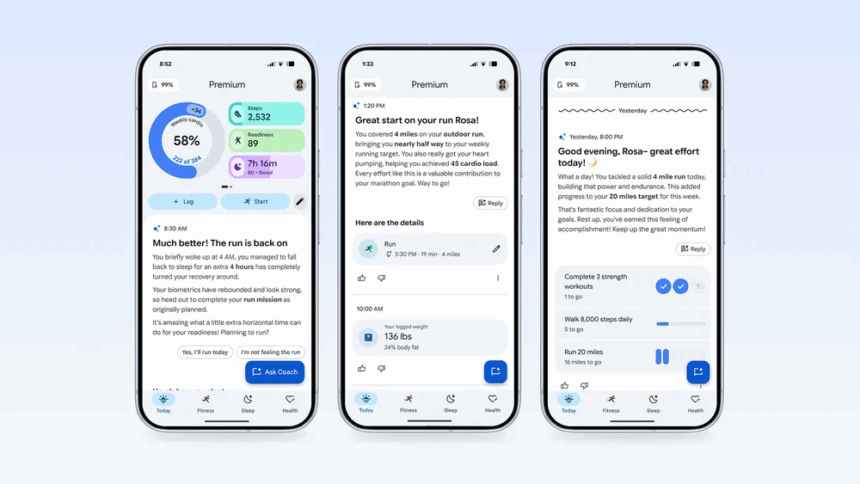
Leveraging Google’s Gemini AI, the new Google Health Coach will offer personalized insights to users, acting as a combination fitness coach, sleep expert, and health and wellness advisor. The service has been in public preview since last year and has been undergoing improvements based on user feedback, the company said.
Google says the Health app will be globally available on May 19, as part of the Google Health Premium subscription — the same day the new Fitbit Air goes on sale. The AI fitness coaching service will come bundled with the Google Health Premium subscription (previously Fitbit Premium), which costs $9.99 per month or $99 per year. Google AI Pro and Ultra subscribers will have access to Google Health Premium at no extra cost.
Google notes the health coach service is customized for the user via an onboarding process, in which you’ll mention your health goals, your daily routine, what sort of exercise equipment you have access to, any injuries the coach should be aware of, and other lifestyle factors. The coach will then use these details to create personalized guidance and insights.
Users can also communicate with the coach using natural language to customize and update their personal details or goals at any time. They can also log workouts, meals, and health records by dictating to it, or by uploading photos or files.
The coach will be accessible from the Today tab of the Google Health app. The company notes any insights the coach provides won’t be just a summary, but would combine information from multiple sources, like fitness and sleep metrics, environment, nutrition, cycle tracking, and U.S. medical records (if access is provided). Google said the cycle tracking, nutrition, and mental well-being features have all been redesigned for the health coach as well.
The AI-powered coach is being infused into other areas of the Google Health app as well, including the Fitness tab’s workout suggestions and guidance, the Sleep tab’s sleep tracking, and the Health tab’s summary of your metrics.
Google’s health coach will be available first for select Fitbit and Pixel Watch users, and support for other devices is coming soon, the company says. However, anyone can download the Google Health app to get started. People without a Fitbit or Google Pixel Watch will be notified when the coach is ready for them, but Google didn’t say when that would be.
Topics
When you purchase through links in our articles, we may earn a small commission. This doesn’t affect our editorial independence.
StrictlyVC Athens is up next. Hear unfiltered insights straight from Europe’s tech leaders and connect with the people shaping what’s ahead. Lock in your spot before it’s gone.
reMarkable’s new Paper Pure tablet goes back to basics with a monochrome screen
Hackers steal students’ data during breach at education tech giant Instructure
As workers worry about AI, Nvidia’s Jensen Huang says AI is ‘creating an enormous number of jobs’
Anthropic and OpenAI are both launching joint ventures for enterprise AI services
Ouster’s new color lidar is coming to replace cameras
This tiny, magnetic e-reader could stop you from doomscrolling
Uber wants to turn its millions of drivers into a sensor grid for self-driving companies
© 2026 TechCrunch Media LLC.