


Share
CMU student research explores AI’s real impact on investment performance
| Author: Reuben Chirikure | Media Contact: Alisha Draper
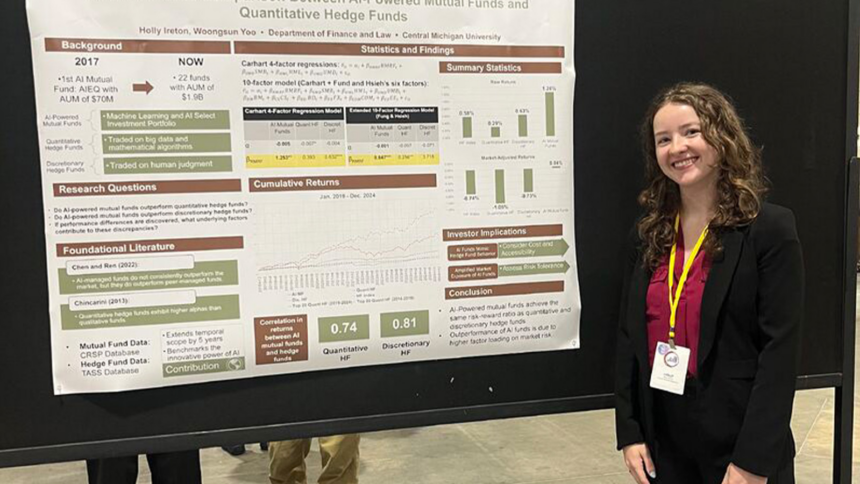
As artificial intelligence continues to reshape financial markets, Central Michigan University student Holly Ireton is helping separate hype from reality. Her undergraduate research, AI in Asset Management: A Performance Comparison Between AI-Powered Mutual Funds and Quantitative Hedge Funds, was presented at the 2026 National Conference on Undergraduate Research in Richmond, Virginia in April, bringing her work to a national audience of student scholars and faculty.
“AI is a huge topic in every industry right now, and I wanted to see how it will affect the future of financial planning and investing,” Ireton said. “Quantitative hedge funds already use large datasets and algorithmic trading, so in the advent of AI, it felt like a natural next step in research.”
Her project explored a key question shaping today’s investment landscape: Do AI-powered strategies truly outperform traditional quantitative approaches?
Ireton’s research compared two data-driven investment models that rely on similar inputs but different decision-making processes.
“I like to think of quant hedge funds and AI mutual funds as two cars running on the same fuel, which is big data, but with two different engines to synthesize the data,” she said. “Quant hedge funds rely on explicit and carefully engineered algorithms, while AI re-optimizes and learns patterns to make algorithmic decisions.”
Her findings revealed a more nuanced reality behind AI-driven performance.
“One of the most interesting insights from my research was how similar AI-powered mutual funds and quantitative hedge funds really are under the surface,” she said. “I found that their returns are highly correlated (0.74), which shows that they tend to respond to the same market movements and trends.”
Despite that similarity, AI-powered funds showed higher returns, but not for the reason many might expect.
“You might think that this would result in similar returns, but I found that AI-powered mutual funds achieve meaningfully higher returns than quantitative hedge funds simply because they take on more systematic market risk,” she said. “In other words, AI-powered mutual funds don’t outperform because of superior stock selection or better market timing, but rather because they are exposed to higher levels of risk.”
Her faculty mentor and advisor, Woongsun Yoo, said the findings challenge common assumptions about AI in finance.
“Holly’s research addresses one of the most pressing questions in contemporary finance: whether artificial intelligence can genuinely improve investment performance or simply repackages existing strategies with technological sophistication,” he said. “Her finding that AI-powered mutual funds’ apparent outperformance stems primarily from higher systematic risk exposure rather than superior security selection challenges the prevailing narrative about AI’s transformative potential in asset management.”
Beyond performance, Ireton was also motivated by accessibility in investing.
“Another big motivation for me was accessibility,” she said. “Hedge funds are typically inaccessible to retail investors, but because the AI funds are structured as mutual funds, previously exclusive strategies open up for the small-scale investor.”
That broader impact is part of what makes the research timely, Yoo said.
“As financial institutions increasingly deploy artificial intelligence for investment decision-making and marketing AI-based products to investors, Holly’s research provides critical empirical evidence distinguishing genuine innovation from marketing hype,” he said.
Presenting at NCUR marked a milestone in Ireton’s academic journey.
“Presenting my research at NCUR is meaningful to me because it represents a true culmination of everything I have been working toward in my undergraduate degree,” she said. “This project started as my Honors Capstone, but has become a real journey into academia, and it feels very special to share this project with students, faculty, and professionals in all fields, not just finance.”
The experience also reinforced the importance of communicating complex ideas clearly.
“At NCUR, I was able to relate my research to people from many different backgrounds, and I really felt the interaction between the technical research and financial storytelling skills that I developed through this experience,” she said.
Yoo said opportunities like NCUR push students beyond traditional classroom learning.
“Conference presentation requires students to conduct original research that meets peer-review standards established by the broader academic community, defend their methodology and findings before expert scholars who critically evaluate their work, and engage in substantive intellectual discourse,” he said.
After presenting, Ireton gained a new perspective on her work, and its relevance beyond academia.
“Writing this paper, I felt very caught up in the depths of finance theory as I worked through regression models and correlation tables,” she said. “Attending the conference brought me back to the basics where I could look at the research holistically instead of zoomed in on technical calculations.”
Conversations with attendees highlighted the real-world implications of her findings.
“One financial planner told me that his firm doesn’t invest in hedge funds because of the high barriers to entry, but he was very interested in the findings of my research because of its implications for similar accessible strategies powered by AI,” she said. “Talking to him reaffirmed my hope that my research would extend beyond academia into industry, and presenting at NCUR showed me that it has.”
Ireton’s work reflects the kind of hands-on, faculty-supported research happening across CMU’s College of Business Administration.
“Holly’s achievement demonstrates that undergraduate students at Central Michigan University can produce scholarship that competes successfully at the highest levels of academic research,” Yoo said.
It’s an example of how CMU students are not just learning about industry trends, they’re contributing to them, aligning with the university’s focus on applied, real-world learning and student success.
Follow us on social