


A free press can only endure when it is supported. Sustaining rigorous, trustworthy reporting takes people who believe it matters.
Nicholas Riccardi, Associated Press Nicholas Riccardi, Associated Press
Leave your feedback
Trump ignited the conflict over redistricting last year by urging Republicans to redraw congressional maps to reduce the likelihood that his party loses the U.S. House in the November midterm elections.
READ MORE: State redistricting battles intensify following U.S. Supreme Court ruling on Voting Rights Act
It was an unusual step, since redistricting normally only takes place after the once-a-decade census to accommodate population shifts. But in 2019 the Supreme Court ruled federal courts cannot prevent partisan gerrymandering, and Trump saw a chance to push the limits.
Once Republican-led states like Texas started shifting district lines, Democratic-led states like California countered. The fight was heading for a draw until the Supreme Court’s conservative majority issued its long-awaited decision in Louisiana v. Callais.
Subscribe to Here’s the Deal, our politics newsletter for analysis you won’t find anywhere else.
Thank you. Please check your inbox to confirm.
The court weakened the last remaining national impediment to gerrymandering — the Voting Rights Act’s requirement that, in places where white people and outnumbered racial minorities vote differently, districts be drawn to give those minorities a chance to elect representatives they prefer.
The ruling opened a new set of political floodgates.
Republicans in Tennessee plan to erase the only Democratic congressional district, which is majority Black and centered in Memphis, by splitting it up among more conservative suburban and rural white communities. More than a dozen other majority-minority districts, mainly in the South, could face the same fate.
Louisiana moved to postpone its congressional primaries, set for May 16, to have a chance to redraw two majority-Black Democratic seats it was required to maintain before the recent ruling. Alabama is trying to get the Supreme Court to let it redraw its two majority-Black seats.
WATCH: How the Supreme Court’s Louisiana districting decision weakens the Voting Rights Act
“We should demand that State Legislatures do what the Supreme Court says must be done,” Trump wrote on social media on Sunday. “That is more important than administrative convenience.”
He said Republicans could gain 20 seats through redistricting.
Democrats have threatened to retaliate by splitting up conservative bastions in states like New York and Illinois, which would reallocate Republican voters to more liberal, urban districts.
With fewer limits — either legal or self-imposed — people expect the issue to become a perpetual race to squeeze every possible advantage out of legislative maps.
“It’s hard to know where it ends,” said Rick Hasen, a law professor at UCLA.
Partisans gleefully shared color-coded maps of California with all 54 House seats drawn for Democrats, or southern states with only a couple of blue districts. Most agreed that eventually it will be very hard for Democrats to get elected to the House in any Republican-run state, even if there are large swaths of blue-leaning terrain, and vice versa for Republicans in Democratic-run states.
That seems un-American, said Jonathan Cervas, a political scientist at Carnegie Mellon who’s redrawn maps on behalf of judges reviewing redistricting litigation. The country’s system, he said, “was founded on this idea that it’s majority rule with minority rights.”
“There is no more rule of law in redistricting,” Cervas said. “There have to be some constraints, somewhere. Otherwise we don’t really have elections.”
The arcane art of drawing legislative lines is the most powerful tool that politicians have for gaming elections. They can make districts an almost guaranteed win for their side by drawing lines that scoop up a majority of their voters and just enough of the opposition’s supporters to ensure the other party cannot win that seat or the one next door, either.
Lawmakers have used the trick since the country’s founding. Democratic gerrymanders helped the party hold onto the House through the Reagan revolution. After the 2010 midterms, Republican majorities in state legislatures allowed the GOP to draw districts to lock up control of the House even during President Barack Obama’s reelection two years later.
However, that didn’t prevent the “blue wave” in 2018, during Trump’s first term, when Democrats retook the House. It was a reminder that even the most partisan gerrymanders may stifle shifts in public opinion but eventually crack as political tides turn.
“When you try to get every last ounce of blood from the stone you can end up shooting yourself in the foot,” said Michael Li of the liberal Brennan Center for Justice in New York.
Political coalitions also change, and voters that a party thinks will be reliable can switch sides. That’s what’s happened in the Trump era, as Democrats have expanded their support among wealthier and suburban voters and Republicans among Blacks and Latinos.
Although Republicans won’t be able to exploit the full force of the Supreme Court ruling until after the November midterms, it will be challenging for Democrats to find enough seats to counter those gains.
Sean Trende, a political analyst who has drawn maps for Republicans, agreed that the court decision is likely to lead to partisan gerrymandering run amok. He said it’s been hard to find neutral arbiters to rein in politicians who draw lines to benefit themselves.
The coming storm, Trende said, will be more of a symptom of polarization than its root cause.
“All our institutions are broken. We don’t speak a common political language,” Trende said. “This is what you get.”
Support trusted journalism and civil dialogue.
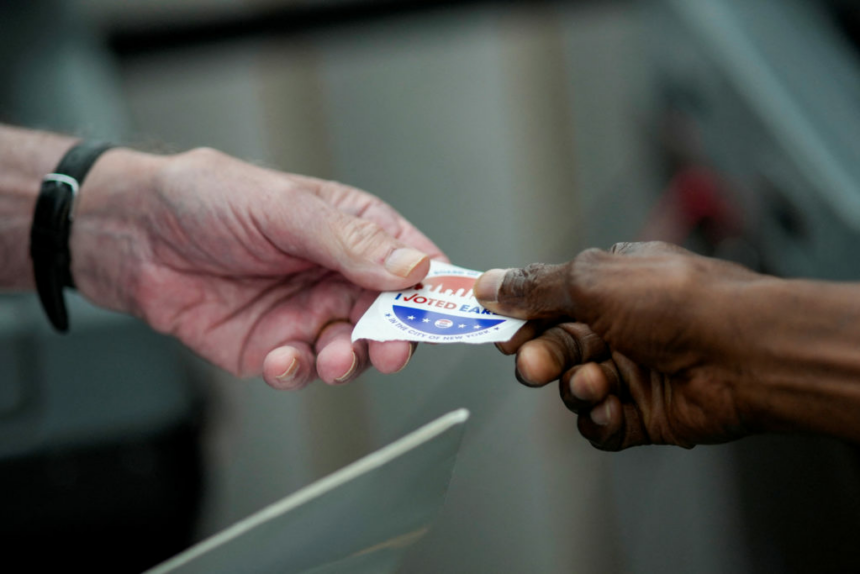
Left: FILE PHOTO: A person gets a sticker during early voting in the New York primary election at the Brooklyn Museum in New York, June 22, 2025. Photo by Eduardo Munoz/Reuters
By Associated Press
By Mark Sherman, Associated Press
By Gary D. Robertson, David A. Lieb, Associated Press
By David A. Lieb, Associated Press
Nicholas Riccardi, Associated Press Nicholas Riccardi, Associated Press
Associated Press
Support Provided By: Learn more
Subscribe to Here’s the Deal, our politics newsletter for analysis you won’t find anywhere else.
Thank you. Please check your inbox to confirm.
© 1996 – 2026 NewsHour Productions LLC. All Rights Reserved.
PBS is a 501(c)(3) not-for-profit organization.
Sections
About
Stay Connected
Subscribe to Here’s the Deal with Lisa Desjardins
Thank you. Please check your inbox to confirm.
Support for News Hour Provided By
Redistricting war accelerates winner-take-all politics straining American democracy – PBS



Leave a Comment