




Home / News / Cancer Clinical Trials / Cancer
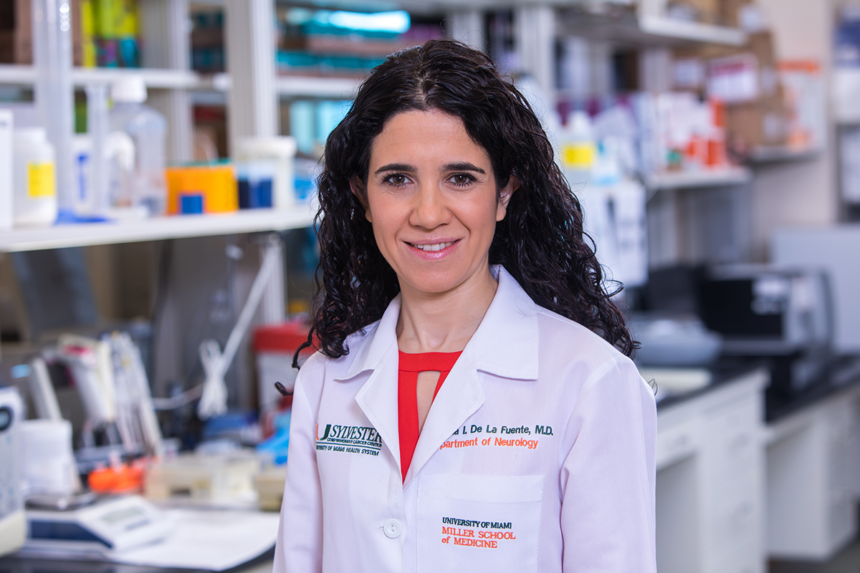
As part of the Sylvester Brain Tumor Institute, Dr. de la Fuente oversees clinical trials for new brain cancer treatments and studies targeted therapies for gliomas.
May is Brain Cancer Awareness Month, a time to spotlight the more than 100,000 Americans diagnosed each year with a primary brain tumor and the urgent work underway to improve outcomes for patients and families facing these complex diseases.
At Sylvester Comprehensive Cancer Center, part of the University of Miami Miller School of Medicine, that mission is central to the work of Sylvester Brain Tumor Institute (SBTI), whose goal is not only to extend survival but also to preserve quality of life, says Macarena de la Fuente, M.D.
Dr. de la Fuente is co-director of clinical neuro-oncology for SBTI and chief and clinical service leader of neuro-oncology at Sylvester, where she focuses on translating scientific advances into more effective, personalized treatments for patients with brain cancer. Her work spans patient care, clinical research and multidisciplinary collaboration, all aimed at moving discoveries from the lab to the clinic.
In the following interview, Dr. de la Fuente discusses her work, the evolving landscape of brain tumor treatment and why progress depends on both innovation and collaboration. This interview has been edited for length and clarity.
At Sylvester, I lead the neuro-oncology clinical care and clinical research programs, working to bring innovative treatments and clinical trials to patients with brain tumors while mentoring the next generation of specialists dedicated to improving outcomes.
I do research in targeted therapies for gliomas. Gliomas are primary tumors that arise in the brain and we focus our research on identifying drugs that can be tailored to specific alterations that those tumors may have.
Early in medical school, I was fascinated by the brain. One of my first patients during residency had a primary central nervous system lymphoma, a very rare type of brain tumor. I evaluated the patient for the first time, and he was really, really sick, in the ICU. We were able to treat him with chemotherapy and he recovered to normal.
Seeing that evolution was really inspirational for me. A patient went from being comatose to being discharged, walking, talking, recovering all his functions, able to have a normal conversation and a very good quality of life.
From there, of course, I learned that not all brain tumors have great outcomes. So, I became interested in trying to find better treatments and more successful treatment options for brain tumor patients.
To achieve our goal, there are a variety of things that we do. On the basic science side, we take tumor samples and generate organoids — in a way, mini-brains — so we can study the tumor itself and drugs to which that tumor may respond and then translate that into a new treatment for patients.
On the clinical care side, we have improved access and expanded geographically across South Florida so that brain tumor patients can receive care closer to home. We not only provide standard care with surgery, radiation and chemotherapy, but also all the support other patients need — social workers, nutritionists, onco-psychiatry and so on — services that help them go through the treatment and improve their quality of life during and after treatment.
My passion is clinical trials because they’re the tool we have to identify better, less toxic treatments and bring them to more patients.
We have one study called ETCTN 10599 that I’m very excited about. It’s based on discoveries from Dr. Antonio Iavarone, the director of Sylvester Brain Tumor Institute. He discovered a fusion in the lab and we were able to translate that to a clinical trial that is now nationally open. We have exciting preliminary results, so we’ll see how the data evolve.
A type of targeted therapy I work on is BRAF inhibitors. I’ve been working with a next-generation drug called plixorafenib to understand its efficacy and safety profile. At SBTI, we explore drugs that may work for patients and provide them with a high quality of life as they’re going through treatment.
I like spending time with my family and creating memories with my kids. My daughter is almost 15 and I enjoy working out and traveling with her. I enjoy cooking with my son, who is almost 10. We play video games like Mario Kart™ and read about Pokémon, which he loves. I try to do things with the kids that they enjoy and we can do together.
Scientists across Sylvester Comprehensive Cancer Center continue to lead the way toward an even brighter future for children with cancer.
A new drug tested at Sylvester Comprehensive Cancer Center is generating encouraging results for patients with low-grade gliomas.
Sylvester researchers contributed to two tumor profiling studies classifying glioblastomas and describing how they evolve after treatment.
The Sylvester Comprehensive Cancer Center researcher discusses brain tumor vulnerabilities and the use of precision medicine to find cancer cures.
Tags: brain cancer, brain tumors, clinical trials, Dr. Macarena De La Fuente, glioma, Sylvester Brain Tumor Institute, Sylvester Comprehensive Cancer Center
This article was printed from The Miller School of Medicine Medical News
at the following URL: https://news.med.miami.edu/qa-macarena-de-la-fuente-personalized-brain-cancer-treatment/
Copyright © 2026 University of Miami Health System
Q and A with Brain Cancer Expert Macarena de la Fuente – University of Miami



Leave a Comment

