


Latest commentary and analysis on the United States from academic experts
Latest commentary and analysis on the United States from academic experts
0 comments
Estimated reading time: 4 minutes
Latest commentary and analysis on the United States from academic experts
0 comments
Estimated reading time: 4 minutes
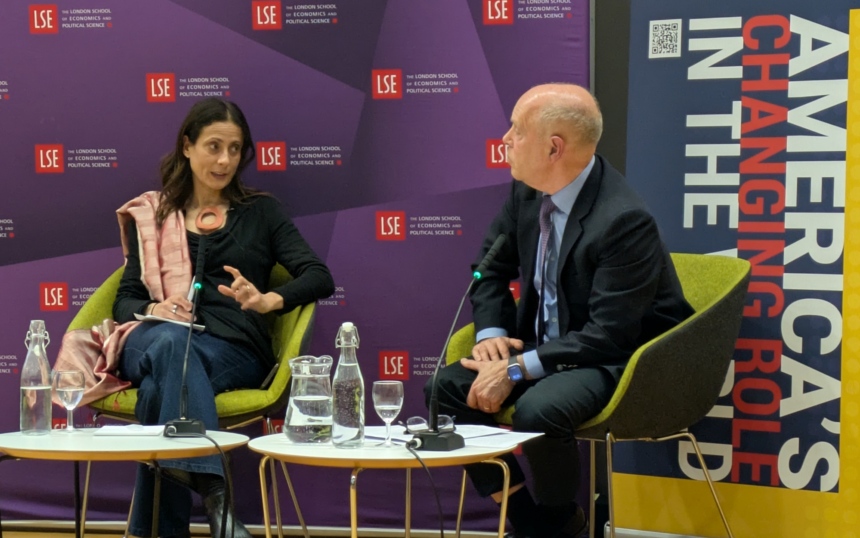
In March 2026, the Phelan US Centre hosted the event “Donald Trump and the unmaking of Europe” with Professor Nathalie Tocci as part of the Centre’s America’s Changing Role in the World lecture series. Lilin Lu gives an overview of the event.
On 12 March 2026 the Phelan US Centre hosted Dr Nathalie Tocci for the event, “Donald Trump and the unmaking of Europe”. The event, chaired by Professor Peter Trubowitz, Director of the Phelan United States Centre, was part of the Phelan US Centre’s America’s Changing Role in the World lecture series. The discussion explored how Europe is responding to Donald Trump’s return to power and whether this represents a temporary disruption or a deeper structural shift in transatlantic relations.
Dr Tocci, who is Director of the Istituto Affari Internazionali and professor of practice at the Johns Hopkins School of Advanced International Studies, framed the discussion around a central question: does Trump represent a structural break in the relationship between Europe and the United States, or simply a temporary political episode?
According to Tocci, many European policymakers seem to have interpreted the situation as largely temporary. From the perspective of the US democratic system, presidents come and go. Economic pressures and market reactions also constrain political decisions, including those of President Trump.
In this light, Tocci argued that European leaders have often taken a cautious approach, which involves diplomatic flattery or accommodation, toward Trump to keep relations stable while Europe assesses the longer-term situation over the past two years.
However, this strategy is not without unease. European leaders remain concerned about issues such as security and regional stability, which cannot remain unaffected by US foreign policy decisions. Tocci illustrated this tension using the example of Iran. While some actors choose to remain cautious observers, others recognise that difficult geopolitical decisions must still be made. In this context, she referred to a recent remark by the German Chancellor Friedrich Merz, paraphrasing that: “at the end of the day, someone is going to do the dirty work.”
When it comes to trade and economic relations, diplomatic accommodation also plays a role in managing and reducing the risks that may arise during Trump’s presidency. Tocci suggested that Europe may sometimes accept deals that are not ideal to limit potential losses.
Although Europe may have shown moments of resistance, such as in the case of Greenland, maintaining working relations with the United States remains a key strategic interest for Europe.
While European reactions often assume Trump is a symptom of a temporary shift, Tocci notes there could be an underlying reading of structural change of European actions. Trump may be the most visible figure, but he could also be a symptom of broader shifts within American politics and in the United States’ role in the world. Europe is not unaware of these developments, and signs of structural realignment may already be emerging beneath all the flattery.
One important area is European defence. Germany, for instance, is expected to significantly increase its defence spending, potentially surpassing the combined spending of some major European partners by the end of the decade. At the EU level, proposals such as a €150 billion defence initiative also suggest a growing recognition that Europe may need to take greater responsibility for its own security. These shifts also have implications for NATO. Some operational responsibilities that were traditionally held by US commanders are gradually moving toward European leadership, reflecting a broader adjustment within the alliance.
Meanwhile, Europe is exploring new forms of cooperation beyond the transatlantic relationship with Agreements such as the Comprehensive and Progressive Agreement for Trans-Pacific Partnership (CPTPP) and closer cooperation with other middle powers.
Tocci concluded the discussion with a sober note. While Europe’s response to Trump suggests that many still see the situation as temporary, there are also signs of deeper structural change. This moment could create space for competing visions of the West to emerge. There may be cooperation between European states, but not necessarily deeper political integration. Some actors may continue to emphasise liberal international institutions, while others may move toward more nationalist or right-leaning approaches.
Lilin Lu is an MSc student in Economic History at the London School of Economics and Political Science (LSE). Her interests lie in how historical perspectives shape contemporary policy debates across East and West.
Your email address will not be published.
© 2026 London School of Economics and Political Science (LSE). LSE Blogs.
LSE United States Politics and Policy – The London School of Economics and Political Science


Leave a Comment