




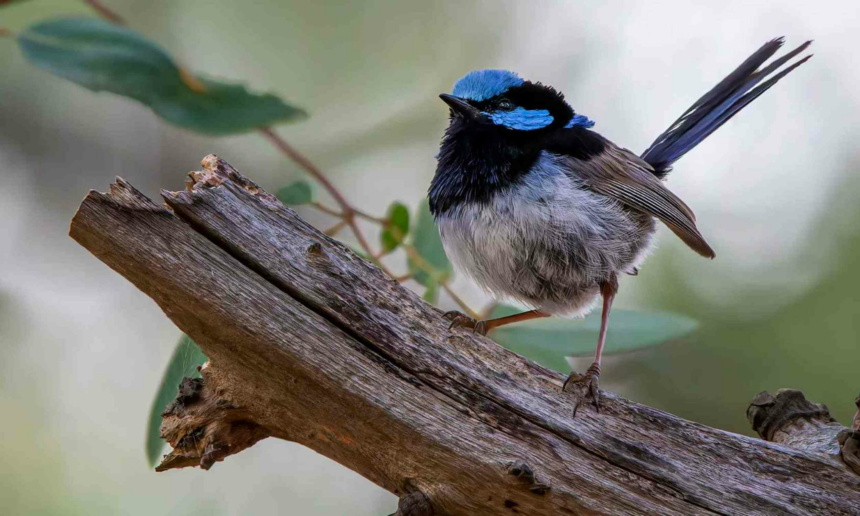
A new study has found that a familiar Australian backyard bird, superb fairy-wrens, could disappear from a long-watched population within 30 to 40 years.
Dry springs, warm winters, and hot summers now appear to chip away at the birds across the year, turning modest stress into lasting decline.
In a 148-acre study site in Canberra, Australia’s inland capital, the danger emerged through years of breeding records, deaths, and newcomers.
By linking those records, emeritus professor Andrew Cockburn from The Australian National University (ANU) showed how minor losses accumulated into a sharper threat.
Cockburn’s team found that small climate effects on superb fairy-wrens did not cancel out; they struck breeding, survival, and new female arrivals.
That pattern leaves even a common garden bird looking less secure than its official status suggests.
Climate pressure rarely landed as one obvious disaster, so the danger grew through separate parts of the birds’ year.
Dry springs cut fecundity, the number of young produced, because fewer insects and plants can support repeated nesting.
Warm winters and earlier hot summers lowered survival, likely by disturbing food timing and leaving birds weaker during cold snaps.
Once fewer females survived and fewer chicks replaced them, the population lost the replacement capacity that common species often appear to have.
Superb fairy-wrens use cooperative breeding, group care for young, as male relatives often stay and help inside year-round territories.
Male helpers feed chicks and defend nests, while young females usually leave to find scarce breeding openings.
This social pattern creates a weak point, because female losses matter most when dry years reduce replacements.
Even a population full of males can shrink fast if too few females survive the scramble for territories.
To connect the year-round records, scientists built an integrated population model, a tool that combines counts with life events.
The model tested how rain and temperature changed survival, breeding success, newcomers entering the area, and yearly population growth.
Across the life cycle, the team found 11 ways climate changed bird numbers rather than one dominant cause.
Because several effects reduced numbers at once, small changes became more dangerous than any one measure suggested.
After matching model predictions to recent bird counts, scientists projected the population from 2022 through 2100.
With no further human-driven warming, female extinction risk, the chance females vanish from the site, stayed at 22.9 percent by 2100.
Under low greenhouse gas emissions, the garden population still disappeared by about 2080, despite slower warming in the scenarios scientists modeled.
Intermediate and very high emission scenarios pushed likely local extinction, loss from that site, toward 2059 to 2062.
The researchers described the risk as cumulative, because no single climate event explained the population decline.
“We found that although many individual impacts of climate change on the birds are small or moderate, together they are expected to have a catastrophic cumulative effect,” said Cockburn.
Cumulative damage changes the conservation problem, since fixing one weak point would leave several others still active.
For managers, the warning is blunt: buffering habitat helps, but emissions still set the ongoing pressure.
Food may explain why warm winters harmed a bird that should, in theory, spend less energy staying warm.
Sudden mild spells can wake arthropods, insects and related small animals, before birds need them most.
When cold returns, exposed prey can die or vanish, leaving wrens with fewer meals during lean weeks.
That possible mismatch remains unproven in this population, but it fits the bird’s insect-heavy diet.
History makes the fairy-wren warning more serious because abundance has failed birds before, even when people assumed numbers meant safety.
The extinct North American passenger pigeon once numbered an estimated 3 billion to 5 billion before collapsing.
In North America, bird monitoring found a net loss approaching 3 billion birds across many once-familiar species since 1970.
Across Europe, intensive farming has driven major declines in common birds, especially across farmland habitats.
Official labels can lag behind local collapse when a species remains widespread across a broad range.
The Red List of Threatened Species, a global extinction-risk system, still puts the species in its safest category.
That category, called Least Concern, can hide severe stress in one well-measured population, even while the species survives elsewhere.
Such gaps matter because local losses can erase familiar birds from daily life before global status changes.
The garden’s fairy-wrens reveal a harder kind of climate threat: many modest changes, spread across seasons, can push survival and breeding below replacement.
Careful year-round monitoring may find similar patterns elsewhere, but prevention depends on cutting warming before common species lose the numbers keeping them stable.
The study is published in Nature Communications.
—–
Like what you read? Subscribe to our newsletter for engaging articles, exclusive content, and the latest updates.
Check us out on EarthSnap, a free app brought to you by Eric Ralls and Earth.com.
—–
An iconic bird is on the verge of extinction due to many small climate change impacts to its habitat – Earth.com



Leave a Comment

