


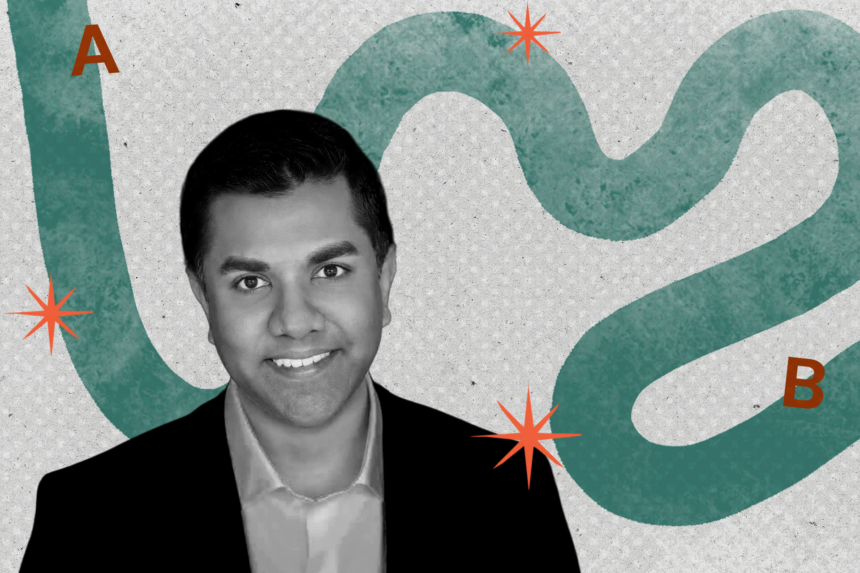
Living between India and the United Kingdom positioned Ravi Agrawal to notice how world events affect communities in varied ways. Now the editor-in-chief of Foreign Policy magazine, Agrawal sat down with CFR to discuss how he brings that perspective to his work.
When Ravi Agrawal was a teenager in India, cable television arrived in the country. The outside world was all of a sudden brought to him on a screen, inspiring him to one day be part of the team that broadcasts those stories. He went on to pursue a career in journalism, spending more than a decade reporting for CNN from London and across India. Now, he leads the editorial team at Foreign Policy. Read about how spending his life in two continents changed the way he thinks, how he approaches covering global issues, and what he makes of the state of world news today.
Here’s how Ravi Agrawal got his career in foreign policy. If you’re interested in this series, check out more editions here.
What did you want to be when you grew up?
When I was four years old, my family moved from London to Calcutta. Mining those cultural differences as areas of inquiry was always interesting to me, but I never imagined that I could make a career of it.
As I grew into my teens, the arrival of cable television in the early 1990s brought the world to India on a screen. All of a sudden, I had access to CNN and the BBC, which allowed me to think about being one of the people I was seeing on television every day—making sense of massive news events, wars and conflict, and diplomacy and international relations around the world, for the world.
The big jump for me was when I moved to the United States for college a few days before September 11, 2001. That was a formative experience for me in many ways. I joined the campus newspaper, the Harvard Crimson, my freshman semester, which was formative in pushing me to think about making a career in this work.
Hearing that you watched CNN at a transformative time in your life makes your next move seem even more significant, knowing your first job out of school was actually at CNN. What did working at a major network teach you about storytelling on a global scale?
I joined at the very bottom of the ladder in 2006. My first job was running the teleprompter as a production assistant. When you do that for hours and hours every day, you take in the ebb and flow of news. You understand what makes a good script and learn about evolving stories.
That was my initial crash course in reporting, then I was lucky to rise quickly at the network to become a writer and then a show producer. I did that for quite a few years in London. I launched Connect the World in 2008, which still continues today. The show was an exercise in trying to find one big story and exploring all the ways in which it had ripple effects around the world. It was very much a theme that I resonated with. Then, I moved to the United States to be a senior producer on Fareed Zakaria GPS.
After a few years in these roles, I realized a lot of producing is receiving information that has been collected by journalists and then editing it, tying it up into a nice bow, and then disseminating it. I felt that I hadn’t done enough of being a journalist in the field. So I chose to move back to India, where I became CNN’s New Delhi bureau chief, reporting from across South Asia. I did that for about three years.
You witnessed the television revolution as a teenager and then wrote a book, India Connected, on the same phenomenon for smartphones. What was the moment for you that you knew you wanted to write about another digital shift?
When I went back to India in 2014, there was another transformation taking place like the one I lived through in the 1990s, and that was the proliferation of the cheap smartphone. These were smartphones that would cost less than one hundred bucks—not Apple iPhones, but cheaper ones made by Indian or Chinese manufacturers.
It immediately occurred to me that for most people, this was not just a phone but their first computer, their gateway to the internet, their first television, their first private screen, their first mp3 player, their first Walkman, their first camera, their first map. I wanted to document how a digital Swiss Army Knife like that would change culture, politics, communal harmony, and gender rights.
The phone was a big equalizer in my eyes. When I left India for the first time in 2001, only 2 percent of Indians (about twenty million people) had access to the internet, and that’s because only 2 percent of Indians had access to personal computers. By 2014, three hundred million Indians were online, and that was entirely because of these smartphones. My book explored that shift, and I thought I was perfectly placed to tell that story, because I had lived half my life in India and half outside—half my life with the internet and half without. I also knew India well, and I was traveling around the country extensively for my job, so this book felt like a natural addition to the work I was doing.
What was the transition like from broadcast work at CNN to managing a smaller digital and print magazine at Foreign Policy?
I was lucky to join the magazine as a managing editor. They were happy to take what I had to offer, and simultaneously give me a lot of room to learn how to edit long-form magazine writing and arguments written by experts. That change was difficult in that I had to learn a new medium and master it quickly. But it was also seamless, in the sense that it’s still covering the world and trying to distill complex ideas, and rapidly moving events, into a cleanly conveyed piece.
I’ve now been at Foreign Policy for eight years. It’s a job that I love very much—I see it as both a privilege to be able to edit the greatest thinkers and writers on particular issues, and a responsibility to put out a debate about news events and the state of the world in a way that is informed and allows people to form their own opinions.
How have the stories you worked on changed your perspective on foreign policy?
Across the twenty years I’ve been a journalist, one animating feature has been the role of American power around the world, and it’s been very important for me to try and bring to light both the positive and negative effects of that power in a way that resonates for a global audience. Both at CNN and at Foreign Policy, our audiences have been very global. It is important to me to air and publish content that resonates with them.
For example, with the ongoing war in Iran, I wrote last week about Americans feeling pain at the pump. But the United States also happens to be an energy superpower. It is the world’s biggest crude producer and biggest natural gas producer. It is not lost on me that Asians, who are net importers of both natural gas and crude, are disproportionately suffering from this war on Iran. It’s not just the price at the pump that is up for them, but they’re having to ration cooking oil, they’re facing the closure of universities, and many countries including Pakistan and the Philippines have imposed four-day work weeks. I view it as vital to present the difference in the war’s ripple effects to Americans, for them to know and understand how their taxpayer money goes toward decisions that can have significant implications for people on the opposite side of the planet.
Iran is just one example, but there are so many other global stories like this one that fit this pattern and that I think need to be covered in a very holistic way to be fair to a global audience. That’s what I’ve always tried to do.
You’ve interviewed many influential figures for FP Live, the magazine’s video format for live discussions with world leaders. Have any of them taught you anything about the foreign policy field that surprised you or changed your mind on a topic?
FP Live marries the two companies I’ve spent the most time at—CNN and Foreign Policy. It allows me to interrogate people in power, and domain experts to teach us something new about an issue we’re all thinking about.
The modes of inquiry are different. If it’s a prime minister or a president, you want to challenge their decisions and speak truth to power. If it is a historian, you want to learn about their take, so you have a better understanding of what’s going on.
For me, it is less about having epiphanies from any one conversation and more about learning something every day. Going back to why I became a journalist, what makes my eyes light up in a conversation is a new fact or data point about a country or culture that adds to my reading of how things work. I think that is also what our audience also tends to enjoy the most.
Foreign Policy has grown a lot since you took the helm. How has covering international affairs changed in the last near-decade you’ve been running it?
One trend line has certainly been declining trust in the media and increased attacks on journalism by people in power. That has been a real challenge for the entire journalistic community to navigate. Another has been significant financial pressure on media outlets. First that was in the form of reduced advertising, and then it was competition in subscriptions.
The world has also just become a much more complicated, messy place. The outlets that are truly able to speak truth to power—not only to their own governments, but to governments around the world—perform a more valuable service than ever before. That’s certainly been something that we’ve kept in mind as we do our jobs.
Then finally, an added pressure has been the rise of misinformation and disinformation, which we see as threats to what we do. But it also stiffens our spine and makes us all the more determined to put out the work that we do, with all the checks and balances and the rigor that we apply to our editorial process.
I know your team recently decided to take down its paywall for Iran-related content so that readers could access free articles about the ongoing war. How did you arrive at that decision? How has it been received?
We attracted lots of new readers who had previously felt that they couldn’t afford a Foreign Policy subscription, so we were able to welcome in a lot more people to read our work and maybe decide if this was worth investing in down the line. The proliferation of paywalls and expensive subscriptions was a necessity for publications like ours because it allowed us to control our own destiny, and I’m all for that. The only downside is that there’s a risk of operating in a closed ecosystem with a strict paywall, so editors are always looking for ways to break out of that.
What advice would you give to young journalists who want to cover international affairs today?
Internships have always been, and still are, the best gateways to understanding whether or not you like the work. If you feel like you can do it once you have those internships, then making the right contacts and mentors who are willing to take a bet on you is the second step. The third, and this is specific to both journalism and international affairs, is to travel as much as possible. This helps build expertise, whether it’s language or domain issues, that allows you to present an aspect to a potential employer that is additive to what they’re already doing.
In a sense, those three things I’ve mentioned haven’t changed in the last forty years. So despite all the tumult in our industry, the basic steps to get in are still the same.
What’s one of the most memorable moments you have experienced while reporting?
When I was writing my book, I was traveling a lot in rural India. The biggest divide between rural and urban India was not just access to the internet in those days, but it was also language. At the time, 273 million Indians were classified as illiterate; they did not have the ability to read or write in any language at all. The smartphone allowed them to speak to their phones, in Hindi or Bengali for example, and participate in the global economy in a way that was previously closed off to them.
It was one thing for me to intellectualize that and write about it in a book. It was entirely another thing to see it in person, and to then see how that one thing gave people more confidence. It was a very powerful set of moments that really ended up being the spine of my book.
This conversation has been edited for length and clarity. This work represents the views and opinions solely of the author. The Council on Foreign Relations is an independent, nonpartisan membership organization, think tank, and publisher, and takes no institutional positions on matters of policy.
This work is licensed under Creative Commons Attribution-NonCommercial-NoDerivatives 4.0 International (CC BY-NC-ND 4.0) License.
©2026 Council on Foreign Relations
How I Got My Career in Foreign Policy: Ravi Agrawal – Council on Foreign Relations


Leave a Comment