


From daily news and career tips to monthly insights on AI, sustainability, software, and more—pick what matters and get it in your inbox.
Access expert insights, exclusive content, and a deeper dive into engineering and innovation all with fewer ads or a completely ad-free experience.
All Rights Reserved, IE Media, Inc.
Follow Us On
Access expert insights, exclusive content, and a deeper dive into engineering and innovation all with fewer ads or a completely ad-free experience.
All Rights Reserved, IE Media, Inc.
NASA’s abandoned space spider concept gets new life as China demonstrates key in-orbit building tech.
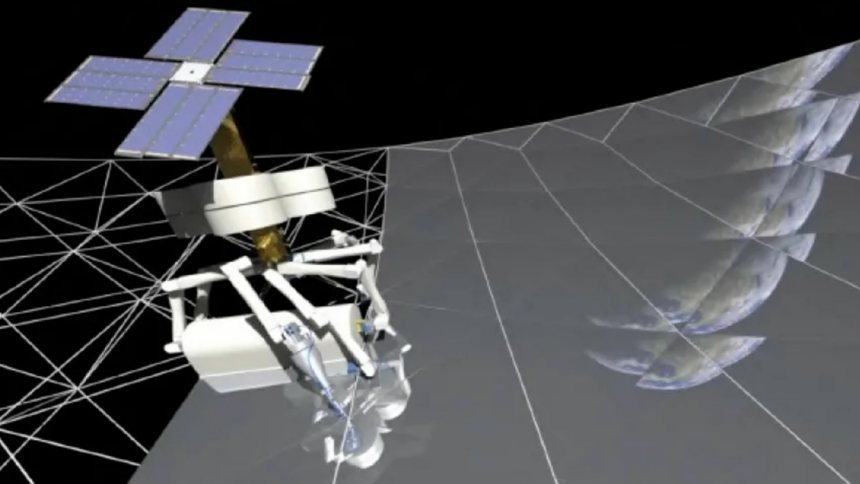
Chinese researcher are reportedly developing their own version of NASA’s “SpiderFab” orbital fabrication autonomous robot. Never tested in orbit, NASA’s robot could, in theory, perform tasks like weaving solar power stations and antennae in space from spools of carbon fiber.
The idea would be for robots like it to construct structures in low-to-zero gravity that are normally too large to carry as a payload in rockets or other spacecraft. Mothballed by NASA, researchers from Shenyang Institute of Automation in northern China believe the idea still has legs (no pun intended).
At present, any piece of kit sent to space needs to be built on Earth and designed in such a way that it can fold neatly inside a spacecraft. This then needs to be launched into space and then unfolded or deployed in space.
While this has proved very effective, it does introduce a hard ceiling on what can actually be sent to space. Things like an object’s size and weight must meet certain criteria, and they must also be designed to be robust enough to survive the violence of a rocket launch.
But concepts like SpiderFab could, in theory, completely change all that. Instead of launching stuff into orbit, robots like it could make things in space from raw materials, like carbon fiber spools.
Similar to how spiders spin webs on Earth, such robots could effectively 3D-print structures in space. This would, in theory, mean there would be no real limit to what they could create, so long as they have enough printing material available.
So, things like a kilometer-wide antenna or enormous solar arrays should be well within the realm of possibility.
Picking up the baton, the Chinese team reports they have managed to solve two major problems NASA faced with their attempt.
Their robot, the team reports, uses carbon-fiber composites rather than just “pure” carbon fiber. This, they say, can be shaped in long hollow tubes which are extremely strong and very light, making them ideal for space-based structures.
Any structures “printed” in space can be connected without the need for bolts or glue, too. According to the team, structures can be designed in such a way that they have in-built 3D-printed joints.
When paired together, component parts can then be laser-bonded to effectively “weld” or fuse them. This, they say, results in much stronger connections, cleaner assemblies, and better automation-friendliness.
The robot is still in research and development on Earth right now, with proof-of-concept tests proving quite promising. To date, the team has used its design to build a scaled-down antenna structure under laboratory conditions.
Going forward, the team now needs to overcome other major challenges, like refining autonomous robotic assembly in microgravity. To make it practical, they will also need to solve for precision alignment over large distances and long-term durability in radiation and other conditions.
“Building structures in orbit removes the need to fold them into rockets or worry about size limits. Parts can be made, joined, and assembled directly in space – potentially a core technology for next-generation space systems,” the institute said, the South China Morning Post (SCMP) reports.
Christopher graduated from Cardiff University in 2004 with a Masters Degree in Geology. Since then, he has worked exclusively within the Built Environment, Occupational Health and Safety and Environmental Consultancy industries. He is a qualified and accredited Energy Consultant, Green Deal Assessor and Practitioner member of IEMA. Chris’s main interests range from Science and Engineering, Military and Ancient History to Politics and Philosophy.
Premium
Follow