




Audioguides at institutions can be hit or miss. They can be plodding, patronizing or somehow make the material before you dull. I would recommend the one narrated by John Stamos at Graceland, though it is mandatory, and the one at the Neue Galerie in New York. The voice for the tour of the latter collection of pre-1945 art from Germany and Austria is none other than that of Ronald Lauder, the man who collected it. As he says on the tour, he has three levels of art that he likes: “oh,” “oh my” and “oh my god.” He only collects the last one.
Thank you for signing up!
By clicking submit, you agree to our <a href="http://observermedia.com/terms">terms of service</a> and acknowledge we may use your information to send you emails, product samples, and promotions on this website and other properties. You can opt out anytime.
There was a lot to be impressed with coming out of the region in that period, which is the subject of “Modern Art and Politics in Germany 1910-1945: Masterworks from the Neue Nationalgalerie, Berlin,” a new exhibition at the Minneapolis Institute of Art. The show brings together over 70 paintings and sculptures from the collection of the national museum of 20th-century modern art and places a special emphasis on the interplay between art and politics during these difficult decades in Germany. And there’s still plenty of “oh my god” to enjoy if you’re a bit tired of the recent vogue for political interpretations of art.
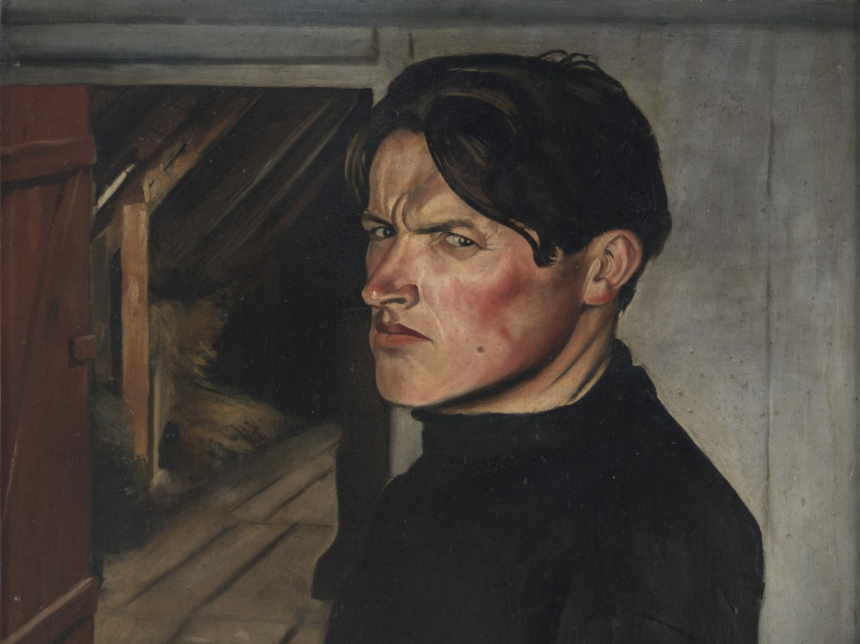
Take Curt Querner’s Self-Portrait with Stinging Nettle (1933), in which the scowling painter holds the toxic plant between two pinched fingers. Sure, there’s an easy analogy there for the threat of National Socialism. Querner was a dedicated Communist responding to a Party meeting in a bowling alley in Dresden, on January 25, 1933, that had ended in a shootout with police, leaving nine of his comrades dead and 11 seriously injured. But it would be a mistake not to admire the painterly aspects of this work. Querner was a student of the great Otto Dix and this work shares his talent for strange yet deeply empathetic facial expressions. His hands are in an odd but defiant position and his clothes may not fit but there’s no doubt how he’s feeling. Behind him the door opens onto an attic—in fact the attic of his parents’ house in the village of Börnchen, where the picture was painted—as vague as his look is sharp, contributing to the precise dread of the New Objectivity movement.
George Grosz was an artist who hopped around styles, including New Objectivity, and his Pillars of Society (1926) is a great example of this sampling. The title is borrowed from Henrik Ibsen’s 1877 play and deeply ironic, with all of liberal Weimar gathered at a bar to vent their multifarious frustrations. At the front sits an earless judge clutching a beer, his head sliced open to reveal sketchy, surreal fantasies of his cavalry days. Behind him a bar-room crony with a dueling scar and a swastika on his tie rides shotgun. Nearby the press baron—bearing the features of newspaper czar Alfred Hugenberg—wears a chamber pot for a hat and offers a palm of peace stained with blood, while a parliamentarian’s brain literally steams from his exposed skull. Bringing up the rear, a military chaplain preaches with outstretched arms above the cartoonish atrocities of the Reichswehr. What unites them is bloodlust, which in moments like our current one can feel monolithic. Grosz gives their unique motivations a horrible texture.
Reaching back even further it’s easier to admire the paint rather than the politics. Max Pechstein’s Seated Girl (1910) shows a woman with a come hither look and an extruding bottom that borrows much from Henri Matisse and Paul Gauguin but adds a German feel to the style four decades before the painter’s country would try to conquer France for the second time. Her skin offers more color texture than the other masters would have used, and it is a less intellectual portrait. She may be a prostitute, but her intense makeup blends with her face in a way that seems to ask if the border between real and imagined is necessary—which is just as well, given that Pechstein built this seductive adult figure on sketches of a nine-year-old neighborhood girl named Fränzi Fehrmann, then posing for several of the Brücke painters. The fiction on the canvas is the fiction; the studio facts are uglier and have generated their own debate since Fehrmann was identified in the 1990s. The catalogue notes that the painting was later featured in a collage equating Expressionism with Communism by the Nazi theorist Wolfgang Willrich, in his 1937 book Säuberung des Kunsttempels (Purge of the Temple of Art). This time period has much to teach us, especially when it comes to the nefarious mingling of art and politics.
“Modern Art and Politics in Germany 1910-1945: Masterworks from the Neue Nationalgalerie, Berlin” is on view at the Minneapolis Institute of Art through July 19, 2026.
We get it: you like to have control of your own internet experience.
But advertising revenue helps support our journalism.
To read our full stories, please turn off your ad blocker.
We’d really appreciate it.
Below are steps you can take in order to whitelist Observer.com on your browser:
Click the AdBlock button on your browser and select Don’t run on pages on this domain.
Click the AdBlock Plus button on your browser and select Enabled on this site.
Click the AdBlock Plus button on your browser and select Disable on Observer.com.



