


By Jen Rice
As Virginians prepare to head to the polls on April 21 and vote on Virginia Democrats’ redistricting proposal, the Republican National Committee (RNC) has filed a lawsuit challenging voter identification in Fairfax County, a Democratic stronghold with a large immigrant population in the suburbs of Washington, D.C.
The suit, which was submitted Friday, alleges that the county’s election procedures don’t explicitly require officials to challenge the eligibility of voters who present a Driver Privilege Card (DPC), a form of ID used by noncitizens.
The issue at the center of the suit is relatively minor: Fairfax County law already requires voters using a DPC to vote to present another form of identification confirming their eligibility.
But the timing — just days before Virginians head the polls — emphasizes the special election’s high stakes. If the redistricting proposal passes, Democrats could gain up to four more seats in Congress and counteract Republicans’ redistricting gains in other states.
Join 350,000 readers who rely on our daily and weekly newsletters for the latest in voting, elections and democracy.
The RNC is asking the Circuit Court of Fairfax County to block the county from using its current DPC policy. Two plaintiffs in the case are Republican members of Congress whose district maps could be impacted by the redistricting election.
Republicans are claiming the county’s “loophole” is being used “to allow unqualified, non-citizen individuals to vote in elections,” according to the court filing. Though the RNC filed the lawsuit just before election day, the state has been issuing this form of ID for five years.
In a statement posted to social media Saturday, the RNC said it “will NOT allow non-citizens to vote in Virginia’s referendum election.”
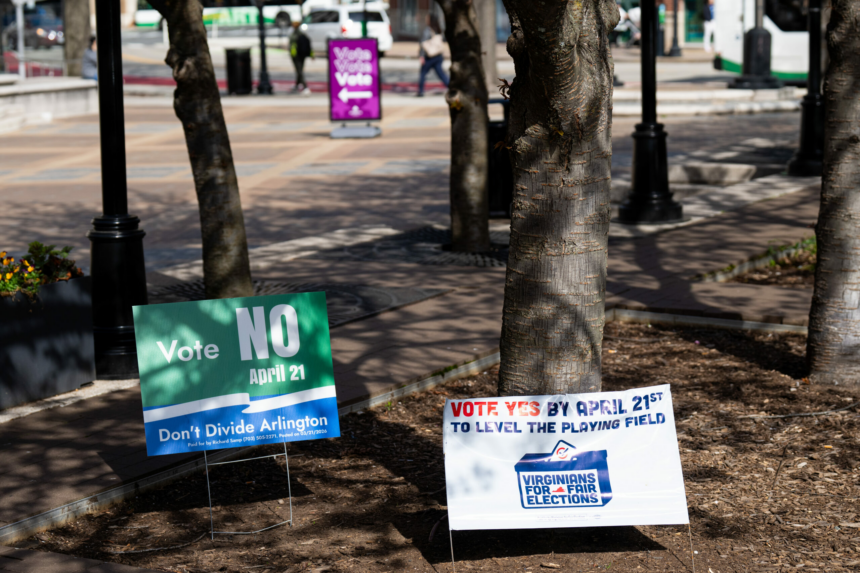
Nearly one year into President Donald Trump’s unprecedented mid-decade redistricting battle, the Tuesday special election will allow Virginia voters to decide how their state responds to GOP gerrymanders in Texas, Missouri, North Carolina and — if Gov. Ron DeSantis (R) gets his way next week — Florida.
So far, more than 1.3 million voters have already cast ballots during early voting, which began March 6.
A narrow majority of Virginia voters said they supported the redistricting plan, according to poll results released earlier this month from the Washington Post and George Mason University’s Schar School of Policy and Government.
“This is really a national fight,” Eric Holder, chairman of the National Democratic Redistricting Committee, told CBS News on Sunday. “It’s not a fight only about Virginia. And when the president told Gov. (Greg) Abbott in Texas, ‘I need five additional seats in the House of Representatives,’ there had to be a response to that.”
Unlike in Republican-controlled states, Democrats in both California and Virginia are required by law to put their redistricting plans to a statewide vote.
In November, California voters responded to the Texas gerrymander by approving a new map to counter the GOP’s potential gains in the Lone Star State. Now, a similar proposal is in the hands of Virginia voters.
“The people have the ability to make this decision in Virginia, as they did in California,” Holder said, “as opposed to it being imposed upon them in Texas and in Missouri and in North Carolina, which proved to be wildly unpopular, but Republican politicians ignored the will of the people in those states.”
Ultimately, Holder said, the long-term solution to end the battle is up to Congress, which has the power to pass a federal ban on gerrymandering.
The Virginia ballot measure would make only temporary changes to the state’s redistricting process, returning to normal procedures for 2030.
Republicans have filed numerous lawsuits aimed at stopping the Virginia redistricting vote, much like they did in California. The Virginia Supreme Court ruled twice that the election can proceed while litigation remains pending.
But even if voters approve the measure, the plan will still need to survive legal challenges.
“They’re basically acknowledging they got nothing,” one elections expert said. “It’s going to be used for propaganda and PR. And DOJ’s law enforcement powers aren’t supposed to be used for propaganda and PR.”
We depend on your support to keep bringing you the latest information and insight on the fight for democracy – always free and available for all. After all, we can’t fight for the future of our democracy unless we know what’s happening.
Democracy Docket is the leading digital news platform dedicated to information, analysis and opinion about voting rights and elections in the courts.
© Democracy Docket, LLC 2026