Facing the Future: Workforce & Apprenticeship Solutions
Tony Lydon, Guest Commentary//April 17, 2026//
Arizona’s next economic chapter depends on moving what we build
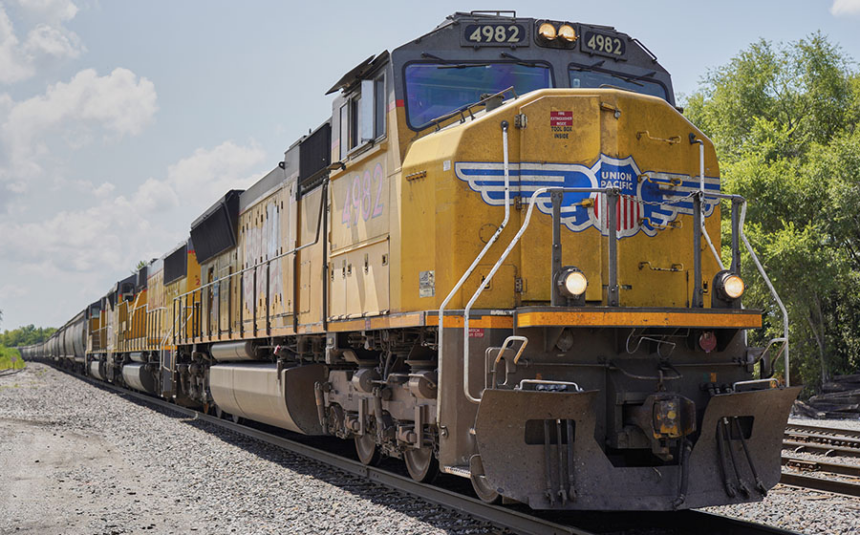
A Union Pacific train travels through Union, Neb., July 31, 2018. (AP Photo/Nati Harnik)
Tony Lydon, Guest Commentary//April 17, 2026//
For more than three decades working in industrial real estate and supply chain logistics, I have seen one principle hold true in every successful market: strong economies are built on the ability to move goods efficiently.
That sounds simple. It is not.
Every product we rely on — building materials for homes, components for advanced manufacturing, goods on store shelves — depends on a system that works quietly in the background. When that system is strong, growth follows. When it is strained, everything becomes more expensive, less reliable and harder to sustain.
Arizona is approaching that inflection point.
Our state has spent decades making deliberate decisions to build a competitive economy. We have invested in higher education and embraced pro-growth policies. Arizona now competes nationally for advanced manufacturing, logistics and investment.
But success creates pressure.
Today, metro Phoenix has become a major hub for manufacturing and distribution in the western United States. Companies that once clustered in California are expanding here. Supply chains increasingly run through Arizona. That growth is not theoretical; it is already happening.
And it is placing strain on how we move freight.
We can debate individual projects. We can discuss location and community impacts. Those are fair conversations. But Arizona’s logistics network is running nearly at capacity.
Standing still carries real consequences for a growing state like ours.
If freight demand accelerates without corresponding investment in infrastructure, the consequences are predictable. More trucks on already burdened highways. Higher transportation costs embedded in housing and groceries. And a gradual erosion of the advantages that have made Arizona competitive.
That is the context in which projects like BNSF’s Logistics Park Phoenix in the West Valley should be evaluated.
From a supply chain perspective, facilities of this scale are foundational. They connect regions to national and global trade networks and give manufacturers confidence that goods can move reliably and cost-effectively.
There is a reason similar facilities in places like Chicago, Kansas City, and Dallas-Fort Worth have attracted billions in investment. They expand capacity, improve efficiency and signal that a region is serious about competing.
Arizona now has a similar opportunity – one equivalent to the economic impact of seven Super Bowls annually.
That does not mean concerns about traffic, infrastructure or community impact should be dismissed. Large-scale projects require planning, transparency and enforceable commitments.
Success depends on getting those details right, particularly around roads, utilities and the impacts on surrounding communities. But those are challenges to solve, not reasons to stand still.
Throughout my career, I have worked with companies making location decisions across North America. One factor consistently rises to the top: confidence in infrastructure. If a region fails to show it can move goods efficiently today and into the future, it becomes harder to attract employers that create high-quality jobs and sustained growth.
Regions that recognize the importance of opportunities like this benefit for generations. Those that hesitate often find themselves trying to catch up.
The conversation in the West Valley should not be framed as growth versus no growth. Arizona will continue to grow. Goods will continue to move. The real choice is whether our growth is supported by modern, efficient infrastructure or constrained by a system which cannot meet demand.
From where I sit, the path forward is clear.
If Arizona intends to remain competitive and continue attracting investment, we need to ensure our logistics infrastructure keeps pace with our ambitions.
That is not about one company or one project. It is about whether we are prepared to build the next chapter of Arizona’s economy or allow it to be defined by the limits of yesterday’s infrastructure.
Tony Lydon has spent more than 30 years advising industrial users, developers, and investors on supply chain strategy and logistics-driven economic growth.
Share this!
Ali Fakih Phoenix had an estimated[…]
April 17, 2026
Adam Trenk A.R.S. § 41-[…]
April 15, 2026
Ian Kingsbury School “accountabi[…]
April 15, 2026
Nicole Newhouse Arizona’s housing […]
April 10, 2026
Amanda Ormond Arizonans should be […]
April 8, 2026
Michael Barrio Arizona hits triple[…]
April 7, 2026
Get our free e-alerts & breaking news notifications!
Essential news and information about Arizona government, policy and politics.
Get our free e-alerts & breaking news notifications!
You don't have credit card details available. You will be redirected to update payment method page. Click OK to continue.