




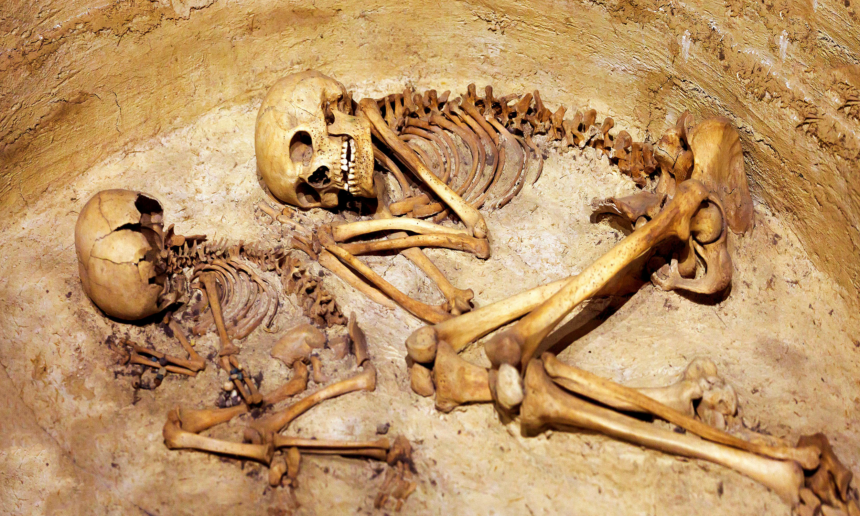
Researchers have found that people buried beneath the same home 8,000 years ago were often not close biological relatives.
That result recasts one of archaeology’s oldest assumptions and points to family ties built through daily life as much as descent.
At Catalhoyuk, in central Turkiye, graves beneath house floors placed the dead inside the household rather than beyond it.
Working from those burials, Sabina Cvecek at the Field Museum entered a long-running debate by showing that shared domestic space did not reliably mark biological family.
What looked like a single bloodline inside one house instead held a more complicated social world, where belonging could outlast or bypass descent.
Once burial place and ancestry stopped aligning cleanly, the larger question was no longer who lived together, but what made them kin.
Recovering ancient DNA, genetic material preserved in old remains, lets researchers estimate who shared parents, children, or more distant ancestry.
Because the petrous bone, a dense bone around the inner ear, often protects fragments better, it became a favored sampling target.
Even then, the result comes back in broken pieces, so researchers infer biological relatedness from fragments rather than a clean record.
That method can sketch a family line, but it cannot reveal adoption, obligation, caregiving, or the quiet labor of belonging.
A 2021 study examined 59 ancient genomes from early farming communities in what is now Turkey, including 22 newly sampled people from sites such as Asikli Hoyuk, an early settlement in central Turkey, and Catalhoyuk.
Genetic ties among people buried together were especially low at Catalhoyuk, where many co-burials lacked close relations.
Those results undercut the easy equation between household space and biological family, even when graves sat under the same floor.
For archaeologists, that meant a buried neighbor or child might have belonged through daily life instead of descent.
Archaeologists use kinship, the social rules of who counts as family, to name bonds built through care, residence, and obligation.
“Even in prehistory, kinship was more than just blood relations,” said Cvecek. Her view fits households where unrelated people shared work, food, and child care strongly enough to be buried as insiders.
That interpretation also pulls family away from a single biological test and toward the social acts that made survival possible.
A 2025 paper expanded the picture with 131 ancient genomes from Catalhoyuk, covering about 1,000 years of burials.
Early on, close relatives often shared buildings, but that pattern thinned over time as unrelated co-burials became more common.
Across that long span, researchers estimated that female offspring stayed linked to buildings 70 to 100% of the time.
Those numbers suggest households were not static units, and some lines of belonging endured more strongly than others.
Earlier evidence had already hinted that house burials were more socially mixed than their arrangement first suggested.
A 2019 study found no clear maternal kinship among ten people buried under neighboring Catalhoyuk floors.
Because mitochondrial DNA, DNA usually passed through mothers, tracks only one line, that result did not settle every relationship.
Still, that result pushed the same message forward: burial under one roof did not automatically mean one bloodline.
Modern readers often treat family as a matter of blood, marriage, and official paperwork, then project that model backward.
“We cannot have just one proxy for understanding family or kinship around the world,” Cvecek said.
Cvecek’s argument takes aim at archaeogenetics, research that combines archaeology with DNA evidence, when it treats descent as the whole story.
Once that bias is named, unrelated kin stop looking like anomalies and start looking like ordinary social life.
Pulling DNA from ancient bones is not a neutral act, because every sample comes from a once-living person and community.
Cvecek and her co-authors called for slower collaboration, better cross-training, and careful choices about which remains get sampled.
Bringing archaeologists, geneticists, and anthropologists together changes the questions themselves, because each field notices a different kind of evidence.
That broader design reduces the risk of mistaking a partial biological signal for a complete map of human relationships.
Across daily life, biology and family still pull apart in housing, insurance, schools, and child care.
Foster parents, step-relatives, godparents, neighbors, and close family friends often carry duties that genetics never records.
“The old saying, that it takes a village to raise a child, is true,” Cvecek said.
Ancient graves make that familiar truth harder to dismiss, because they show care and membership surviving where biology alone fails.
Seen across graves, genomes, and household space, the record suggests that ancient families were assembled through practice as well as descent.
Future work will be strongest when it joins DNA to burial context, household life, and ethical collaboration before drawing family lines.
The study is published in Cambridge Archaeological Journal.
—–
Like what you read? Subscribe to our newsletter for engaging articles, exclusive content, and the latest updates.
Check us out on EarthSnap, a free app brought to you by Eric Ralls and Earth.com.
—–
Analysis of ancient burials show that genetics did not define family 8,000 years ago – Earth.com



Leave a Comment

