


As an independent publication, we rely on contributions from readers like you to fund our journalism.
Sign up to our free newsletter to get the latest news delivered straight to your inbox.
Register today to stay up-to-date with the latest news.
Thank you for registering!
Cambridge Day
News | Features | Commentary | Calendar
If you frequent the Harvard Square T station, you may have seen sign boards urging you to “Swab your nose, get $2” in order to “Help detect the next pandemic.”
Those signs are part of a program called Zephyr, which began in 2024 to collect nasal swab samples every day from people around Cambridge and Boston. Those samples get put through a DNA sequencer to pick up the presence of any pathogens, especially ones that might spur the next pandemic.
Every morning, two or three field samplers gather at train stations across Cambridge and Boston armed with clean nasal swabs, hand sanitizer and two-dollar bills, inviting busy commuters to donate a few seconds, and a few microbes, to science.
Many walk past avoiding eye contact or ask questions but choose not to swab their nose. What exactly happens when people stop to oblige?
“I believe in science!” announced one anonymous donor at the Harvard Square station, as she twirled a nasal swab, identical to the ones used for COVID-19 tests, around both her nostrils and placed the swab into the collection tube. Once 30 swabs are collected, the tube gets placed into a biosafe bag and replaced with a fresh one.
On any given day, samplers collect anywhere from 80 to 250 such swabs and have collected over 16,000 samples since the beginning of the program. After their usual 9:30 a.m. to 3:00 p.m. collection day, the container is rushed to the lab on Kneeland Street in Chinatown — on foot, by bike or by taxi. Public transport is off-limits for the transport of infectious disease material. Speed matters, explained the team, because the viral genomic material collected is not very stable. On this particular day, the samples were being transported by taxi.
Once in the lab, the first step is stripping out as much identifiable human information as possible that can be found within our DNA, both to keep the samples anonymous and to isolate the pathogens to be studied. Zephyr’s method looks not only for various COVID variants, but also influenza, respiratory syncytial virus and even rarer pathogens like Hepatitis D.
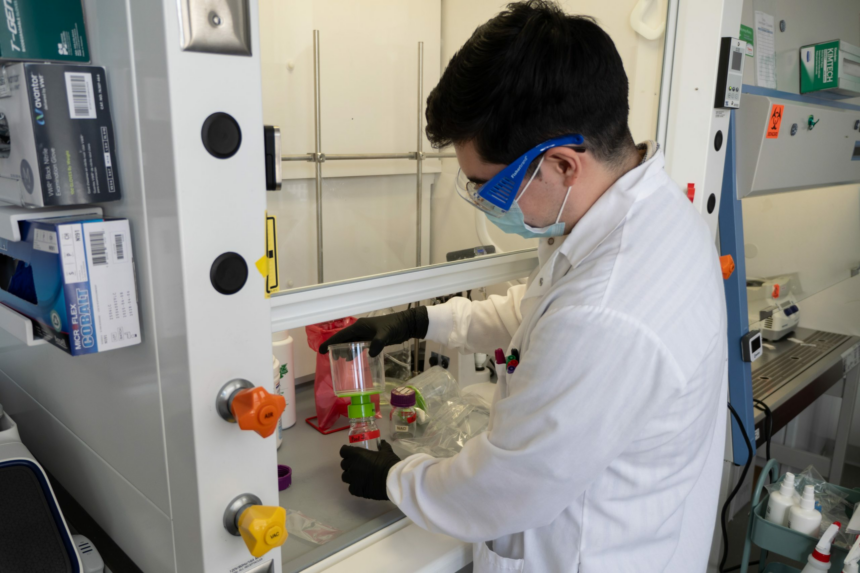
To separate human and viral material, a lab technician works to shake the swabs around in two machines: first a vortex mixer and then a centrifuge. These machines vigorously shake the swabs to first separate the microbes from the swab into a solution, and then to separate heavier pieces like human cells, skin or dirt. This heavier material is shaken into a small pellet and discarded.
What remains — viral genomic material suspended in a solution that prevents them from disintegrating — is then concentrated down through filters to get a small sample that can be studied more closely: like buying a large coffee but concentrating it back into espresso by evaporating away the water.
The whole process takes under two hours, and purified samples can be stored at -80 Celsius until sequencing begins. Sequencing itself takes around 72 hours and produces a detailed picture of the viruses circulating around Cambridge and Boston.
“We noticed that in the winter, there was an increase of COVID and Flu A, which leads to suggest that COVID is probably going to be something seasonal, not an outbreak like it was in 2020,” said Tanya Gonzalez, a Cambridge resident who works as a field sampler and lab technician for Zephyr.
The lab currently employs around 50 people and is preparing to move to First Street in Kendall Square this spring. Zephyr also has plans to expand elsewhere in Cambridge, including a new sampling site near the MIT campus and potential partnerships with private employers — including Google’s Cambridge office on Main Street — to expand swabbing beyond the public sphere.
“By making respiratory virus data public on our dashboard, we allow the community to make informed decisions about their own health and behaviors,” said Alessandro Zulli, the project’s lead research scientist. “As we expand our sampling locations in the Cambridge area, we’ll be able to provide more timely and actionable information for everyone.”
“Cambridge is the perfect place to be working in biosecurity,” Zulli continued. Eventually, the team hopes to bring Zephyr to cities like New York and Los Angeles.
Once the lab has a snapshot of the circulating viruses, Zephyr, part of the nonprofit SecureBio, then shares the data with health officials in the Boston area and the U.S. Centers for Disease Control and Prevention. Those officials then incorporate these local findings into their own infectious disease tracking methods.
Anna Kaplan, the director of epidemiology at the Cambridge Public Health Department, which does not work with the Zephyr project, said, “This seems like a very cool project, and looking at the collection locations you have throughout the city, probably gives a good sense of circulating disease in the region.”
While she said she could see checking this data periodically as part of a weekly surveillance data review because “more broad data collection is always better,” she also cautioned that any serious intervention based on anything revealed by the data would require regional or state level coordination of response. “It’s hard to imagine a response limited to the city level,” she said.
Still, plugging in with health officials is especially useful because the swab program also works in parallel with their wastewater disease tracking team, together forming one of the most comprehensive biosurveillance networks in the country. By comparing data collected from wastewater tracking, they can get a fuller picture of pathogens in circulation.
“Zephyr allows us to collect data on viruses that may not be shed into wastewater,” said Zulli. Viruses behind the common cold, for example, don’t easily shed in wastewater, he explained, “But we see them very regularly through swabs.”
Not everyone is thrilled about the swabs, however. Gonzalez says she has had passersby express concerns ranging from fears about DNA cloning to suspicions that the two-dollar payment is counterfeit money.
“A lot of older adults are very skeptical about it,” said Gonzalez, explaining that it’s likely a holdover of the misinformation that was rampant during the pandemic. But the work is still important, she said, as she prepared the lab space for the next days’ swab processing. “There’s so much stigma in science, especially in Hispanic, Black and low-income communities [that] creating that trust feels pretty good.”
As an independent publication, we rely on contributions from readers like you to fund our journalism.
Please consider making a financial contribution to maintain, expand and improve Cambridge Day.
We are now a 501(c)3 nonprofit and all donations are tax deductible.
Please consider a recurring contribution.
You must be logged in to post a comment.
A stronger Cambridge Day
Please consider making a financial contribution to maintain, expand and improve Cambridge Day.
We are now a 501(c)3 nonprofit and all donations are tax deductible.
Please consider a recurring contribution.
The street has been closed in West Cambridge between Lowell and Willard streets for the demolition of the Riverview condominiums since July 19, 2025. Spark Street will also reopen.
Somerville education consultant calls for a refresh in the Mass. education system.
The Cuban restaurant in Porter Square will feature Paul O’Connell’s cult classic before launching its own.
Cambridge News Inc. is a 501(c)3 not-for-profit organization dedicated to publishing fact-based news and information for Cambridge and Somerville.
Sign in by entering the code we sent to , or clicking the magic link in the email.
You must be logged in to post a comment.