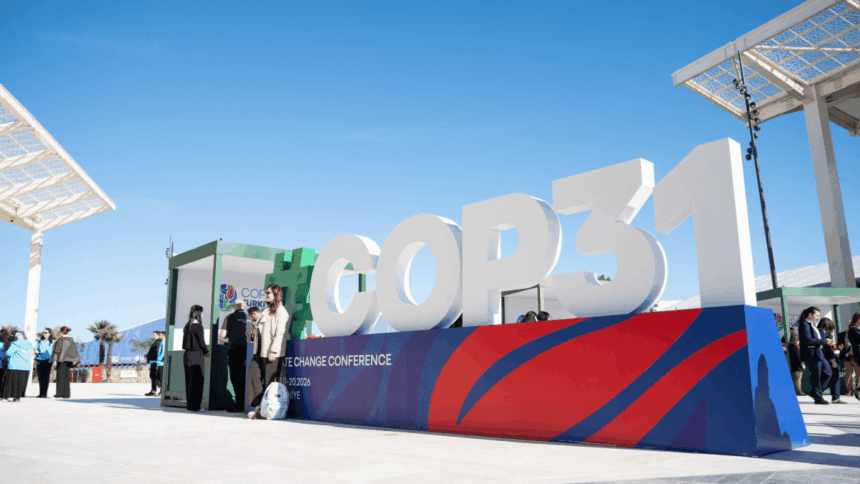
Participants arrive at the COP31 Blue Zone venue on the opening day of the United Nations Climate Change Conference, queuing to collect their accreditation passes and attending the opening ceremony, panel discussions, press conferences, workshops and other events in Antalya, Türkiye on November 9, 2026. Sandro Basili/Zuma
The world’s biggest climate conference kicked off today in Antalya, Turkey, a country known for growing political repression. Under an unusual compromise, Turkey is hosting, but Australia’s government will preside over negotiations among more than 190 nations seeking to address the climate crisis. And for the third year in a row, one problem underscores all the others: Why can’t anyone say “fossil fuels”?
For the next two weeks, delegates from all over the world—except, notably, the United States—will discuss their progress under the Paris Agreement, the international treaty they signed in 2015 (which Donald Trump has twice withdrawn the US from). Under that deal, countries committed to limiting global warming to well below 2 degrees Celsius above pre-industrial levels, and ideally to 1.5 degrees, by setting their own targets for cutting greenhouse gas emissions.
The timing couldn’t be more urgent. We’re in the middle of an El Niño season that has already smashed global temperature records and caused catastrophic flooding in Nepal. And last month, the United Nations warned that we’re on track to overshoot 1.5 degrees entirely. The urgency is real. So is the cynicism.
“UN climate summits have become all but synonymous with low expectations, long on rhetoric, short on action,” Covering Climate Now (CCN) reported, even though “an overwhelming majority of the world’s people, 80 to 89 percent of them, want their governments to ‘do more’ about the climate crisis.”
The annual Conference of the Parties, as COP is officially known, has been the backdrop to my entire life. I have vague middle-school memories of the 2009 Copenhagen summit, which ended in a weak, non-binding accord that left many observers deflated. As a college student in 2015, I remember the surge of possibility I felt when negotiators in Paris emerged with a deal described as “the best possible shot to save the one planet we’ve got.” As an adult, I joined the National Security Archive, where I interviewed dozens of former government officials, scientists, and advocates about all the ways we’ve gotten it wrong—and right—in our quest to save the planet.
Perhaps the most absurd part of this history is that for nearly 30 years—my entire life—international climate negotiations largely avoided naming the primary driver of the climate crisis: fossil fuels. It wasn’t until COP28 in Dubai in 2023 that a final agreement explicitly called for transitioning away from fossil fuels in energy systems, a step UN climate chief Simon Stiell called the “beginning of the end” of the fossil fuel era. But the deal crucially neglected to say how or when a phaseout would happen.
Last year was supposed to be different. Brazil hosted, which was a hopeful sign: In 1992, the United Nations Framework Convention on Climate Change was adopted at the Earth Summit in Rio de Janeiro, an inflection point that ushered in a new era of international cooperation on climate change. For the three years before that, the conference had been held in countries whose economies rely heavily on fossil fuels: Egypt, the United Arab Emirates, and Azerbaijan. But at COP30 in the Amazon city of Belém, delegates failed to make any new commitments on how they’d permanently ditch oil, gas, and coal.
It’s difficult to assess the long-term significance of any individual COP in its immediate aftermath. Copenhagen was considered a failure because negotiators failed to produce a global treaty to replace the 1997 Kyoto Protocol. But years later, observers credited it with having “killed off the top-down treaty-based approach” to climate change, as Joshua Busby, a public affairs professor and researcher at the Center for Climate & Security, pointed out in 2015.
In its place came the system of national pledges at the heart of the Paris Agreement. Those pledges, non-binding though they are, have had real impact. Renewable energy projects boomed. Energy demand growth slowed. Projected warming by the end of the century has dropped from about 3.6 degrees Celsius to 2.6 degrees.
Of course, 2.6 degrees Celsius is hardly a victory, and a gargantuan amount of work remains to avoid the most catastrophic climate scenarios, assuming all nations meaningfully pitch in. When President Trump refused to send a delegation to last year’s conference, former Secretary of State and Special Climate Envoy John Kerry told PBS that the absence of of leaders from the world’s second-biggest greenhouse gas emitter “defeats the fundamental purpose of these meetings” because “no one country can solve this problem by itself.”
Despite a handful of Democratic members of Congress attending this year’s summit, COP31 will be the second year in a row with a US delegation–sized hole in it. But plenty of other countries have woken up to the idea that we have to break up with fossil fuels, with over 60 nations coming together in April in Santa Marta, Colombia to discuss a fossil fuel phaseout outside formal COP negotiations.
A conference that fails to deliver the right language can still build momentum that changes what’s politically possible at the next one.
“We are a majority power that therefore can have confidence that we have a collective global community that really wants this to succeed, and that it isn’t too late,” Johan Rockström, director of the Potsdam Institute for Climate Impact Research, said at the close of an October webinar. “The window is still open, but rapidly shutting.”
Subscribe to the Mother Jones Daily to have our top stories delivered directly to your inbox.
By signing up, you agree to our privacy policy and terms of use, and to receive messages from Mother Jones and our partners.
This is the season for packed schedules and long to-do lists. For us too: Mother Jones reporters are busy digging deep into the next powerful investigations that we’ll be publishing here soon. So we’ll make this quick: We can’t do this work without your support.
We’re a nonprofit newsroom, which means articles like the one you just read are funded by readers, never by a corporate owner. And if you’ve read this far down the page, that means the story mattered to you. Help fund more of this essential work by making a donation of any amount today. It’ll only take a minute. Thanks in advance for powering the next story.
Rachel Santarsiero
Damian Carrington
Fred Pearce
Rebecca Leber
Madison Pauly
Satchel Walton
Anna Merlan
Rachel Santarsiero
Anna Merlan
Alex Nguyen
Anna Merlan
Kate Yoder
Subscribe to the Mother Jones Daily to have our top stories delivered directly to your inbox.
By signing up, you agree to our privacy policy and terms of use, and to receive messages from Mother Jones and our partners.
Save big on a full year of investigations, ideas, and insights.
Mother Jones has no billionaires calling the shots—just readers like you making fearless reporting possible
Inexpensive, too! Subscribe today and get a full year of Mother Jones for just $19.95.
Award-winning photojournalism.
Stunning video. Fearless conversations.
Subscribe to the Mother Jones Daily to have our top stories delivered directly to your inbox.
By signing up, you agree to our privacy policy and terms of use, and to receive messages from Mother Jones and our partners.
This site is protected by reCAPTCHA and the Google Privacy Policy and Terms of Service apply.
Copyright © 2026 Mother Jones and the Center for Investigative Reporting. All Rights Reserved.
And we respect that! But maybe you’d consider supporting our work directly? Help fund more journalism that seeks the truth and holds power to account. We can’t do it without you.
We noticed you have an ad blocker on. Can you pitch in a few bucks to help fund Mother Jones’ investigative journalism?
Nothing changes our mission here.
Uncertain times call for journalism you can rely on. We’re not swayed by predictions, and we don’t put our pens down when the results come in. Our mission is to seek the truth and share it with you. And no matter what happens next, that mission remains true: fearless, investigative journalism that doesn’t bend to the whims of those in power. Will you stand with us?
Sign up for the free Mother Jones Daily newsletter and follow the news that matters.