


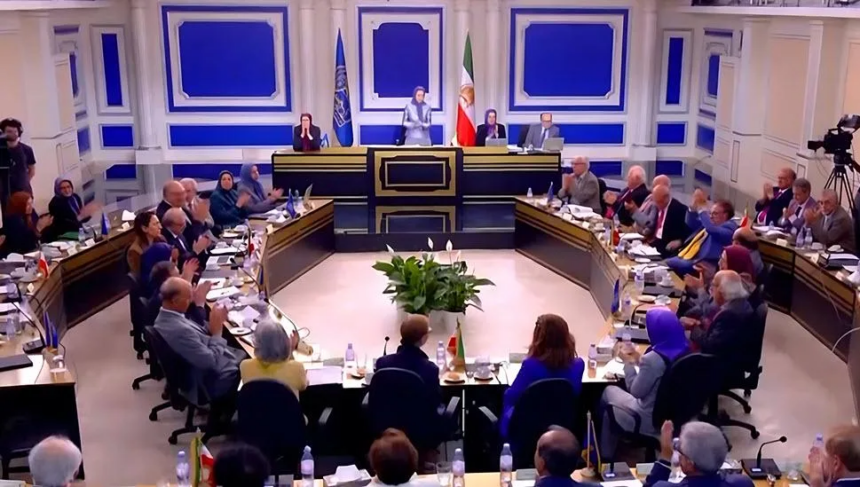
The National Council of Resistance of Iran (NCRI), Iran’s parliament-in-exile, has developed a framework for the transition from clerical rule to a democratic republic. At its center is a Provisional Government with a maximum six-month mandate to organize free elections and transfer political authority to representatives elected by the Iranian people.
The framework rests on a fundamental principle: the future of Iran must be determined by the Iranian people through universal suffrage, not by any individual, political organization, or foreign power.
As Maryam Rajavi, President-elect of the NCRI for the transitional period, emphasized in her June 2026 Free Iran Summit speech:
We do not seek power for ourselves. We seek to transfer sovereignty to the people of Iran.
The NCRI was established in Tehran on July 21, 1981, by Massoud Rajavi as a coalition of Iranian opposition forces committed to replacing the ruling dictatorship with a democratic political system.
In October 1981, the NCRI announced its plan for a provisional government. Its subsequent program, resolutions, and organizational structures established a framework for transferring sovereignty to the Iranian people.
On February 28, 2026, the NCRI formally announced the formation of a provisional government, reaffirming its commitment to a democratic republic based on Maryam Rajavi’s Ten-Point Plan.
This announcement is distinct from the commencement of governmental authority in Iran. Under the NCRI’s framework, the Provisional Government’s six-month mandate begins following the overthrow of the ruling regime and the establishment of the government on Iranian territory.
According to the NCRI’s adopted program, the Provisional Government’s primary mission is not to retain political power but to transfer sovereignty to elected representatives.
The transition follows four defined stages:
Maryam Rajavi outlined this sequence in her November 20, 2024, address to the European Parliament, emphasizing that the NCRI’s role concludes when political authority passes to the elected Assembly.
This process establishes a clear distinction between the initial six-month Provisional Government and the subsequent government chosen by the Constituent Assembly.
On October 22, 1993, the NCRI announced the election of Maryam Rajavi as its President-elect for the transitional period following the overthrow of the clerical regime.
Her mandate is to oversee the transfer of sovereignty to the Iranian people. This transitional presidency is distinct from the six-month tenure of the Provisional Government.
Under the NCRI’s adopted structure, Mrs. Rajavi’s presidential mandate concludes following the adoption of the new constitution and the election of a new president of Iran.
The arrangement is designed to provide continuity during the transition while ensuring that the future government and presidency derive their authority from democratic institutions and elections.
The NCRI’s transitional framework is supported by decades of political organization and institutional planning.
The Council has 25 committees that function as shadow ministries, conducting research and preparing policies for future governance. Its organizational structure includes committees responsible for areas such as foreign affairs, security, economic policy, and social affairs.
These preparations are intended to provide administrative and political capacity during the transition, address urgent national challenges, and help establish the conditions for democratic governance.
In her January 2026 discussion of Iran’s political future, Mrs. Rajavi emphasized the importance of having a political and executive framework prepared for the period following the regime’s overthrow.
The NCRI maintains that an organized democratic alternative is essential to prevent a political vacuum and ensure that the transition leads to representative government rather than another form of authoritarian rule.
The Provisional Government’s framework extends beyond the organization of elections. It includes previously adopted NCRI plans addressing fundamental rights and the principles of a democratic republic.
Among these are:
Together with Maryam Rajavi’s Ten-Point Plan, these policies define the NCRI’s proposed foundation for democratic governance, including political pluralism, separation of religion and state, gender equality, an independent judiciary, abolition of the death penalty, and a non-nuclear Iran.
In her March 5, 2026 address on the Provisional Government, Mrs. Rajavi specifically emphasized women’s equal participation in political leadership and the rights of Iran’s Baluch, Kurdish, Arab, and Turkmen communities.
The NCRI’s objective is a democratic republic that preserves Iran’s national unity while recognizing the rights and freedoms of all its citizens.
The NCRI rejects both a return to monarchical dictatorship and the continuation of clerical rule. It also opposes arrangements that would impose a new political leadership on Iran from outside the country.
In her speeches, including her 2026 Free Iran Summit address, Maryam Rajavi has emphasized that democratic change must be brought about by the Iranian people and their organized Resistance.
The Provisional Government is intended to provide the institutional framework through which that change can lead to popular sovereignty.
Its mission is to transfer power, not perpetuate its own authority. By organizing free elections within six months and handing responsibility to an elected Constituent Assembly, the NCRI’s framework establishes a defined path from dictatorship to representative government.
The ultimate authority to determine Iran’s political future, constitution, and elected leadership rests with the Iranian people.
The National Council of Resistance of Iran (NCRI) is a coalition advocating a democratic, secular republic in Iran. Maryam Rajavi, the NCRI’s President-elect for the transitional period, has outlined a Ten-Point Plan for a future democratic Iran. The People’s Mojahedin Organization of Iran (PMOI), also known as the Mujahedin-e Khalq (MEK), is the NCRI’s principal organized movement.
Disclaimer
These materials are being distributed by NCRI-US on behalf of the National Council of Resistance of Iran. Additional information is on file with the Department of Justice, Washington, DC.
Contact NCRI-US
National Council of Resistance of Iran
U.S. Representative Office
1747 Pennsylvania Ave. NW, Suite 1125
Washington, DC 20006
Phone No.: 202-747-7847
Email: info@ncrius.org
Copyright © 2026 National Council of Resistance of Iran – US Representative Office