




As inflation reaches a three-year high, many Oklahoma families are being forced to make tougher choices to keep up with rising costs, federal officials say.
And some Oklahomans may feel the pinch more than others.
Cortney Cowley, assistant vice president for the Federal Reserve Bank of Kansas City, said that Oklahoma’s wealthiest consumers are able to spend above that inflation rate; however, low- and middle-income individuals can’t meet that increase the same way.
“Anyone that’s in the 80th percentile or below, so typically low- and middle-income consumers especially, are really only increasing their spending in line with inflation,” Cowley said. “When we start to see higher inflation, that puts more pressure on them because they’re having to increase their spending and make decisions about it.”
Oftentimes, these decisions sound like choosing affordable alternatives for necessities or finding a way to do without.
For example, since gas cost a dollar more per gallon in March than a year ago, some consumers opted to spend less on groceries in order to cover fuel costs.
These decisions then create a pileup in industries across several markets.
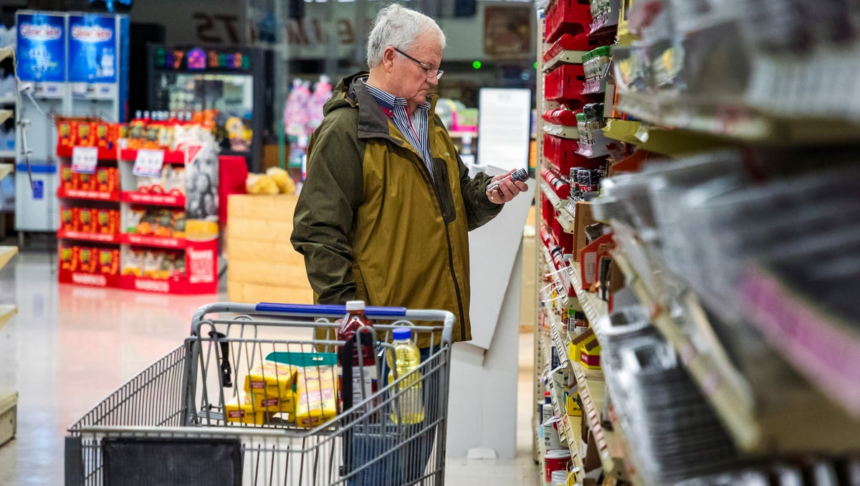
When visiting Crest or Walmart, middle-income individuals may choose the store-brand cleaner that costs less than the name-brand alternative, or they may buy nothing at all. Conversely, those with higher wages can afford any of the options on the shelf.
More: Are you worse off financially today? More Americans say yes. Here’s why
Cowley, who is also the Oklahoma City branch executive, said that this results in a “hollowing out” of products in the middle.
“We’re hearing that some consumers are trading down to lower-value products or less expensive products, but there’s also evidence that the wealthiest consumers are still spending at a pretty strong rate,” Cowley said.
Similarly, the Fed’s Beige Book, a somewhat monthly report from the Reserve, states that middle-income households in the 10th District were eating out less or spending less money when eating out.
Higher-income homes continued to remain consistent with their spending habits.
The prices are consistently being driven up by the current inflation rate, which is creeping up to 3.5%, according to Kansas City Federal Reserve President Jeffrey Schmid.
The Federal Reserve ultimately decided on June 17 that the benchmark inflation rate for the nation will remain at 3.5% to 3.7%. This decision is on the back of two important questions the Fed is attempting to answer:
Should the Fed wait and see if the financial climate changes? And how much of a lasting effect will the Iran War have on the economy?
“The big question now is, do we stay patient?” Schmid said at an economic forum in Oklahoma on June 5, Reuters reported. “Our inflation numbers have probably crept up into the three-and-a-half percent range, which nobody likes. Is it temporary…or do we act? Do we say, okay, now it’s time to raise rates a quarter or two and see if we can’t tamp this thing down?”
This decision, though, still does not change much of what consumers are seeing with stubborn inflation.
The Fed’s decision not to cut rates comes on the heels of ongoing tensions in Iran.
Gas and oil prices are dropping slowly since the U.S. and Iran entered a ceasefire; however, bond yields have barely budged.
This month, the United States and Iran agreed to a framework deal to end the monthslong war and reopen the Strait of Hormuz. But questions remain about whether the cost-of-living crisis could be resolved soon or by how much.
“How many times have we talked about a ceasefire? We have been here before and we’ve seen the same reactions time and time again,” said John Mousseau, chief investment officer for Cumberland Advisors, a subsidiary of Mid-Penn Bancorp, in an interview with USA TODAY. “If the war actually ends, then the follow-through should be lower oil prices, declining bond yields, and declining inflation – but that’s going to take time.”
Speaking before the ruling came in, Cowley said that June’s federal decision will be interesting to see if the Fed views the Iran War as a one-time shock to prices or if they see the inflation has staying power.
“Consumers might be expecting, for example, for prices to still be higher or inflation to be at the same rate next year, but what are they thinking about five years from now?” Cowley said. “Are they thinking that inflation is still going to be there, and it depends on how long this conflict persists, and that’s the big question that nobody really knows, so there’s a lot of uncertainty on the inflation side.”
Iran has already proven to be a large risk to the inflation rate and economy for customers, as gas prices soared in March following the start of the war and farmers saw a jump in prices with the closure of the Strait of Hormuz.
With the level rating, what can be understood from Federal Reserve Chair Kevin Warsh, consumers can expect price stability from the Fed.
“Persistently high prices are a burden for the American people,” Warsh said, “but the recent past need not be prologue. I am pleased to report that members of the FOMC are unambiguous and unanimous: This committee will deliver price stability.”
Contributing: Daniel de Visé, Andrea Riquier, USA TODAY
Who is inflation hurting the most? Fed data shows which Oklahoma populations hardest hit – The Oklahoman



Leave a Comment

