Download our app for the optimal streaming experience
Topline:
L.A. Co Health Department prepares: In Los Angeles, which is hosting eight games, risk-assessment teams will monitor the surroundings for chemical exposures and biological threats. In L.A., diminished federal assistance means the health department is counting on existing staff to do the extra work. “Most of our staff are not taking vacations during the month of the World Cup because they’ll need to work -– we’ll be obviously accruing overtime costs,” says Barbara Ferrer, the L.A. county health director.
Diminished federal presence: Ferrer hopes these events will help authorities see that public health is key to public safety — and worth investing in. On the federal level, the Centers for Disease Control and Prevention, which serves as the nation’s public health agency, has a muted presence this year. The current Trump administration has pushed thousands of workers out of the CDC workforce and tampered politically with some of its functions. Other governmental groups that would typically be involved, such as the National Security Council’s biosecurity group, the Office of Pandemic Preparedness and Response Policy, and the Assistant Secretary for Preparedness and Response, have been disbanded, left vacant or don’t have permanent .
Millions of people are about to pack stadiums across the U.S., Canada and Mexico for the World Cup, starting June 11.
Public health officials have been working to ensure the health and safety of the masses of fans they’re expecting at the 104 matches across 16 cities through mid-July.
In the U.S., World Cup preparations are coming in a time of a diminished federal health presence and funding. It’s upped the workload for host city health departments, as they’re also strapped for federal funding.
Nevertheless, World Cup host city health officials say they’re prepared for the many challenges that come with large-scale celebrations and gatherings.
“We’ve been focusing on expecting the expected” — issues related to weather, health and human behavior, says Dr. Marcus Plescia, district health director for Fulton County, Georgia, which includes Atlanta.
Planning for the event is ongoing, says Dr. Philip Huang, director of Dallas County Health and Human Services in Texas. “To be able to begin preparations a year out is a luxury for us, compared to a lot of the situations that we deal with,” he says.
For public health departments, the World Cup is a big deal –- but they’re well prepared for the biggest challenges.
Summer heat, for instance. “We call Atlanta ‘Hotlanta’ for a reason,” says Georgia’s Dr. Plescia, “It’s going to be hot and humid here -– so heat-related injuries are going to be an issue.”
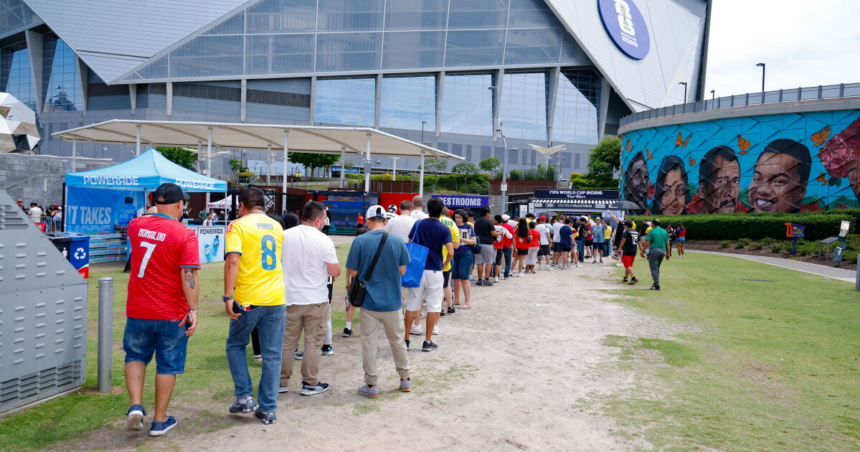
Atlanta is hosting eight World Cup matches and the team from Uzbekistan. At downtown Centennial Olympic Park, a month-long fan festival is expected to draw some 15,000 people a day. Cooling stations will offer air-conditioning and hydration.
Then there’s feeding the crowds. “The biggest lift for us and for all health departments is that our environmental health workers have to inspect all of the food vendors — and there will be a whole lot of food vendors,” Plescia says.
Inspectors will check every day to ensure the facilities are in working order and the food is safe to eat. “We want to make sure that people feel confident that they can go out to eat and have a good time –- and they don’t have to worry about getting food poisoning,” Plescia says.
When lots of people gather, germs tend to spread. “We’re worried about sexually transmitted infections because there’s going to be a lot of people here and it’s going to be a festive atmosphere,” Plescia says. “And then we’re worried about things maybe we wouldn’t have been worried about as much before, particularly measles.” Measles is highly contagious among those who haven’t been vaccinated, and there have been 30 U.S. outbreaks this year.
Dallas is hosting nine World Cup matches — the most of any city. The health department is stepping up disease surveillance in wastewater, expanding sites and covering more area, says Dr. Huang, the county health authority. Beyond looking for typical threats like influenza and COVID, they’re also testing for “whatever might appear” through genomic sequencing, he says.
They’re also broadening mosquito surveillance –- setting insect traps and testing for pathogens they can spread. “We always test for West Nile virus,” Huang says, “But we’re also increasing our testing for dengue, chikungunya and Zika because of all the [incoming] international travel.”
Medical staff are also looking out for symptoms of Ebola or hantavirus, due to outbreaks.
Keeping track of which diseases are circulating means they’ll be able to alert hospitals and the public quickly if they see a spike. “It’s a lot of things we normally do but certainly more enhanced,” Huang says.
They’re also preparing health tips for the public in different languages: Wear a hat and sunscreen and hydrate when it’s hot out. Bug spray and long sleeves help prevent mosquito bites. Stay home if you’re sick. “It’s the same messages [we always share], but it’s really concentrated because we’ve got so many people coming during a hot period of time in Dallas,” Huang says.
The World Cup finals are jointly hosted by New York and New Jersey on July 19.
Officials have been running practice simulations to prepare for outbreaks and mass casualty events. “We plan for the worst case scenario and go through it before it actually happens,” says Dr. Alister Martin, New York City’s health commissioner.
They’ve also set up “incident command” to “divert resources from normal stuff so that we can manage any potential emergencies,” Martin says, adding that the operation will continue through much of the summer, for other big events planned in New York, including America’s 250th anniversary, Pride month and the Puerto Rican Day parade.
In Los Angeles, which is hosting eight games, including the U.S. opening match versus Paraguay, risk-assessment teams will monitor the surroundings for chemical exposures and biological threats.
In L.A., diminished federal assistance means the health department is counting on existing staff to do the extra work. “Most of our staff are not taking vacations during the month of the World Cup because they’ll need to work -– we’ll be obviously accruing overtime costs,” says Barbara Ferrer, the L.A. county health director.
And much of their regular work, like routine food inspections, gets put aside. “I know it would be easier if we weren’t in a resource constrained environment,” Ferrer says. “But I want to provide assurance that even in a resource constrained environment, we’re well prepared.”
Ferrer says they’ve successfully planned and managed other events of national significance, like the 2022 Super Bowl. “This work isn’t new to us,” she says, adding that staff are making great efforts “to make sure this is a joyous time in L.A. county and [that] we’re all safe.”
This year’s experience will better prepare Los Angeles to host other events, she says — like the 2027 Super Bowl and the 2028 Summer Olympics.
Ferrer hopes these events will help authorities see that public health is key to public safety — and worth investing in.
On the federal level, the Centers for Disease Control and Prevention, which serves as the nation’s public health agency, has a muted presence this year.
“Usually, the CDC is a visible lead when we have international events in the United States, particularly across the country, versus just in a single state,” says Dr. Debra Houry, former chief medical officer for the CDC who resigned last year.
The current Trump administration has pushed thousands of workers out of the CDC workforce and tampered politically with some of its functions, such as setting vaccine policy and publishing scientific papers. The agency’s scientists rarely speak directly with the public anymore; their messages are filtered through politically appointed leadership.
Other governmental groups that would typically be involved, such as the National Security Council’s biosecurity group, the Office of Pandemic Preparedness and Response Policy, and the Assistant Secretary for Preparedness and Response, have been disbanded, left vacant or don’t have permanent leaders, Houry says.
The diminished federal presence serves as the backdrop for the World Cup.
Emily Hilliard, press secretary for the Department of Health and Human Services which oversees the CDC and ASPR, wrote in an email response to NPR: “HHS and the Centers for Disease Control and Prevention (CDC) are actively coordinating with state, local, and global partners to ensure public health and safety during FIFA World Cup 2026 and enhance any measures, as needed.”
Localities have found that the federal presence is late in coming, and not as coordinated as it may have been in the past, says Lori Freeman, CEO for the National Association of County and City Health Officials, which represents health departments.
Freeman says the CDC started holding coordination calls and issuing some guidance a few months ago –- long after host cities started their own preparations. She notes: “When it comes to merging public health, emergency response and preparedness, that is an area we worry constantly about because the federal government is the agency that must manage across state jurisdictions between and among states.”
Some have stepped up to fill perceived gaps. For instance, Georgetown University has set up a Health Security Operations Center to track infectious diseases and send out daily reports, to inform places expecting an influx of travelers throughout the World Cup.
Copyright 2026 NPR
Topline:
The backstory: Once a year, dozens of sound artists converge on the hill with views of the harbor below to perform their audio art, which can range from serene to “beautifully weird.”
What to expect: This year includes a performer bending a bar of tin with his bare hands to get it to emit what’s called a “tin cry” and synthesizer-based soundscapes that take inspiration from both the ocean and the industrial space below.
When to go: Soundpedro is free and lasts from 7-10 p.m. Saturday.
More info at the Soundpedro website.
Topline:
The backstory: Once a year, dozens of sound artists converge on the hill with views of the harbor below to perform their audio art, which can range from serene to “beautifully weird.”
What to expect: This year includes a performer bending a bar of tin with his bare hands to get it to emit what’s called a “tin cry” and synthesizer-based soundscapes that take inspiration from both the ocean and the industrial space below.
When to go: Soundpedro is free and lasts from 7-10 p.m. Saturday.
More info at the Soundpedro website.
Topline:
Why it matters: The 1939 building mixes art deco and Spanish colonial in a Mission Moderne style and earned a spot in the National Register of Historic Places.
The backstory: It’s called Union Station because when it opened in 1939, it joined the Southern Pacific and Union Pacific railroads with the Atchison, Topeka and Santa Fe railway.
The displacement: A thriving Chinese American neighborhood was destroyed to make way for Union Station’s construction. The tour explores this history through an art piece titled include “City of Dreams/River of History,” created by artists May Sun and Richard Wyatt in 1995.
Coming up: Union Station is the site of an official FIFA-sponsored Fan Zone from June 25-28 as the transportation hub becomes a World Cup soccer hub.
Go deeper: The controversy behind Union Station’s construction
You may know about Union Station as an L.A. landmark or as a transportation hub — but how much do you know about its rich architectural history?
To foster that interest and knowledge, Metro created a series of public tours of the station this spring.
“There’s so much that you might just walk by without really having the opportunity to delve deeply into,” said Zipporah Lax Yamamoto, deputy executive officer of Metro’s art program. “[The tours are] a really wonderful opportunity to be able to spend time with the station, learn more about the historic landmark, which belongs to all of us.”
It’s called Union Station because when it opened in 1939, it connected the Southern Pacific and Union Pacific railroads with the Atchison, Topeka and Santa Fe railway.
While it was designed by father-and-son team Donald and John Parkinson, the architects who gave us L.A. City Hall, its style is very different. Union Station’s interior and exterior mixes art deco, Spanish colonial and other styles into a hybrid dubbed Mission Moderne.
As you begin the tour, entering from Alameda Street, tour guides ask you to look up at the decorative elements in the high ceilings. The beams and geometric patterns may look like wood — but they’re actually just painted to look that way.
Along the way, the tour gives background on pieces created more than 30 years ago. These include “City of Dreams/River of History” by artists May Sun and Richard Wyatt in 1995. Sun’s piece uses remnants of the Chinese American homes torn down to build the station, a reference to the high price that community paid for this building’s construction.
“It was an enormous price. Chinatown ceased to exist in this area. … The families that lived here during that time are still around and maintain archives of that time period and the original Chinatown here, and we’ve worked with those families to have those objects on display,” Lax Yamamoto said.
Meanwhile, Wyatt’s large-scale mural includes the face of a Chinese man, along with nine other people of different races, ethnicities and ages; a nod to the diversity of the city since its founding in the late 1700s.
There are also stops to see new art installed for the World Cup.
There are three tours left in the series but the RSVPs have reached their maximum; however, Lax Yamamoto said Metro will decide whether to continue them based on what people have thought about the tours.
Meanwhile, Union Station is set to swell with people in the next couple of months as L.A. hosts World Cup games. The station is the site of an official FIFA-sponsored Fan Zone from June 25-28.
Topline:
Why now: As all eyes look to the Americas, English fans are beginning another bruising round of matches. Could this year be the one that brings the trophy home?
Why it matters: Because Levy would like England to win the cup just once before her time on Earth expires. Just once.
When I first came to the states many years ago, if I’d mentioned Arsenal, people would have thought I was referring to the U.S. military or something. But all that has changed. You can now watch U.K. premier league games in sports bars, most kids play soccer, and Ted Lasso is must-watch TV.
To which I say — welcome. We English are proud of the fact that soccer began with us more than 150 years ago. And every World Cup, we think, surely this will be the year that the trophy returns home — the year that we’ll win!
I mean it did happen … once… back in 1966. It’s such a long time ago the game was televised in black and white and shillings were still being used. My mother was nine months pregnant with my brother, and got so excited jumping up and down she went into labor and had him the next day. World Cup Willie they called him. Actually his name is David, but never mind.
Since then, every four years everyone in the U.K. watches the games with bated breath. And then something stupid will happen, and we’ll lose, like that time in 1998 when David Beckham (who played for England before he came to L.A. Galaxy) lost his temper and was sent off, and we’ll sit there, gloomy and despondent. I know because I was there in my friend’s living room in London, gloomy and despondent, thinking just once, just once, maybe could we please have a win?
The last World Cup, I went to Ye Olde Kings Head in Santa Monica to watch England play. At 7 a.m. it was full of people already on their third pint of beer. And when the team got through to the next round, the gentle men of England ran outside the pub, whipped off their shirts and started weaving through traffic, singing football chants and acting like hooligans. I really couldn’t decide if I was embarrassed or if it felt like home.
Anyway, this time, since I’m now an American citizen, it’s in my contract that I need to support Team USA. I’m a dual citizen, though, so I’ll also be cheering for England. If by any chance Team USA and England play each other, my two selves will be watching, with a cup of tea in one hand, and a cold brewski in the other, and the polarities will explode, or something. But what will probably happen is that both teams will be eclipsed by Brazil or France playing the beautiful game… beautifully. Cheers.
Topline:
Why it matters: But if you opt to engage in the gladiator sport that is L.A. driving — a reminder you’re going to need to park that thing too.
Read on… to find tips on parking your car in L.A.
Stereotypes die hard. Los Angeles actually has a massive public transport system serving the region, which boasts the world’s longest light rail line in the form of the 58-mile long Line A (or for old-timers, the Blue line) and tons of buses.
But if you opt to engage in the gladiator sport that is L.A. driving — a reminder you’re going to need to park that thing too.
Here’s where we come in.
No surprise, our curbs are painted in different colors with different restrictions.
Heads up: Red, White and Blue curb regulations are in effect 24/7, unless otherwise noted. And additional restrictions could apply if posted on a sign, according to the Los Angeles Department of Transportation.
Before we move on to other facets of parking in Los Angeles. We want to take a moment to address a persistent complaint about confusing parking signs that are often clustered together.
L.A street parking signs are diabolical. Chat, can I park here? For context, it’s 7:15pm on a Monday. #losangeles #streetsign #parking #meter #parkingmeter
When you encounter this phenomenon, we suggest patience. You don’t need a degree in math, probably just a pen and paper.
For the sign in the video, here’s when you can and cannot park (we think):
Heads up: When in doubt, find somewhere else to park.
LADOT says it operates some 38,000 parking meters in the city. Sometimes it feels as if there are as many meter enforcement people out there.
There are different ways to pay — coins, credit cards, and via text or an app at a number of meters.
Heads up: If a meter is broken, meaning it cannot accept coins or a credit card, then you can only park for free up to the posted time limit.
Here are several other no parking rules, pulled from this list from LADOT
Certain city parking regulations are not enforced on national holidays. They are enforced on state holidays.
If a national holiday falls on a Saturday it will be observed by the city on a Friday. If it falls on a Sunday it will be observed by the city on a Monday. Parking restrictions are not enforced on both the holiday and the observed holiday.
LAist is an independent, nonprofit newsroom that is also home to L.A.’s largest NPR station broadcasting at 89.3 FM. We center our coverage around people and communities, not institutions or policies. We hold power to account. We are unapologetically L.A.