


Science and Technology
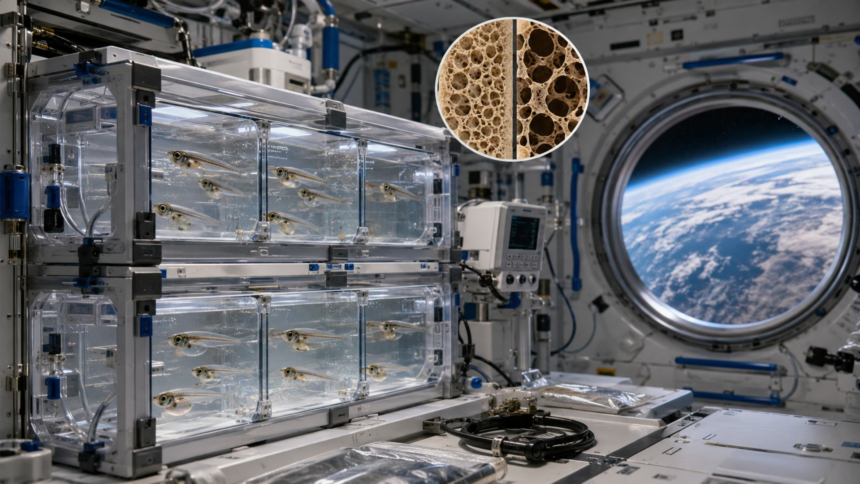
China is transforming its space station into something beyond an orbital outpost: a biology laboratory investigating how the body behaves when gravity disappears. The Tianzhou-10 cargo ship, launched on May 11 from the Wenchang Space Center by the Long March-7 rocket, carried 6.2 tons of supplies and scientific equipment to the Tiangong station, including 41 experiments and 67 pieces of equipment. According to Olhar Digital, among the most significant cargo are normal and genetically modified zebrafish embryos, as well as mouse bone cells, materials that will be used to investigate at the cellular level the mechanisms of bone loss in a microgravity environment.
The zebrafish is considered a fundamental model organism for research on bone metabolism and cardiac remodeling. Its genome shares approximately 70% similarity with humans, and its transparent embryos allow scientists to observe organ development in real time. China had already sent adult zebrafish to Tiangong in 2024, in the so-called “Tiangong Aquarium,” with six fish and six grams of hornwort. The new stage, with embryos, deepens the analysis by allowing researchers to study the effects of the absence of gravity from the early stages of development, when tissues are forming for the first time.
Bone loss is one of the most serious problems faced by astronauts on long-duration missions. In space, without the mechanical load that gravity exerts on the skeleton, the body begins to reabsorb bone mass in a process similar to osteoporosis, but at a much faster rate. Astronauts can lose up to 1.5% of bone mass per month in orbit, a rate that would make a manned mission to Mars biologically risky.
With the thermometer nearing zero degrees and the risk of frost, the city hall issued an urgent alert to the countryside in Santa Catarina and provides guidance on how to save vegetables, bananas, and newborn animals before the cold causes damage.
Scientists discover that the melting of Antarctic ice shelves may trigger a “hidden accelerator” in the ocean, capable of accounting for two-thirds of the future increase in basal melting.
Euclid Telescope reveals 26 million galaxies in just one week, finds objects 10.5 billion light-years away, and begins a giant map of 1.5 billion galaxies to decipher the dark Universe.
From passport to train seat, China develops a surveillance system capable of tracking foreigners in real time and turning each person into a “holographic file” for the police.
The zebrafish embryos sent by China allow the study of this process from the moment bones begin to form. Researchers analyze how proteins related to bone structure protection behave when there is no gravity to stimulate them. Mouse bone cells complement the experiment, providing data on bone metabolism in a mammalian organism. The results may provide cellular-level evidence that explains not only bone loss in space but also mechanisms of osteoporosis on Earth.
In addition to the zebrafish, the Tianzhou-10 transported the first models of artificial human embryos ever cultivated in orbit. The experiment, led by researcher Yu Leqian from the Institute of Zoology at the Chinese Academy of Sciences, is described as unprecedented in the world and uses cellular structures derived from stem cells that simulate early stages of human development between 14 and 21 days after fertilization. They are not fertilized embryos.
The samples were installed in the Tiangong experimental module by taikonauts in orbit and will spend five days in space before being frozen and returned to Earth for comparative analysis. Identical samples are being studied simultaneously in terrestrial laboratories, allowing scientists to identify exactly what differences in development are caused by microgravity. China seeks to understand how radiation and the absence of gravity affect reproductive processes, essential information for any plan of prolonged habitation in space.
The results of experiments conducted on China’s space station will not only benefit astronauts. Research on bone loss in microgravity has direct application in understanding and treating osteoporosis, a condition that affects millions of people worldwide. If scientists can identify which proteins stop protecting bones in the absence of gravity, they may develop treatments that activate these same proteins in patients on Earth.
The study on cardiac remodeling with zebrafish also has potential for cardiology. Microgravity causes cardiovascular dysfunction in astronauts, and understanding this mechanism may open pathways to treat heart failure and other circulatory conditions. Tiangong has received 53 scientific projects since 2023, with 387 proposals submitted, and China plans to expand the station’s capacity with two crews in 2026, including a taikonaut who will stay in orbit for more than a year.
While the United States and China compete for milestones like the return to the Moon, planned by China for 2030, the less visible race happens in orbital laboratories. Tiangong is increasingly positioning itself as a biomedical research platform, and experiments with zebrafish and artificial human embryos show that China is treating space not just as a destination, but as a tool to advance science on Earth.
The International Space Station, operated by a coalition led by the United States, also conducts biological research, but the pace of cargo launches and the diversity of experiments at Tiangong grow with each mission. Tianzhou-10 delivered more than supplies: it delivered a scientific agenda that places China at the center of research on the effects of microgravity on the human body.
Did you know that China is using zebrafish embryos in space to study bone loss? Do you think these experiments can really benefit medicine on Earth or are they just a demonstration of space power? Share your thoughts in the comments.
I cover construction, mining, Brazilian mines, oil, and major railway and civil engineering projects. I also write daily about interesting facts and insights from the Brazilian market.
© 2026 Click Petróleo e Gás – All rights reserved