


Personalise the news and
stay in the know
Emergency
Backstory
Newsletters
中文新闻
BERITA BAHASA INDONESIA
TOK PISIN
Topic:Oil and Gas
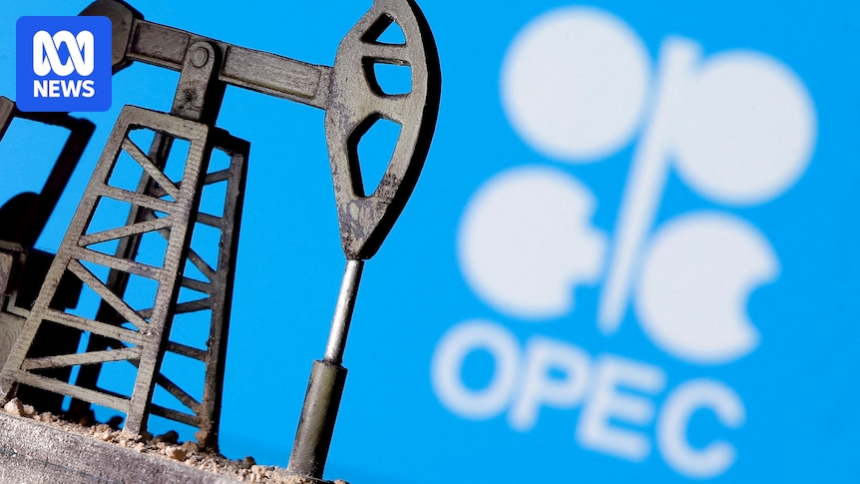
OPEC is an alliance of oil-producing countries, but not every country that exports oil is a member. (Reuters: Dado Ruvic)
The United Arab Emirates (UAE) says it is pulling out of an international oil-producers' group called OPEC.
It comes amid the fuel crisis sparked by the Iran war and subsequent blockades of the major oil shipping route, the Strait of Hormuz.
Here's why it matters.
OPEC stand for the Organization of Petroleum Exporting Countries.
OPEC has a major influence on oil prices around the world.
It can do that thanks to its member countries collectively producing a big portion of the world's oil and oil liquids.
Critics of the organisation accuse it of manipulating oil prices, but OPEC denies this.
The group says its mission is to:
"…coordinate and unify the petroleum policies of its Member Countries and ensure the stabilisation of oil markets in order to secure an efficient, economic and regular supply of petroleum to consumers, a steady income to producers and a fair return on capital for those investing in the petroleum industry."
The organisation was formed in 1960, with Iran, Iraq, Kuwait, Saudi Arabia and Venezuela as the founding member countries.
In 2016, the group formed the OPEC+ alliance with several new non-member countries.
Experts say the UAE is leaving OPEC to be free of its obligations under the OPEC agreement.
Senior research strategist at UK trading broker Pepperstone, Michael Brown, said the UAE felt "very constrained" by OPEC's quotas and targets, and would now be free to supply more oil.
"They're now talking about potentially an output target of as much as 5 million barrels per day in 2027," Mr Brown said.
"They're [producing] around 3 – 3.5 [million barrels per day] at the moment, so we are looking at a significant increase."
In a ministry statement announcing the split, the UAE government said it planned on increasing production "in a gradual and measured manner, aligned with demand and market conditions".
There's speculation about why the UAE wants to produce more oil now.
Associated Press business writer David McHugh said experts predict oil consumption will peak in the coming years, as the "world transitions to renewable energy sources that do not emit carbon dioxide".
"That means barrels underground could be worth more today than they might be later, when oil consumption declines, so restraining production might mean losing out on profits," he said.
Analysts do not expect the change to affect oil prices in the short term.
"This does absolutely nothing to alter the near-term picture," Mr Brown said.
That's because the blockades in the Strait of Hormuz continue to impact the global oil supply.
But Mr Brown said it could speed up the process of returning prices to where they were before the Iran war and getting the global commodity market back into balance.
"That should be a lot quicker than we otherwise expected it to be because we're going to have a hell of a lot more barrels coming online from the UAE," he said.
It may be a while away, but there's optimism that the extra supply from the UAE could eventually make a difference to fuel prices.
"You would say that the increase in output from the UAE, if that is indeed delivered, it is going to put downward pressure on the price of crude," Mr Brown said.
The blockades in the Strait of Hormuz continue to impact oil prices. (Supplied: Sentinel Hub)
The group produced more than 50 per cent of global crude in the 1970s, according to Reuters calculations.
That figure dipped between 30 and 40 per cent in later decades, but jumped back up after OPEC formed the OPEC+ alliance with several other countries in 2016.
OPEC represented nearly 50 per cent of global oil and oil liquids production in 2025, according to the International Energy Agency.
However, it appears to be dropping.
In March, a month into the Iran war, that share fell to about 44 per cent.
It's unclear exactly how much of that output the UAE is responsible for, but estimates suggest the nation is a major contributor to the OPEC supply.
You might be seeing a bunch of other news outlets describing the group as a cartel.
The Associated Press, for example, features a piece calling OPEC "the world's most prominent cartel". Another of the news syndicate's stories about OPEC uses the term "cartel" six times.
While we often hear the word "cartel" in the context of the illegal drug trade, the word itself generally means a group of businesses working together.
Here's how the Macquarie Dictionary defines it:
"a collusive syndicate, combine, or trust generally formed to regulate prices and output in some field of business."
"Many economists continue to view OPEC as a cartel whose members' central goal is to extract rents in excess of the market equilibrium by reducing competition between themselves," a report from US-based research hub The Middle East Institute says.
OPEC's website lists the following member countries:
The UEA says its exit from the group will be effective as of Friday.
Importantly, OPEC isn't an alliance of every single country that exports oil.
The organisation says any country with "substantial net export of crude petroleum" could apply to join.
However, they must have "fundamentally similar interests" to member countries and must be accepted by the majority of members.
Outside of those member countries, there's also an alliance called OPEC+, which was formed in 2016.
That alliance includes:
Other countries have left OPEC.
Here's a list of former OPEC member countries:
Gabon left the organisation in 1995, but rejoined in 2016 and remains a member.
ABC with wires
Topic:Missing Person
Topic:Pauline Hanson's One Nation
Topic:World Politics
Topic:Crime
Topic:Foreign Affairs
Topic:Oil and Gas
Analysis by Ian Verrender
Analysis by Ian Verrender
Oil and Gas
Petrol Prices
United Arab Emirates
Topic:Missing Person
Topic:Pauline Hanson's One Nation
Topic:World Politics
Topic:Crime
Topic:Foreign Affairs
Topic:War
Topic:Elections
Analysis by David Speers
Your home of Australian stories, conversations and events that shape our nation.
This service may include material from Agence France-Presse (AFP), APTN, Reuters, AAP, CNN and the BBC World Service which is copyright and cannot be reproduced.
We acknowledge Aboriginal and Torres Strait Islander peoples as the First Australians and Traditional Custodians of the lands where we live, learn, and work.
Sign up to get the latest on your favourite topics from the ABC
What is OPEC? Why is the UAE leaving it? – Australian Broadcasting Corporation



Leave a Comment