
By using this site, you agree to the Privacy Policy and Terms of Use.
Accept
Global News TodayGlobal News TodayGlobal News Today
  • World
  • Politics
  • Business
  • Technology
  • Science
  • Entertainment
  • Sports
  • Health
Reading: Space Twitter’s Ad Hoc Heat Shield Analysis – NASA Watch
Share
Notification Show More
Font ResizerAa
Global News TodayGlobal News Today
Font ResizerAa
  • World
  • Politics
  • Sports
  • Business
  • Science
  • Technology
  • Entertainment
  • Home
    • Home 1
    • Home 2
    • Home 3
    • Home 4
    • Home 5
  • Demos
  • Categories
    • Technology
    • Business
    • Sports
    • Entertainment
    • World
    • Politics
    • Science
    • Health
  • Bookmarks
  • More Foxiz
    • Sitemap
Have an existing account? Sign In
Follow US
  • Advertise
© 2022 Foxiz News Network. Ruby Design Company. All Rights Reserved.
Science

Space Twitter’s Ad Hoc Heat Shield Analysis – NASA Watch
Editorial Staff
Last updated: April 12, 2026 8:07 pm
Editorial Staff
21 hours ago
Share
SHARE

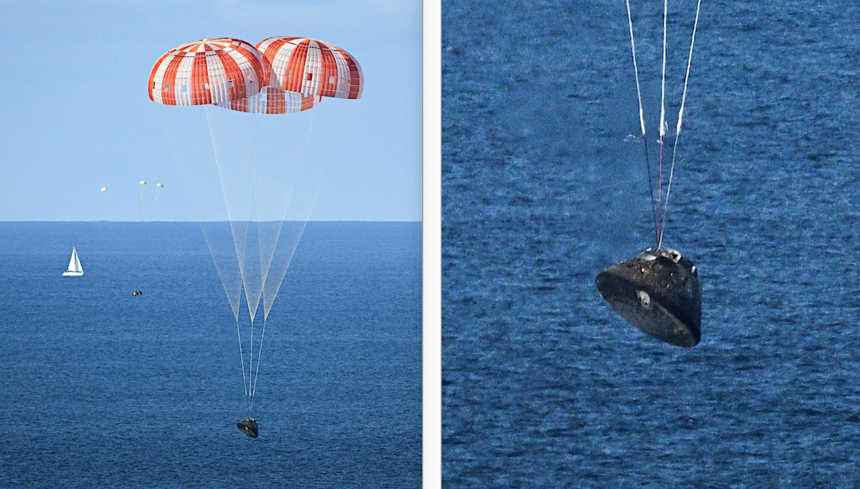
Keith’s note: An enlargement of this image from the splashdown of Artemis II is all over space Twitter. There is a bright colored region on the heat shield. Armchair experts and space influencers all have an opinion. That’s all they have – from one blurry pic. Jared Isaacman @NASAAdmin said this in response. When he has an answer he’ll tell us. So chill and focus on some #MoonJoy. More below
“I am hesitant to get ahead of a proper data review, but I understand the space community’s curiosity, especially when imagery can give the impression of a problem.
As you would expect, engineers were eager to inspect the heat shield, starting with diver imagery shortly after splashdown and continuing with the review aboard the ship. No unexpected conditions were observed. I suspect when the images are released, it will be pretty obvious the stark difference between Artemis I and Artemis II head shield performance.
As to the question specifically, the discoloration was not liberated material. The white color observed corresponds to the compression pad area and is consistent with the local geometry, AVCOAT byproducts, and transitional heating environments. We observed this behavior in arc jet testing and expected it in this compression pad area.
We will complete a full data review across all systems, including the thermal protection system, and make the results publicly available.”
NASA Watch founder, Explorers Club Fellow, ex-NASA, Away Teams, Journalist, Space & Astrobiology, Lapsed climber.
You must be logged in to post a comment.
2026 © Reston Communications. All rights reserved.

source

Arcadia University Shoulder Research Center seeking participants with shoulder pain for paid research studies – MoreThanTheCurve
Heritage Discovery Center featuring immigrant exhibit telling Johnstown's story – WJAC
From the Dean: Remarkable Achievement – UC Davis College of Biological Sciences
Scientists Finally Solved a Massive Mystery About Static Electricity Using Acoustic Levitation – ZME Science
NASA preps first crewed Artemis II mission to the Moon – WPEC
Share This Article
Facebook Email Print
Previous Article Cate Blanchett, Bryan Cranston and Paddington Bear are up for prizes at London's Olivier Awards – Audacy
Next Article N-able's Case for a Defence-in-Depth Strategy in the AI Age – Cyber Magazine
Leave a Comment

Leave a Reply Cancel reply

Your email address will not be published. Required fields are marked *

  • World
  • Politics
  • Business
  • Technology
  • Science
  • Entertainment
  • Sports
  • Health
Join Us!
Subscribe to our newsletter and never miss our latest news, podcasts etc..
[mc4wp_form]
Zero spam, Unsubscribe at any time.
Welcome Back!

Sign in to your account

Username or Email Address
Password

Lost your password?