


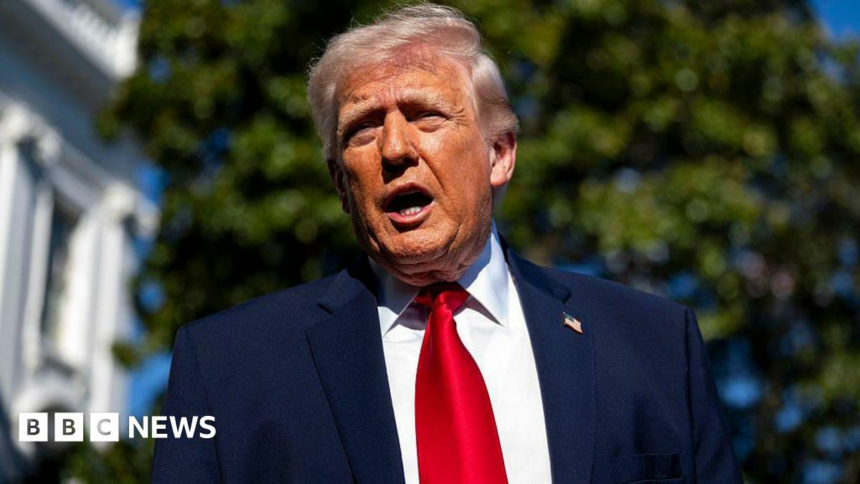
President Donald Trump says the US Navy will "blockade any and all ships" trying to enter or leave the Strait of Hormuz – a vital shipping route
In a separate post on Truth Social, he adds that direct talks with Iran in Islamabad failed because "Iran is unwilling to give up its nuclear ambitions"
Earlier, Iran's delegation leader said the US failed to gain Tehran's trust during lengthy negotiations in Islamabad, Pakistan – how they unfolded
It's not surprising that a deal wasn't reached but Trump now has a stark choice – escalate or negotiate, writes our chief international correspondent
Our world news correspondent tackles the key question: What happens next?
Meanwhile, Israel and Lebanon are set to hold their own talks in Washington next week. Our Middle East correspondent in Beirut says there is no respite from Israeli attacks in the country's south
Edited by Caitlin Doherty and Angus Thompson, with Lyse Doucet, Carrie Davies and Azadeh Moshiri in Islamabad. Additional reporting from BBC Persian and teams across the Middle East
Centcom says the blockade will be enforced "impartially against vessels of all nations entering or departing Iranian ports and coastal areas".
It says this includes all Iranian ports in the Gulf, and the Gulf of Oman.
"CENTCOM forces will not impede freedom of navigation for vessels transiting the Strait of Hormuz to and from non-Iranian ports," the military says.
It adds more information will be provided to commercial operators through a formal notice before the start of the blockade."
Earlier on in a post on Truth Social, Donald Trump said the US would "begin the process of BLOCKADING any and all Ships trying to enter, or leave, the Strait of Hormuz."
US Central Command says a blockade of traffic entering and exiting Iranian ports will begin at 10:00 ET (15:00 BST) on Monday.
We'll bring you further details shortly.
Nick Beake
Reporting from Jerusalem
A still of the video Netanyahu posted on X earlier, in which he says Israel "thwarted the threat of an invasion from Lebanon"
Benjamin Netanyahu’s social media account has posted a short video of the PM saying he has been visiting Israeli troops in southern Lebanon.
Speaking in Hebrew, he says recent Israeli operations to create a buffer zone – or a security strip – have "thwarted the threat of an invasion from Lebanon”, referring to Hezbollah fighters.
He says "tremendous work" has already been done by the military but vows there is "there is still more to do, and we are doing it”.
Mr Netanyahu says Israeli action in Lebanon is evidence that Israel has “essentially changed the face of the Middle East.” This action has been widely criticised though for the number of civilians killed.
The Lebanese health ministry says Israeli air strikes have killed more than two thousand people since the start of the war.
Iran has said it will resume attacks – and end its ceasefire deal with the US – if Israel continues to bomb Lebanon.
Lebanon's health ministry says at least five people have been killed in Israeli strikes in Qana in southern Lebanon.
Three women were among the dead and 25 people were wounded, Lebanon's state-run National News Agency (NNA) reported the ministry as saying.
Pictures taken by AFP news agency show the destruction to the village, as well as emergency responders carrying a body from the rubble.
The Israel Defence Forces (IDF) has not commented on the reports.
Israel, which is continuing its campaign against Hezbollah despite a ceasefire between the US and Iran, carried out other strikes in southern Lebanon today.
Pezeshkian, pictured in January, says an agreement with the US can "be found" on certain conditions
Iranian President Masoud Pezeshkian says that an agreement with the United States "will certainly be found" if "the American government abandons its totalitarianism and respects the rights of the Iranian nation".
The post on X comes after Iranian media reported a read-out between Pezeshkian and Russia's Vladimir Putin in which it quoted the former as saying a deal with the US was "not out of reach".
Trump has said that direct talks with Iran in Islamabad failed because "Iran is unwilling to give up its nuclear ambitions". He then told Fox News: "I predict they come back and they give us everything we want." Anthony Zurcher
North America correspondent
After a diplomatic team led by Vice-President JD Vance tried, and failed, to reach a negotiated agreement to end the US war with Iran on Saturday, President Donald Trump had to decide his next move.
That came on Sunday morning, in a series of Truth Social posts.
The US will impose a naval blockade, he wrote.
"No one who pays an illegal toll will have safe passage on the high seas."
He also said that the US would continue clearing mines from the Strait of Hormuz in order to ensure a safe passage for allied shipping.
The US military, he added, was "locked and loaded" and prepared to resume attacks against Iran at an "appropriate moment".
He went on to say that while progress had been made in the 20-hour negotiations in Islamabad, Iran would not meet the US demand that it abandon its nuclear ambitions.
While his posts didn't have the apocalyptic bluster of last week's threat to end Iranian civilisation, they pose a number of new challenges – and risks – for the American side.
You can read more of Anthony's analysis here Ghoncheh Habibiazad
Senior reporter, BBC Persian
Mohammad Bagher Ghalibaf, speaker of Iran’s parliament who was the head of negotiations between Iran and the US in Pakistan, has issued a statement upon his return to Iran.
Responding to comments from US President Donald Trump, he says that “such threats have no effect on Iranians” and Iran will not “surrender under threats”.
According to reports by Iranian outlets, Ghalibaf has addressed Trump by saying that “if you fight, we will fight, if you come forward with logic, we will respond with logic.
"We will not submit to any threat. If they test our resolve once more, we will teach them an even greater lesson”.
Elsewhere in his remarks, Ghalibaf has said that Tehran had said from the beginning that they “do not trust the Americans” and that they must “earn” Iran’s trust because they attacked Iran twice during negotiations in less than a year.
The war that started on 28 February this year and the 12-day war back in June last year both began when Iran and the US were engaging in talks over Iran’s long-debated nuclear programme.Ghoncheh Habibiazad
Senior reporter, BBC Persian
Iran’s Islamic Revolutionary Guard Corps (IRGC) Naval Forces says any military vessels that approach the Strait of Hormuz will be considered to be violating the ceasefire and "dealt with severely".
In a statement published by Iranian outlets by IRGC’s Public Relations quoting Naval Forces, it adds that “contrary to the false claims of some enemy officials”, the Strait of Hormuz is “open for the innocent passage of non-military vessels under intelligent control and management in compliance with specific regulations” of Iran.
The statement has not mentioned names of any ‘“enemy” officials but US President Donald Trump had said that US Navy will “blockade any and all ships” trying to enter or leave the Strait of Hormuz.
Omani Foreign Minister Badr Albusaidi has called for an extension to the ceasefire to allow for talks between the US and Iran to continue.
Donald Trump announced late on Tuesday night that a ceasefire would take place for two weeks, conditional upon the Strait of Hormuz being opened immediately.
Oman had been mediating nuclear talks between both countries before conflict broke out on 28 February.
Albusaidi said earlier this afternoon in a post on X that when he had met US Vice President JD Vance "just hours before the war began, I formed an impression that both he and the President had a genuine and strong preference to avoid the entanglements of war."
"So I urge that the ceasefire be extended and talks continue. Success may require everyone to make painful concessions, but this is nothing as compared to the pain of failure and war," he says. Daniel Bush
Washington correspondent
Vice President JD Vance believes a deal with Iran remains possible – but left the talks in Islamabad after making Tehran a final offer because the regime appeared unwilling to agree to abandoning its nuclear programme, according to a US official.
Vance, who led the US delegation, left the talks convinced that Iran misunderstood the amount of leverage it has in negotiations with the Trump administration, said the official, who offered a summary of the talks on the condition that they not be named.
The negotiations lasted more than 21 hours, with Vance leading a US team that also included special envoy Steve Witkoff and President Donald Trump's son-in-law Jared Kushner.
The US and Iran did not reach agreement on a wide range of issues, the US official said.
According to the official, those issues including ending Iran's uranium enrichment, finding a framework for a broader peace that includes allies in the region, and a solution to reopen the Strait of Hormuz that does not include charging tolls.
Donald Trump told Fox News earlier the US got "just about every point we needed, except for the fact that they refused to give up their nuclear ambition".
The BBC understands the UK will not be involved in a US-led blockade of the Strait of Hormuz.
A spokesperson for the UK government says that the strait "must not be subject to tolling" and that Westminster is working on a "coalition to protect freedom of navigation".
The spokesperson says: “We continue to support freedom of navigation and the opening of the Strait of Hormuz, which is urgently needed to support the global economy and the cost of living back home.
"The Strait of Hormuz must not be subject to tolling.
"We are urgently working with France and other partners to put together a wide coalition to protect freedom of navigation.”
Donald Trump has also said Iran will come back to the negotiating table and "give us everything we want".
In the same earlier interview with Fox News' Sunday Morning Futures, Trump says US negotiators got "just about every point we needed, except for the fact that they refused to give up their nuclear ambition".
He asserts Iran hasn't "left the bargaining table".
"I predict they come back and they give us everything we want," he says.
During another moment in the interview, Trump threatens China with 50% tariff if it helps Iran's military. He also says that the price of oil and gas will eventually be lower following the conflict.
We can now bring you more from Donald Trump's conversation with Fox earlier this afternoon.
The US president also compared UK PM Keir Starmer to Neville Chamberlain.
Trump makes the criticism in his earlier Fox News interview, in which he says Starmer promised to "send equipment after the war is over".
"That's a Neville Chamberlain-type statement," he adds.
Starmer has previously said the UK was talking with international partners about a plan to return normal shipping to the Strait of Hormuz but has repeatedly refused to involve the UK in a wider war.
Trump has previously likened Starmer to Chamberlain, while also describing him as "no Winston Churchill", who came to office after Chamberlain.
Iranian President Masoud Pezeshkian says a deal with the US is "not out of reach" if the Trump administration abides by international law, the country's state broadcaster reports.
The remarks were carried in a reported read-out of a call between Pezeshkian and Russian president Vladimir Putin, carried in a Telegram post by Islamic Republic of Iran Broadcasting.
The call followed US-Iranian talks in Islamabad.
The US Navy will blockade the Strait of Hormuz, Donald Trump announced earlier, after talks in Islamabad failed to produce a deal between the US and Iran.
It's a critical shipping route through which roughly 20% of the world's oil and natural liquefied gas is transported.
The strait's geography has allowed Iran to use it as leverage throughout this war, selectively preventing vessels from passing through the narrow waterway and spiking oil prices in the process.
Trump says that Nato has offered to help "clean out" the Strait of Hormuz, in comments made to Fox News shortly after he announced plans to blockade the key shipping lane.
He says the US was "very disappointed with Nato", but that "now they want to come and they want to help with the strait".
"It won't take long to clean it out, so we're gonna clean out the strait", he tells the outlet, adding that he thinks it will be free to use again "in not too long a distance".
He also says that the US is bringing in minesweepers, and that the UK – a member of Nato – will too. "I understand the UK and a couple of other countries are sending minesweepers", he tells the outlet.
The BBC has approached the UK Ministry of Defence for comment.
Nick Beake
Reporting from Jerusalem
The Israeli government has largely ignored the talks in Pakistan – publicly at least.
Prime Minister Benjamin Netanyahu didn’t want them to happen in the first place.
His wish was for US and Israeli attacks on Iran to continue and he was forced to deny reports he only found out at the 11th hour that President Trump had agreed to a tentative truce, amid growing global turmoil.
Today, there’s been no official reaction to the US and Iran failing to agree to any rapid deal in Islamabad – unlikely as one may have been.
Instead, Israeli media is now reporting that IDF Chief of Staff, Eyal Zamir, has ordered the military to move to a heightened state of readiness – to a level seen on the eve of previous military operations.
We’ve asked for confirmation from the IDF, but have not yet received it. Certainly, the language chimes with what Netanyahu has been saying.
A few days ago he said the finger “remained on the trigger”, and last night he vowed once again that the war with Iran was not over.
All the while the IDF continues to bomb Lebanon, saying it is hitting Hezbollah positions.
The authorities in Beirut say these Israeli operations have killed more than 2,000 people in recent weeks.
Last Wednesday, more than 350 were killed – a third of whom were women and children, according to the Lebanese health ministry.
Rachel Clun
Business reporter
US President Donald Trump’s threat to blockade the Strait of Hormuz will only affect a small handful of vessels that are still navigating the waterway, shipping expert Lars Jensen says.
“If this is actually done by the Americans, it will halt a very tiny trickle of vessels. In the greater scheme of things, it doesn't really change anything,” he says.
Jensen, chief executive of Vespucci Maritime, says Trump's threat of preventing safe passage for any ships paying tolls to Iran would also have little impact, as any company doing so would already face sanctions for paying the regime.
“First of all, there's very few ships that pass. There's even fewer of those that pay, and those that pay will already be subject to American sanctions,” he says.
Most shipping companies will continue to wait and see if there is a tentative peace agreement and whether that might hold, Jensen says, and if that occurs, a slow ramping up of shipping may resume.
As for what it would take shipping lines to decide whether it was safe to transit the strait again, he says the honest answer from those firms would be that they don’t know.
“Because at the end of it, it boils down to trust: trust that any agreement between the US and Iranians will hold for a significant portion of time, and that's a subjective feeling, there is nothing hard and tangible you can point to,” he says. Azadeh Moshiri
South Asia correspondent, reporting from Islamabad
As we watch to see whether the next few days bring more talks or a resumption of the war, the US president has made various threats in a lengthy Truth Social post.
We knew Iran's nuclear point was a huge point of contention and one that Trump has confirmed negotiators couldn't get past.
The future of the Strait of Hormuz is clearly an immediate concern, and the US is now threatening a blockade. Not only that, Trump is threatening any country who pays Iran "an illegal toll" to get through the vital shipping lane.
There have been reports that some ships have passed through after paying a very expensive fee to Iran.
Before these talks, he claimed there has been regime change in Iran, with new and more "reasonable" leaders, but they are now "volatile, difficult, unpredictable people".
But, he did acknowledge there had been points of agreement during these talks, and that's a sense we had here in Islamabad, as we heard technical experts became involved and talks continued into the early hours of the morning.
Trump has also said the US delegation became "very friendly" and "respectful" of Iran's delegation, which would suggest some sort of working relationship difficult to imagine before this weekend. Joe Inwood
World news correspondent
President Trump is known to want quick deals.
We had wondered how he might react to the failure to agree to come to an agreement in Islamabad… we can now see his first response.
Across two lengthy social media posts, he says he will block the few ships that are currently making it through the Strait of Hormuz.
“I have instructed our Navy to seek and interdict every vessel in International Waters that has paid a toll to Iran. No one who pays an illegal toll will have safe passage on the high seas.”
The posts do not make it clear how “safe passage” will be denied, but it is worth remembering that the US has, in just the last few months, boarded vessels en route to or from Venezuela.
Crucially, he also says "Other Countries will be involved with this Blockade”, without specifying who.
Iran’s selective – but effective – blockade of one of the world’s most important waterways has generally only been bypassed by ships either aligned to Iran, to nations Tehran considers friendly, or by vessels that are thought to have paid a toll, believed to be around $2m (£1.5m).
He also suggests that Iran has promised to open the Straits.
Going by their public statements, they have repeatedly said the reverse, seeking formal recognition of what has become maybe their key strategic point of leverage.
If followed through, the president’s threat would further restrict the amount of oil making it to global markets, with associated economic consequences.
These messages are not the full resumption of hostilities that could have ensued, but they are a further escalation.
Copyright © 2026 BBC. The BBC is not responsible for the content of external sites. Read about our approach to external linking.
Iran war: Trump says US to 'blockade' Strait of Hormuz, as Iran says it will not 'surrender' to threats – BBC


Leave a Comment