




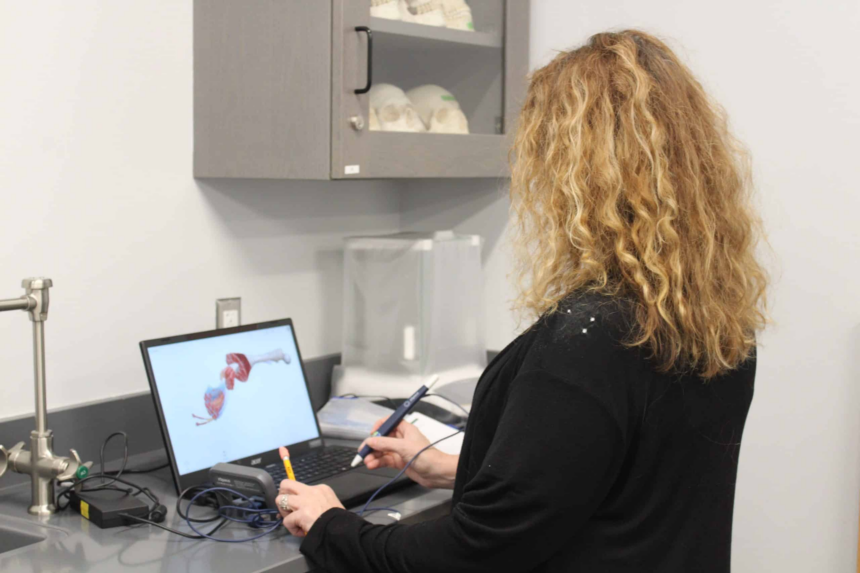
Using zSpace technology, a West Georgia Technical College student interacts with a 3D anatomical model, bringing complex biology concepts to life through immersive, hands-on learning.
West Georgia Technical College (WGTC) is transforming science education with the implementation of zSpace, an augmented and virtual reality learning platform now enhancing biology instruction. As one of the first colleges in the Technical College System of Georgia to adopt this technology, WGTC is leading the way in innovative, technology-driven education.
Using specialized computers, a stylus, and lightweight glasses, zSpace allows students to interact with fully manipulable 3D models—rotating structures, isolating layers, zooming in, and exploring biological systems in real time. This immersive approach moves beyond traditional flat images, helping students better understand complex concepts through hands-on engagement.
WGTC launched zSpace in Spring 2026 following faculty training in Fall 2025. The technology is currently being piloted in Anatomy and Physiology I, with plans to expand into additional natural science courses.
The adoption of zSpace addresses a common challenge in science education: visualizing three-dimensional biological structures using two-dimensional materials. While traditional instruction remains essential, students often struggle to grasp depth, movement, and spatial relationships—gaps this technology helps bridge.
“zSpace changes that dynamic,” said Caycee Tyler, Natural Sciences Department Chair and Biology instructor at WGTC. “It turns confusion into clarity and curiosity into momentum. Instead of asking students to imagine complex systems, we’re giving them the tools to explore and understand them firsthand.”
In Anatomy and Physiology courses, students can peel away layers of the heart, isolate chambers, trace blood flow, and observe how structures function together. These interactive experiences improve retention and application in labs, exams, and future clinical settings.
Since implementation, faculty have observed increased engagement, deeper discussions, and stronger comprehension—along with a noticeable boost in student confidence.
“We’re seeing students lean in,” Tyler added. “They’re asking better questions, making stronger connections, and feeling more capable of mastering the material. That confidence is a game changer.”
Beyond the classroom, zSpace supports workforce readiness by mirroring tools and thinking used in healthcare, laboratory science, and technical fields. It strengthens spatial reasoning, technical confidence, and problem-solving skills essential for high-demand careers.
In areas like cell biology, where concepts are often abstract, zSpace provides a new level of clarity. Students can zoom into a cell, rotate it, and examine how organelles interact—building a deeper understanding and stronger recall of spatial relationships.
“zSpace doesn’t replace traditional learning—it strengthens it,” Tyler said. “Students still read, discuss, and test. This technology simply gives them another way to engage—one that makes learning more active, meaningful, and lasting.”
West Georgia Technical College Brings Biology to Life with zSpace Technology – The City Menus



Leave a Comment

