


Olympics
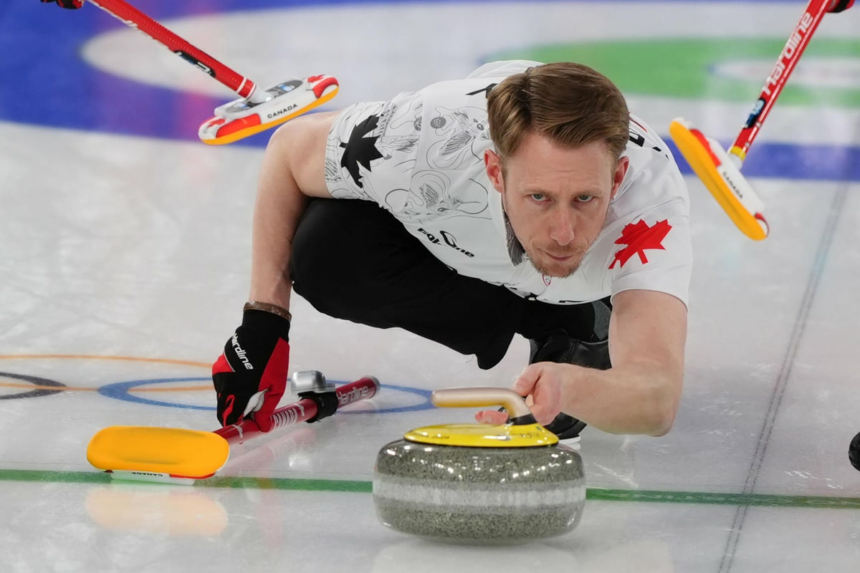
Canada's Marc Kennedy was at the center of a still-simmering Olympic dispute over the manner in which he delivered his stones. Andrew Milligan / PA Images via Getty Images
TORONTO — Two months after the 2026 Winter Olympics, the controversy that rocked the curling tournament hasn’t been swept away.
During the Olympics, Swedish curler Oskar Eriksson repeatedly called out Team Canada — and specifically Marc Kennedy, who threw third stones for Canada — for double-touching a rock on the granite part after the point at which players must release the stone (known as the hog line). This ignited a firestorm in Cortina d’Ampezzo, Italy, the Olympic host city, and resulted in officials monitoring athletes’ stone deliveries and changes to the sport’s rulebook.
Advertisement
About two weeks ago, while competing at the World Curling Championships, a video of Eriksson demonstrating how a double-touch infraction can impact a rock’s trajectory appeared in Swedish media. Brad Jacobs — the Canadian skip who led the team to the Olympic gold medal despite the controversy — said he will not just let it go.
“Something needs to happen here,” Jacobs said this week. “There needs to be accountability. Everything that happened at the Olympics with this controversy was not handled properly, starting from the top down.”
All of this has occurred amid the inaugural season of the Rock League, curling’s latest attempt at making the sport relevant year-round, which debuted this month in Toronto. While it’s certainly an opportune time to reignite the fight that got everyone talking about the sport, Jacobs is not taking it lightly.
“They’re nothing to me,” he told The Athletic. “It’s quite simple, I act like they don’t exist. I’m very unhappy with all of their actions and things they’ve done recently.”
After the Olympics, the teams went their separate ways. Kennedy and Team Jacobs — including lead Ben Hebert and second Brett Gallant — participated in the Canadian men’s national championship in February for a chance to represent the country at the world championships last month, but they came up short against Matt Dunstone and his rink.
Sweden’s Team Edin — which includes skip Niklas Edin, Eriksson, Rasmus Wranå and Christoffer Sundgren — represented their country at the men’s World Curling Championship and defeated Dunstone’s Canadian team in the final to win gold.
While competing at the world championships, Eriksson made a video demonstrating the double touch for Swedish media outlet SVT, and it reached fans around the world. Eriksson’s purpose, he said, was to show what the rule violation actually looked like.
Advertisement
“A lot of people have been talking about, like, ‘You can’t do anything with a finger on a 20-kilo granite rock,’” Eriksson explained after the Alpine Curling Club’s game Thursday night at Rock League. “But when it’s moving, it’s quite easy to give it a small push, and you can actually change the angle quite a bit more than the speed. So (Swedish media) wanted to see how big of a difference you can make with just a small touch with the finger.”
The timing of the reignited beef is auspicious for The Curling Group, which owns the Rock League and is driving the hopeful transformation of professional curling. Interest in curling is up this year, as the sport typically enjoys a moment in the spotlight every four years at the Winter Games before returning to the background.
Korey Dropkin, the American who won Olympic silver in mixed doubles and captain of the Frontier Curling Club franchise at Rock League, said the controversy is great for the sport he grew up loving.
“It’s perfect. You need to have rivalries,” Dropkin said. “You need to have good guys and bad guys, right? So, when you have individuals who already bring a sense of that, I think it actually, in a way, can help viewership.
“People like to see that in sports. Everyone loves a really good Red Sox-Yankees matchup. Everyone loves watching a Canada-United States battle of the border. Everyone’s gonna love a good battle between Oskar Eriksson and Marc Kennedy. Of course, Marc’s not here, but, you know what? You’ve got Oskar and you’ve got Brad, two of the best curlers to ever slide down the sheet of ice.”
As for the word “cheaters,” Dropkin said it has no place in this discussion.
“I don’t believe that belongs,” he said. “I don’t believe that they are cheaters. Yes, there was an infraction — call it infractions, because it was not just once. At the end of the day, you have to take ownership for things you’ve done. Apologies are appreciated. Because I think in general, we’re all good people.”
Advertisement
The Rock League is also testing a variety of rule changes to curling, including hog-line challenges. Teams will have one challenge per game, and they must signal if they want to challenge a suspected infraction — similar to the new automated ball-strike (ABS) system in Major League Baseball.
Jacobs, who is the only member of the Canadian gold-medal contingent participating in Rock League, said he has not spoken to Eriksson this week in Toronto, nor does he plan on speaking to him anytime soon.
The two also play on the Grand Slam of Curling circuit with their quadrennial teams — squads put together for four-year stints in pursuit of Olympic glory — and will participate in the second season of Rock League, starting in October 2027. Eriksson confirmed that he hasn’t interacted with Jacobs.
“I shook his hand in the first game,” he said. But otherwise? “No, it doesn’t look like he wants to.”
Spot the pattern. Connect the terms
Find the hidden link between sports terms
Play today's puzzle