

Israel and Hezbollah Exchange Strikes
BBC News
This video can not be played
Lebanon will only take part in talks with Israel next week if a ceasefire is in place beforehand, a senior official tells the BBC
There has been confusion over whether the US-Iran ceasefire covers Lebanon, where Hezbollah is based, with mediator Pakistan saying it does and both the US and Israel saying it doesn't
Meanwhile, Donald Trump criticises Iran over its handling of the Hormuz strait – here's the latest on the vital oil shipping route
In a series of Truth Social posts, Trump says Iran is doing a "very poor job" managing the passage, where 20% of the world's oil passes, and warns Tehran against "charging fees to tankers going through"
It comes ahead of separate peace talks scheduled to take place in Pakistan this weekend, with US Vice President JD Vance and an Iranian delegation due to attend
Will that meeting go ahead? "Not finalised yet," a senior foreign ministry official in Tehran tells our chief international correspondent
Edited by Matt Spivey and Charlotte Hadfield, with reporting from BBC Persian and teams across the Middle East
As attention turns to possible talks between Lebanon and Israel next week, we can bring you a recap of what we heard from Iran's Deputy Foreign Minister yesterday.
Iran has made it clear that it believes Lebanon was covered by the two-week ceasefire agreement brokered with the US – something Washington and Israel dispute.
On Thursday, Iran's Deputy Foreign Minister Saeed Khatibzadeh told the BBC continued Israeli attacks on Lebanon are a "grave violation" of the agreement.
At least 303 people were killed on Wednesday in air strikes on what Israel called Hezbollah command centres and military sites, the Lebanese health ministry said.
Khatibzadeh told Radio 4's Today programme that the US must choose "between war and ceasefire" and that it "cannot have cake and eat it at the same time".
This video can not be played
Israeli attacks were 'grave violation' of ceasefire – Iran deputy FM Samantha Granville
Reporting from Beirut
A senior official in the Lebanese president's office has just confirmed to the BBC that Lebanon will participate in direct negotiations with Israel next week if, and only if, there is a ceasefire in place beforehand.
The day and time of the meeting has not been set.
Direct talks between Lebanon and Israel are not unprecedented, but they are unusual.
The two countries generally communicate via intermediaries, such as the US.
Efforts to establish negotiations have been ongoing since a ceasefire agreement in November 2024, with US envoys previously mediating indirect talks between the two sides. Frank Gardner
Security correspondent
Prior to this war, only six weeks ago, Iran was boxed in by sanctions and it wasn't targeting the Strait of Hormuz.
Now it’s proposing a toll charge and wants its military to be able to check ships' cargo, which is unacceptable to the Gulf states. In other words, Iran is exercising its dominance over the Strait of Hormuz because it's got geography on its side.
It's impossible to keep the Strait of Hormuz open by force; there are so many inlets and caves that Iran only has to hide one missile and maintain the threat of an attack, that's all you need for insurers to make it unaffordable for ships to travel.
Iran doesn’t need its navy, it just needs its coast.Frank Gardner
Security correspondent
This ceasefire is more full of holes than a piece of Swiss cheese. It is a ceasefire in name only.
Every aspect of it is flawed; while most of the bombing has stopped, it hasn't completely stopped the shooting and Kuwait says it came under attack from Iranian drones in the last few hours.
Meanwhile, the war is raging in Lebanon as Israel doesn’t consider that the ceasefire applies to it, while Pakistan and Iran consider that it does.
Then there's the Strait of Hormuz, the critical waterway through which 20% of the world's oil and gas flows, and Donald Trump has taken to Truth Social to say he's very upset that Iran hasn't been honouring its deal.
Iran is in a very strong position. Even though it has been battered militarily with hundreds, if not thousands of its missiles and drones destroyed, it can rebuild those and get more help from Russia and China, so that's only temporary.
Because the Islamic Republic has survived this war, Iran has effectively broken out of its box.
In my next post, I'll bring you more on how Iran is utilising its geography to maintain its strong position.
By Dan Isaacs
A total of 15 vessels have made the crossing through the Strait of Hormuz since a two-week ceasefire in the US-Israel war with Iran was announced on Tuesday night, according to data from the tracking website MarineTraffic.
This compares with an average of almost 140 each day prior to the outbreak of the conflict.
Of these, four of the ships were tankers carrying either oil, gas or chemicals. The rest are listed as container ships of various types.
Although the ceasefire included a condition that "safe passage" be granted through one of the world’s most important shipping lanes, vessels in the area have been warned by Iran they will be "targeted and destroyed" if they attempt to make the journey without permission.
Iran’s effective closure of the strait after the conflict began five weeks ago has left almost 800 ships stranded in the Gulf, most of them loaded with cargo, according to shipping analysts Lloyd’s List.
Israeli strikes have continued in Lebanon since the ceasefire agreement, with Israel stating it remains in a 'state of war' against Iran-backed Hezbollah
Concerns over "serious ceasefire violations" in Lebanon have been raised by the Pakistani and French foreign ministers.
In a call between France's Jean-Noël Barrot and his counterpart in Pakistan, Mohammad Ishaq Dar, Barrot said France supported Pakistan’s efforts toward a diplomatic pathway for "lasting peace and stability in the region".
"Both leaders expressed concern over serious ceasefire violations made in Lebanon and underscored the importance of full implementation and respect for the ceasefire," a statement from Pakistan's foreign ministry says.
It comes ahead of peace talks between the US and Iran that are due to take place in Pakistan this weekend, but uncertainty remains over whether they will go ahead.
As our chief international correspondent has just reported, Pakistan is preparing to host Iran and US delegations for peace talks this weekend.
The nation is a key mediator in facilitating discussions between the two countries, who have agreed to a two-week conditional ceasefire. Here's what we know about the agreement between the US and Iran.
Pictures show heightened security in Islamabad, as roads around the city’s Red Zone – where many government buildings and embassies are based – are also shut, according to our Pakistan correspondent.
Armed soldiers line the streets of Islamabad, Pakistan, as roads are closed
Members of the media report in front of President House Lyse Doucet
Chief international correspondent
In Islamabad, Pakistan, security is heightened ahead of the expected peace talks this weekend
Is it all systems go for the high-level high-stakes US-Iran talks set to take place in Islamabad on Saturday?
“Not finalised yet” was the reply of a senior foreign ministry official in Tehran when I asked on Friday morning.
Reports yesterday that the Iranian delegation had arrived in the Pakistani capital were denied, and one post deleted, from social media.
But preparations are advancing in Pakistan in a way which seems to leave no doubt these discussions will take place as planned.
Iran’s Tasnim news agency, close to the powerful Islamic Revolutionary Guards Corps, reported yesterday that the talks were suspended as long as there was no ceasefire in Lebanon.
Iran’s deputy foreign minister, Saeed Khatibzadeh, also made that clear in his interview with the BBC’s Today programme.
It may be brinkmanship but Iran confronts a challenging choice – abandon Hezbollah, its most important ally, or endanger critical diplomacy?
The frantic talks to reach a ceasefire went down to the wire and so too, it seems, do these talks. Jacob Phillips
Live reporter
The Strait of Hormuz has become a key sticking point in the US-Israeli war with Iran after Tehran effectively closed the shipping route.
US President Donald Trump's demands for a two-week ceasefire hinged on Tehran reopening the strait – which has been agreed.
However, yesterday Trump accused Iran of breaching a ceasefire deal and says it is "doing a very poor job" of allowing oil to go through the Strait of Hormuz.
In an earlier post on his social media site Truth Social he warned Iran "better not be charging fees to tankers" passing through the vital waterway.
BBC Verify has found at least nine ships have crossed the strait since an uncertain ceasefire was announced. Before the war, around 128 ships passed through the choke point each day.
The Prime Minister Keir Starmer has spoken to Trump about the need for a practical plan to get shipping moving after visiting the UAE, Bahrain, Qatar and Saudi Arabia to underline the importance of reopening the strait.
The International Maritime Organization says it is supporting 20,000 seafarers in the region – many of whom remain stranded on ships unable to exit the strait.
Meanwhile, international oil prices are just shy of $100 a barrel after prices plunged following the ceasefire announcement.
This Flourish post cannot be displayed in your browser. Please enable Javascript or try a different browser.
This Flourish post cannot be displayed in your browser. Please enable Javascript or try a different browser.
There's another operational update from Hezbollah now.
The Shia Muslim political and military group, based in Lebanon, says it's targeted a northern Israeli town in response to what it describes as Israel's "violation" of the US-Iran ceasefire agreement.
Hezbollah says it fired rockets at Kiryat Shmona, near the Israel-Lebanon border, at 10:00 local time (06:00 BST) on Friday, and Misgav Am in the Upper Galillee region of northern Israel.
"This response will continue until the Israeli-American aggression against our country and our people ceases," it says in the statement.
Israel has not commented.
Starmer met Bahrain's Crown Prince and Prime Minister Salman bin Hamad Al Khalifa during his visit
UK Prime Minister Keir Starmer travelled to the UAE, Bahrain and Qatar on Thursday, having visited Saudi Arabia the day before.
Downing Street says talks with all leaders focused on condemning Iranian attacks on Gulf states, underlining the importance of upholding the ceasefire, and reopening the Strait of Hormuz.
After meeting with leaders in the region, Starmer spoke to US President Trump on the phone.
Starmer outlined the "UK's effort to convene partners" to agree a plan to open the strait and discussed with Trump the need for "a practical plan to get shipping moving again as quickly as possible", No 10 says.
Images taken in Tel Aviv, Israel, overnight show residents running to shelters following warnings of incoming strikes, reportedly from Hezbollah in Lebanon.
Israel's emergency services, Magen David Adom, said at about 01:30 local time (23:30 BST) that no injuries had been reported following the strike alert, but "a few people sustained injuries while heading to a shelter".
Hezbollah says its forces launched an attack against a gathering of Israeli soldiers in southern Lebanon on Friday morning.
The group says it launched a "rocket barrage" toward the Israeli forces near the town of Al-Khiyam, in Nabatieh, at about 03:50 BST.
Israel has not commented.  Adam Goldsmith
Live reporter
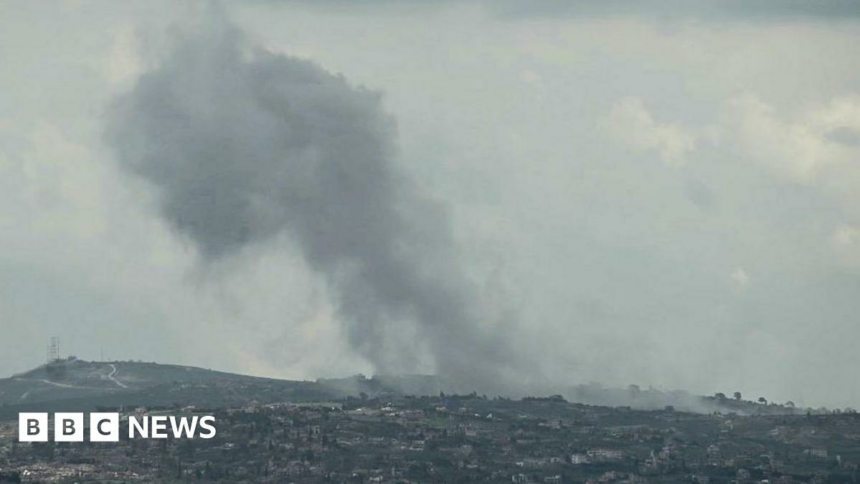
Strikes continue to hit Lebanon without a ceasefire between Israel and Hezbollah
Strikes between Israel and Lebanon have continued overnight and US President Donald Trump has criticised Iran's handling of the Strait of Hormuz. Here's a brief catch up of the latest developments: Daniel De Simone
Reporting from Jerusalem
There has been fresh fighting overnight between Israel and Hezbollah, with airstrikes by Israel in Lebanon and rockets fired by the armed group that triggered alerts in Tel Aviv and elsewhere.
The disputed status of Lebanon being part of the fragile Iran ceasefire deal is creating tension ahead of scheduled peace talks in Pakistan this weekend.
Israel said it had struck Hezbollah rocket launchers in Lebanon overnight, with the Iran-backed group saying it had fired rockets at several places in Israel. The fighting comes after US President Trump was quoted as saying Israel would be more "low key" in Lebanon – comments widely seen as him asking Israel's Prime Minister Benjamin Netanyahu to be more restrained.
Israel’s assault on Lebanon on Wednesday killed more than 300 people, according to Lebanon's health ministry.
In a statement read on Iranian State TV, Iran's Supreme Leader Mojtaba Khamenei was quoted saying he reserved the right to retribution for US-Israeli attacks on his country and its allies – implying Hezbollah in Lebanon which Israel and the US claims isn't covered by the ceasefire.
World leaders are seeking to shore up oil and fuel supplies as the clock ticks down on the two-week ceasefire in the Middle East.
Japan has confirmed it will release 20 days worth of oil reserves as early as next month with an eye to traffic through the Strait of Hormuz, media reports indicate.
Meanwhile, Australian Prime Minister Anthony Albanese is visiting Singapore in a bid to secure his own country's fuel supplies amid fears of shortages.
US Vice-President JD Vance is also set to head to Islamabad, Pakistan to lead peace talks with Iran that begin on Saturday.
Meanwhile, Israeli Prime Minister Benjamin Netanyahu has made plans to start talks on a peace deal with Lebanon after the Israeli military reportedly killed hundreds of people in the country in a deadly wave of strikes on Thursday.
Contention over the two-week ceasefire deal between the US, Israel and Iran continues as Trump has said that Iran's handling of ships in the Strait of Hormuz is "not the agreement we have".
Meanwhile, Israel is set to negotiate with Lebanon after the Lebanese health ministry said Israeli strikes in the country killed 303 people yesterday.
Israeli Prime Minister Benjamin Netanyahu had said Lebanon was not included in the ceasefire deal, while Iranian officials have called the strikes in Lebanon a violation of the agreement.
We're pausing our live coverage for now. You can find the latest on the conflict in the Middle East here.
Fergal Keane
Special correspondent
A woman and her child look at the aftermath of an air strike in Tehran
The war is inside his head now. A slamming door or cutlery being dropped makes him jump. The ceasefire doesn't change that.
"Before the war, I had no stress at all," says Ali. "But now even the smallest sound causes my brain to react very badly."
Although he is only 15, Ali – not his real name – understands these fears will linger even with a ceasefire. Loud noises trigger an automatic "startle response", he says.
"The sound of explosions, the shock waves, and the sound of fighter jets flying over the city can have a very serious effect," he says.
More than 20% of Iran's population is under the age of 14 – approximately 20.4 million children. What Ali and many others are experiencing is what psychologists call "hyper arousal" and it can be an early warning of post-traumatic stress disorder (PTSD).
Congresswoman Sarah Elfreth, a Democrat who sits on the House Armed Services Committee, is telling the BBC that she wants the administration to give Congress and the public more information about the ceasefire deal and what comes next.
"We've had a number of closed door classified briefings on the war, but never any conversations out in the open," she told Caitriona Perry, the BBC's chief presenter in Washington. "It's critical the American people hear some type of strategy, some type of plan. We should have heard it before we went in. Now we need to hear what is the exit strategy."
Elfreth says she's conflicted on whether or not to vote in favour of doling out more funding to the US military. She supports the troops, she says, but Trump has bypassed congressional clearance on the war with Iran.
She noted that former President George W Bush lobbied members of Congress and sought approval from Congress in 2002 before the Iraq War was launched.
"The president has made absolutely zero effort to bring Congress into this planning," she said. "My colleagues refuse to check and balance this president, and it's very frustrating." Ghoncheh Habibiazad
Senior reporter, BBC Persian
Iranian outlets are reporting that former Foreign Minister Kamal Kharrazi has died following injuries he sustained in an attack earlier this month.
Kharrazi was known in Iran’s political atmosphere as a reformist politician, head of Iran's Strategic Council on Foreign Relations, and an adviser to Iran’s late Supreme Leader, Ali Khamenei. He served as Iran’s foreign minister from 1997 to 2005.
Iran’s reform-leaning Jamaran news website had reported on 1 April that Kamal Kharrazi had been "severely injured and hospitalised" following an attack that, according to the report, killed his wife. Jamaran had reported Kharrazi’s house in Tehran was targeted.
Copyright © 2026 BBC. The BBC is not responsible for the content of external sites. Read about our approach to external linking.