


IMPARTIAL NEWS + INTELLIGENT DEBATE
Account
From Europe to the Indo-Pacific, here are key scenarios that could lead to global escalation – and how likely experts think they are
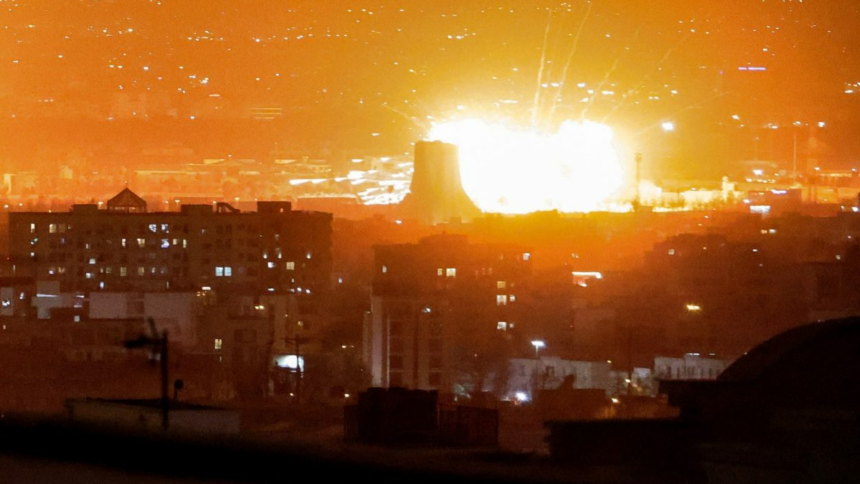
As the war in Iran rages on, fears are growing of a third World War.
Marko Mihkelson, the chair of Estonia’s foreign affairs committee, described the current situation as “the waiting room of World War Three”, while Nato officials told The i Paper that conflicts around the world were increasingly interconnected.
Hamish Mundell, an associate fellow at defence thinktank Rusi, said that “we are in a period that increasingly resembles the kind of unstable prelude that has historically preceded” a World War.
“If history does not repeat itself, it often rhymes. Both world wars were preceded by a series of regional conflicts and escalating crises rather than a single triggering event,” he told The i Paper.
“What we have seen over the last few years, from Ukraine, to the Middle East, to the persistent grey-zone activity; it reflects the gradual breakdown of the post-war international order and the emergence of a looser axis of authoritarian powers willing to challenge it.”
There are several ways in which the war in Iran could expand to incorporate other world powers, bringing new countries into the conflict or escalating among those already involved.
From Europe to the Indo-Pacific, these are some of the scenarios which could lead to global escalations – and how likely experts think they are.
The UK and Europe have remained largely outside of the conflict, with No 10 resisting pressure from US President Donald Trump to join them in airstrikes on Iran.
But they are currently mulling action to clear the Strait of Hormuz, a key waterway through which around 20 per cent of the world’s oil and gas transits. Iran has been bombing the Strait and allegedly laying mines, in a bid to disrupt the global economy and spike energy prices.
Should a mission be launched, Iran could continue to fire missiles or drones at ships aiming to clear the Strait, or sow mines from “otherwise innocent-looking dhows”, according to Nick Childs, a Senior Fellow at the International Institute for Strategic Studies.
But Childs said that in European capitals, the operational risks of a Strait of Hormuz mission will look formidable” and there appears to be “no appetite” for taking on a more challenging mission than the efforts to protect commercial shipping from the Houthis in the Red Sea from February 2024.
To reduce the risk, it seems likely that the UK would only undertake military action in the Strait of Hormuz if an end to bombing is assured.
Military planners from a range of countries will meet in the coming days to discuss practical options to make the Strait accessible and safe – after fighting stops, The i Paper understands.
Dr Patrick Gill-Tiney, an international relations fellow at the London School of Economics, said a mission without Iranian approval would be “prohibitively costly”, meaning it is unlikely that the UK or other European allies would attempt this without US support and some level of Iranian agreement.
A direct attack on British assets already in the region – such as military bases, embassies or naval assets – could lead the UK to join the war offensively, former defence minister Tobias Ellwood said.
There have been a number of near misses for British troops in the Middle East, who have been present at bases attacked by Iran in Bahrain and Iraq. The UK’s own Cyprus airbase, RAF Akrotiri, was also hit by a drone, though there was minimal damage and no casualties.
However, Ellwood said such an attack would likely only trigger retaliation to deter further attacks, rather than a declaration of war from the UK.
“It’s often the case that you would retaliate with a major response to say, look what happens if you dared across this line again. That would be controlling the escalating ladder,” Ellwood told The i Paper.
“It’s often about how far you can push back without triggering something much, much larger in response.”
Ellwood said that the Iran war “could be part of a wider escalation towards a global war, but it won’t look like World War Two.”
“World War Three will look very different indeed,” he said. “World War Three is a world in conflict, where there’s multiple conflicts around the world, where nobody is abiding by global rules anymore. It is possible to alter this, to change this, you’re not past a point of no return.”
But should things escalate, the UK may be ill-equipped to cope with it. Mundell said that “escalation pathways do exist” but that after protracted defence cuts, the UK “increasingly lacks the military tools it once had to manage crises”.
“Our ability to shape events or control how far we are drawn in is limited, and we risk becoming a more passive actor, reacting to crises rather than influencing their trajectory,” he said. “The reason for that is straightforward. Military options depend on capabilities, and capabilities take time, investment and industrial clarity to generate.”
Russia – which insiders said the UK considers its primary security threat – has only peripherally engaged in the war so far but is undoubtedly benefiting from the conflict.
It is “decidedly within Russia’s interest for the US/Israel–Iran war to continue”, Gill-Tiney said.
“It diverts US attention and resources – most notably missile interceptors – away from Europe. It similarly diverts European attention and demonstrates their vulnerability,” he said.
Ellwood agreed that Russia is benefiting economically and militarily, saying it is “now able to sell its own oil at twice the price” and will use the Iran war as a distraction to “advance and push hard in Ukraine”.
All of this may support Russia to launch further aggression in the future, which Nato believes may be targeted at a member state within five years.
Russia is reportedly sharing intelligence with Iran to help it target US assets, but so far, Trump has appeared to be unperturbed by this, saying Russia “may be helping them a bit” but suggesting it was equivalent to US support for Ukraine.
However, Gill-Tiney said that beyond its supply of intelligence to Iran, “it is hard to see Russia becoming more involved” – as it wants to avoid direct confrontation with Europe.
“Russia certainly wants to avoid the US seeing it as a direct threat. That would undo much of the work to convince Trump (and those around him) that Ukraine is the barrier to peace,” he said.
“Secondly, Russia likely has little material capacity to supply Iran with weapons – drone and missile production is high, but is earmarked for its own forces fighting Ukraine. As such, any support is likely to remain limited, covert, and plausibly deniable – largely in the form of satellite targeting or intelligence sharing – and carefully calibrated to remain below escalation thresholds rather than a first step toward more extensive involvement.”
Dr Marina Miron, a researcher in the war studies department at King’s College London, said that at this stage, any escalation between the US and Russia would be indirect.
“As things stand, there would be no direct clash of Russian or US troops. Maybe something like cyber attacks, or trying to gain foothold in regions which are strategically important to Russia, like Armenia,” she said.
“But the White House, under the current administration, is also interested in working with Russia on deconflicting regions such as [the] Arctic, so [Iran’s intelligence sharing] would be considered a very minor thing, given the fact that Iran doesn’t really have the kinds of capabilities that intelligence sharing could basically pose a serious threat to the US.”
There are growing concerns about Chinese aggression towards Taiwan in the Indo-Pacific, with the head of the British Army previously suggesting China could make a move by 2027. Like Russia, China may benefit from the distraction – and military testing ground – caused by the Iran war.
Gill-Tiney said that as the US appears increasingly tied down in the Middle East, attention and military capabilities were diverted away from the Pacific.
“Interceptor stocks have been depleted, and relations with some allies strained, all of which point to a US that is both materially stretched and more isolated than before,” he said.
China will also be learning from the US and Israeli operations, noting their ability to strike large numbers of targets with precision, its capability to target foreign leaders and a willingness to disregard norms against doing so – all of which “may shape Chinese threat perceptions in any future confrontation.”
But Gill-Tiney said that at present there was “little reason for China to become directly involved”, as they are already benefiting without the risk.
Gulf nations have been hit by a barrage of Iranian missiles and drones since the start of the conflict, but have so far chosen not to strike Iran in retaliation. Should they directly attack Iran, the war could expand significantly, engulfing the entire region with lasting political and economic instability.
Bilal Y Saab, Associate Fellow at Chatham House, said that the chances of the Gulf nations going “on the offensive” are low – but that they could reconsider if Iran escalates its attacks on critical infrastructure and civilian areas.
Should the Gulf strike back, Iran may double down on its key assets like oil fields, airports, data centres, and desalination plants, Saab said, and destabilise wider Middle East relations.
It may also align them with Israel, which is “politically perilous” and “could fatally undermine leaders’ credibility with swathes of their populations.”
“Internal political stability is paramount for those authoritarian countries. Fighting an external enemy could strengthen patriotism,” he said. “But some countries like Bahrain, Kuwait, and Saudi Arabia have to worry about entities and cells that can be activated by Iran and threaten their internal security.”
Dr Rob Geist Pinfold, an international security lecturer at King’s College London, said that there were also divisions between the Gulf countries over the possibility of escalation.
“My understanding is that the Qataris and the Omanis are still leaning towards negotiations. The UAE is keen for a much more robust Gulf response, and has been chafing to escalate, and the Saudis, to some degree, have as well,” he said.
Pinfold said that if the Houthi rebels, an Iran-affiliated militant group which has stayed largely out of the conflict so far, increase their involvement, it could draw the Saudis and other Gulf nations in.
“The Saudis are watching the Houthis, and the Houthis are watching the Saudis to see who escalates next, who strikes first,” he said.
“That could be the key determining factor on whether the Gulf states go on the offensive. They don’t want to join a war that they see as the US and Israel’s war, particularly Israel’s war, but they feel like their purely defensive position is not sustainable indefinitely.”
In that case, Geist Pinfold said that Gulf and Israeli planes would not be flying together to bomb Iran, but that the Gulf could involve itself by carrying out an operation against the Houthis in Yemen.
“But for the time being, the Gulf is not sold on this war,” he said. “There’s real fear that America will cajole them to get involved and then pull out, leaving the Gulf states to deal with the mess.”
Impartial news + intelligent debate
All rights reserved. © 2026 Associated Newspapers Limited.
Fears of WWIII are growing. This is what insiders really think – The i Paper



Leave a Comment