


Ambassador Thomas A. Shannon Jr. is no stranger to shifting global orders.
Shannon began his career as a foreign service officer in the early 80s, serving in places such as Guatemala and Cameroon. Over the course of his career, he’s served under nine different presidential administrations and witnessed major shifts in public policy. Recently, the Florida State University community had an opportunity to hear how best to navigate shifts like these from Shannon himself.
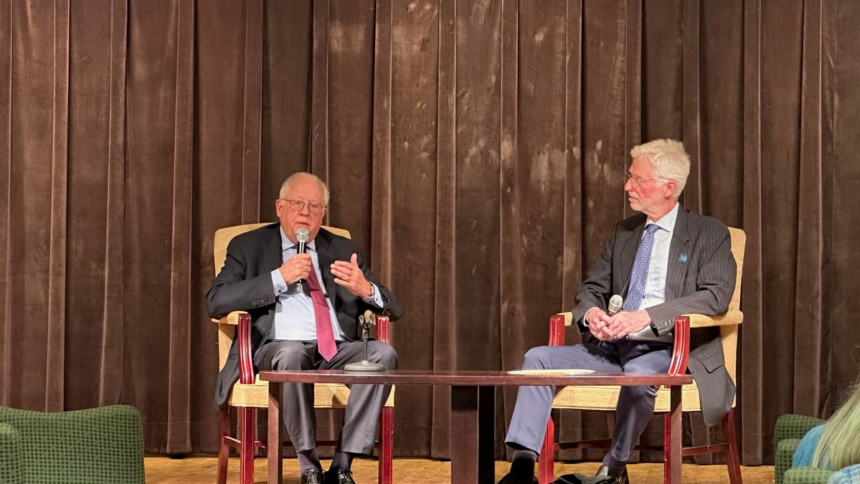
The Center for Global Engagement welcomed Shannon for an evening lecture on foreign affairs in the Globe Auditorium on March 26. The lecture, entitled “Strategic Leadership in the 21st Century: How You Can Shape the Emerging Global Order,” offered a career diplomat’s approach to modern political evolutions, challenges in foreign policy, and how students can play their part in shaping the future of the world.
Featuring moderated discussion and question-and-answer, the lecture created a space of open dialogue on politics and international affairs. Shannon argued that such free discourse, engagement, and discussion allow us to embrace diverse perspectives, which may inspire diverse solutions.
Those who know Shannon will affirm that his diplomatic prowess knows no bounds. Mark Schlakman, senior program director of the FSU Center for the Advancement of Human Rights, worked at the White House alongside Shannon at the end of the Clinton Administration.
“His analytical skills and understanding of history are formidable,” Schlakman told the FSView. “[He] arguably continues to be a quintessential diplomat several years after officially retiring from the Foreign Service.”
Among Shannon’s most noteworthy achievements was his ascension to the role of Counselor — a position very few Foreign Service Officers have occupied. And, in early 2016, he was appointed to the role of Under Secretary of State for Political Affairs: the third most senior position in the U.S. Department of State.
Schlakman said this position meant “compelling global responsibilities,” calling Shannon’s background “extraordinary.”
More: A new era: Trump actions in Iran, Venezuela are ‘uncharted territory’
Shannon began his lecture by putting all political topics on the table for discussion, such as the U.S.-Israeli war with Iran, the Russian invasion of Ukraine, the North Atlantic Treaty Organisation, President Trump’s actions in Venezuela, and U.S.-China relations, to name a few. Shannon infused accessibility into these hot topics, which are often considered too politically charged, complex, or controversial to discuss openly.
“The United States is in the midst of a profound political transformation,” Shannon told the audience. He named globalization and technology as forces that have “outpaced the ability of our political leaders and our political institutions.”
With increasing international interconnectivity, the rise of artificial intelligence, and continuing demands for social justice and equality, the American people are looking to their government for answers. The New York Times latest presidential approval polling average shows that 56% of Americans disapprove of the Trump Administration’s responses to the current political moment.
“The American people are moving from party to party, from leader to leader, looking for political leadership that they have a degree of trust and confidence in,” Shannon said, acknowledging that the United States seeks to understand their purpose and political trajectory in the world.
Never miss a beat: Sign up for the FSView newsletter
Every day, Americans feel a deepening divide between Democrats and Republicans. The U.S. government struggles to find consensus across partisan politics, as seen in the recent struggle to reopen the Department of Homeland Security. Shannon posited that this signals something beyond polarization.
“I would actually say that we live in a fragmented and fractured America, politically,” he said, citing the binary nature of U.S. political institutions as the cause behind this effect.
Shannon gave the audience his assessment of American international relations. He said President Trump imagines a U.S. sphere of interest that includes Canada, Greenland, and Panama, hence his vigor for acquiring these regions. This approach to foreign policy breaks from the principles of the international community and alliance embraced after World War II, which had birthed institutions like the United Nations.
“President Trump represents a counter-revolution in American foreign policy,” Shannon said. “The President began to articulate a vision for the world that is really pre-World War II.
It is a vision of the world in which our central security focus is our hemisphere.”
Shannon also argued that people should rethink the U.S. role on the world stage. For example, the ongoing U.S.-Israeli war with Iran raises questions about the purpose and direction of American power overseas.
“In the world we live in, values matter. There’s an effort right now to present power as the defining characteristic of international relations … But power, absent of principle, and absent of purpose, is an empty vessel,” Shannon said.
International affairs major Thomas Shallenberger told the FSView that Shannon’s lecture reinforced his own ideas of how politics and society are evolving.
“I feel like in general we’ve moved more towards social connection and community connection rather than political connection, which is, in my opinion, a good thing,” he said.
More: Greenland and the United States: Students share their perspectives
Shannon discussed the importance of connecting “society to society” and “people to people” in foreign affairs. He referenced the dismantlement of USAID, which was poised to show American solidarity with global development.
Samantha Macarounis, a clinical professions student who attended the lecture, called Shannon’s presentation “very insightful.” She told the FSView that it evoked an outward-looking perspective, helping her see “the bigger picture.”
“You are not just an individual in an individual country; you are an individual in a global community,” Macarounis said as she reflected upon the lecture.
At the end of his lecture, Shannon turned to student attendees, emphasizing that now is not the time to be afraid. Rather, “This is a time to understand that we are in a moment of change.”
Shannon’s lecture made foreign policy and international affairs feel personal; he encouraged the audience to engage in political discussions and to actively shape a new global order, as their opinions and actions will prove important.
“Together we have a remarkable opportunity to transform the emerging global order on a scale that hasn’t presented in decades,” Schlakman said. “We must think boldly. We don’t have the luxury of being cynical.”
In the post-lecture moderated discussion, Schlakman referenced the Ambassador’s “focus upon the power of the possible,” reminding the audience of Shannon’s encouragement of students to step up to the plate when leadership calls.
“Your generation will be judged,” Shannon predicted. He left students with one unforgettable piece of advice: “Get it right.”
Amelie Galbraith and Leah Ursini are Staff Writers for the FSView & Florida Flambeau, the student-run, independent online news service for the FSU community. Email our staff at contact@fsview.com.
The American ‘counterrevolution’ explained by a US Ambassador – FSView & Florida Flambeau



Leave a Comment