




Go behind the headlines: From the economy and healthcare to politics and the environment – and so much more – On Point talks with newsmakers and real people about the issues that matter most. On Point is produced by WBUR for NPR.
The EPA has proposed adding microplastics and pharmaceuticals to a list of priority contaminants.
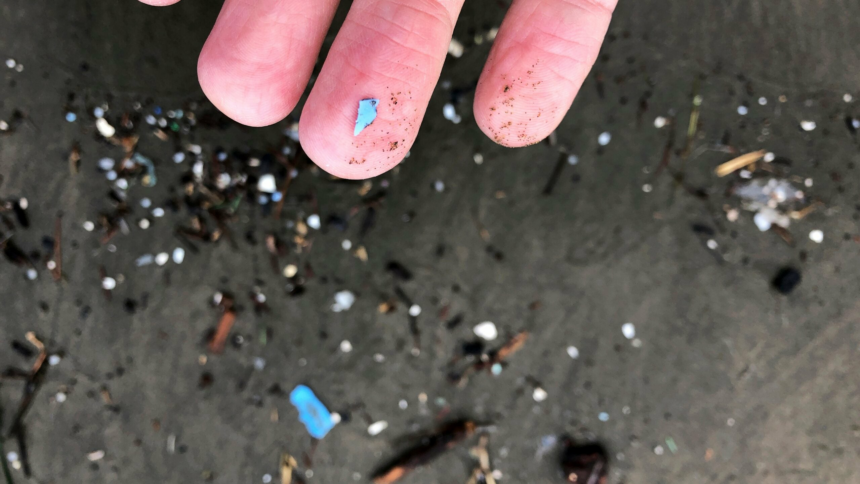
File – This Jan. 19, 2020 photo shows microplastic debris washed up in Oregon. (AP Photo/Andrew Selsky)
This story is part of the WHYY News Climate Desk, bringing you news and solutions for our changing region.
From the Poconos to the Jersey Shore to the mouth of the Delaware Bay, what do you want to know about climate change? What would you like us to cover? Get in touch.
President Donald Trump’s administration announced Thursday it wants to fund research on microplastics and pharmaceuticals in public drinking water and examine their potential health impacts. The proposal could help environmental regulators create future drinking water restrictions.
The federal government also announced a $144 million program to measure, research and remove microplastics from the human body as part of the administration’s Make America Healthy Again initiative. The program will prioritize pregnant people, children, patients with chronic conditions and workers in high-exposure environments.
“We will give the American people clear answers about what’s in their bodies and what it means for their health,” said U.S. Department of Health and Human Services Secretary Robert F. Kennedy Jr.
How do microplastics enter our bodies?
Microplastics are tiny particles derived from plastic waste that break down into small pieces, contaminating soil, air, food and water. Once ingested, microplastics can bioaccumulate in the body.
Pharmaceuticals, from antidepressants to pain relievers, are known to enter water systems through human waste and improper disposal. A 2008 Associated Press investigation found pharmaceuticals in the drinking water supplies of at least 41 million Americans. The Philadelphia Water Department had some of the highest levels.
Every five years, the Safe Drinking Water Act requires the Environmental Protection Agency to publish a list of unregulated contaminants to help prioritize research and funding. The list supports the agency in making decisions about potential drinking water regulations. The EPA’s draft Sixth Contaminant Candidate List features both microplastics and pharmaceuticals.
Temple researchers hope to remove PFAS, microplastics with sustainable treatment method
Water providers are removing toxic PFAS chemicals from drinking water, but current methods are energy intensive. Temple researchers are looking at alternative technologies.
2 months ago
The list also identifies toxic PFAS, or “forever chemicals” because they don’t break down naturally, and disinfection byproducts, as well as 75 chemicals and nine microbes that may appear in drinking water.
“This is a direct response to the concern of millions of Americans who have long demanded answers about what they and their families are drinking every day,” said EPA Administrator Lee Zeldin in a statement. “This will allow us to better understand the potential risks of these substances in drinking water while advancing gold standard science.”
In recent years, growing concerns about the health impacts of microplastics have spurred greater research urgency. Some researchers say exposure to microplastics could increase heart attack or stroke risks.
However, people are more likely to be exposed to microplastics from plastic bottles and food containers, said Samantha McBride, an assistant professor at the University of Pennsylvania who has researched microplastics.
“We have done some experiments ourselves in the lab, where we compare the microplastic in plastic bottled water, also within aluminum cans, which have a plastic liner,” she said. “The amount of microplastics in tap water is absolutely minimal compared to those other sources.”
There has been far more research on the scope of pharmaceuticals in surface water and drinking water, said Heather Preisendanz, a professor of agricultural and biological engineering at Penn State University. While commonly detected in waterways and tap water, levels of pharmaceuticals remain well below prescribed doses.
“If you are near a potential source like wastewater treatment plants that don’t fully remove pharmaceuticals in the influent water, then they’re going to be discharged into the receiving stream,” Preisendanz said. “We often see them transported through groundwater pathways, as well to surface water bodies, because they’re not fully treated in septic tank systems.”
Pennsylvania lawmakers push for new clean up law, a year after Upper Makefield pipeline leak
The legislation comes as Mt. Eyre residents continue to grapple with the Sunoco pipeline leak that contaminated six wells with jet fuel.
2 months ago
The EPA also announced Thursday that it is releasing so-called “human health benchmarks” for 374 pharmaceuticals. Though unenforceable, the benchmarks could help local water systems evaluate risks and protect their communities if contaminants reach concerning levels.
The general public is encouraged to submit comments on the proposed list for 60 days.
Never miss a moment with the WHYY Listen App!
Play, pause, and rewind the live radio stream, access on-demand audio features, and dive into podcasts from both local and national sources.
WHYY is your source for fact-based, in-depth journalism and information. As a nonprofit organization, we rely on financial support from readers like you. Please give today.
Preserving Our Water: How we use our Delaware Watershed.
The project is funded by The William Penn Foundation.
‘Right plant, right place’: Philly Flower Show encourages adapting to climate change
Gardeners learn how to be more sustainable while adapting to climate change during the Philadelphia Flower Show.
4 weeks ago
Pa., N.J. and Del. could see increased risk of power outages due to supply and demand crunch on regional grid
Grid operator PJM was unable to secure enough promised power to reach its reliability goal during an auction this week.
3 months ago
Delaware City Refinery failed to immediately report accurate butane emissions
The refinery has received more than 50 violations over the last decade.
4 months ago
4 hours ago
4 hours ago
5 hours ago
Want a digest of WHYY’s programs, events & stories? Sign up for our weekly newsletter.
Together we can reach 100% of WHYY’s fiscal year goal
WHYY provides trustworthy, fact-based, local news and information and world-class entertainment to everyone in our community.
WHYY offers a voice to those not heard, a platform to share everyone’s stories, a foundation to empower early and lifelong learners and a trusted space for unbiased news. Learn more about Social Responsibility at WHYY. It’s how we live.
215.351.1200
talkback@whyy.org
302.516.7506
talkback@whyy.org
© 2026 WHYY



