


News
An international consortium of more than 80 researchers from over 30 institutions across nine countries is calling for a coordinated, worldwide effort to map gene expression across every cell type and developmental stage of wheat.
In a major perspective article published in Nature Genetics, the Wheat Spatial Omics Consortium (WSOC), led by researchers from Murdoch University’s Centre for Crop and Food Innovation (CCFI), Adelaide University, BGI Research and Xianghu Laboratory present a strategic framework outlining how spatial omics technologies can transform wheat research by revealing how individual cell types respond to stress, regulate grain development and control yield-related traits.
Wheat provides roughly 35% of global dietary calories and feeds more than a third of the world’s population.
With the global population projected to reach 9.8 billion by 2050, wheat production must increase by an estimated 60% to keep pace with demand; a target increasingly threatened by climate change, drought, heat stress and emerging diseases.
The paper details how spatial omics technologies, which map gene activity, proteins, and metabolites at the cellular level while preserving tissue architecture, can amplify the precision of genomics research to levels previously impossible with traditional bulk-tissue approaches.
The consortium has proposed a systematic experimental framework that goes well beyond current spatial transcriptomics research on wheat, calling for future efforts to encompass diverse wheat accessions, growth stages, tissues, stress treatments, and time points.
The authors also call for a multi-omics approach, which they consider essential for moving beyond description to a mechanistic understanding of how genes, proteins, and metabolic pathways interact within intact tissues.
They add that artificial intelligence, including deep learning models for cell segmentation, graph-based spatial analysis and large language model-driven automation of research workflows, will be a key enabler for analysing the massive, multilayered datasets generated from this work, thereby dramatically narrowing the list of candidate genes and accelerating the discovery of elite genetic variants.
In a statement, co-corresponding author and CCFI Director, Professor Rajeev Varshney, explained:
Co-corresponding author of the study, Professor Zhong-Hua Chen from Adelaide University, explained:
“Our ambition is to build a comprehensive spatial omics atlas to benefit the whole wheat community. By mapping wheat biology at subcellular resolution across the full life cycle, WSOC aims to decode the integrated mechanisms of wheat development, stress response, and grain quality.”
The paper also acknowledges substantial barriers to spatial omics research, including the difficulty of preparing plant tissue samples for spatial capture, the scarcity of wheat-specific antibodies for protein profiling, computational bottlenecks from massive hexaploid datasets, and the absence of standardised data formats across studies.
The authors outline concrete strategies for each, ranging from adopting medical research imaging techniques to developing cloud-based data platforms.
Murdoch University Deputy Vice Chancellor Research and Innovation, Professor Peter Eastwood, said:
Pro Vice Chancellor of the Food Futures Institute at Murdoch University, Professor Peter Davies, added:
“The WA grain industry has recently announced a target of 30 million tonnes of grain per year and growth to a $20 billion/annum industry by 2035. Through ambitious, innovative, and collaborative research approaches such as this, we can turn that vision into a reality. Congratulations to all the authors for this important call to action, and I look forward to hosting the international plant spatiotemporal omics research community at Plant STOC 26 this September.”
WSOC, which includes leading wheat researchers from Australia, China, India, the UK, Germany, Israel, Japan, Mexico, and Canada, has also called for the international wheat community to join the Consortium and advance the collective understanding of this complex, yet critically important crop.
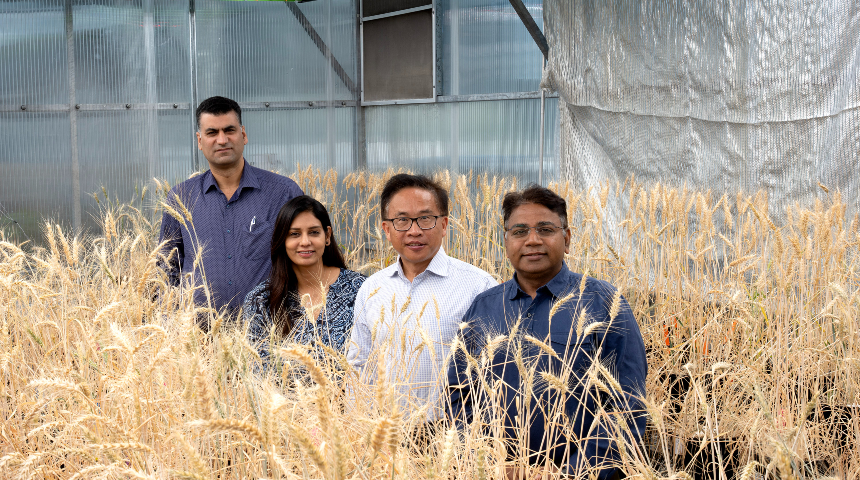
Image: Key WSOC Members from Murdoch University
News
Posted on
Topics
Research, Science
Explore the Murdoch experience
Browse news and opinion by topic
Looking for an expert opinion?
Find an expert
We acknowledge that Murdoch University is situated on the lands of the Whadjuk and Binjareb Noongar people. We pay our respect to their enduring and dynamic culture and the leadership of Noongar Elders past and present. The Boodjar (Country) on which Murdoch University is located has, for thousands of years, been a place of learning. We at Murdoch University are proud to continue this long tradition.
Find out more about our commitment to the Aboriginal and Torres Strait Islander community.