


The ocean may look the same on the surface, but a profound change is happening in the water to phytoplankton – tiny organisms that form the base of the ocean’s food chain.
Scientists have found that climate change is not only warming the oceans but is also changing the quality and nutritional value of the food that supports marine life.
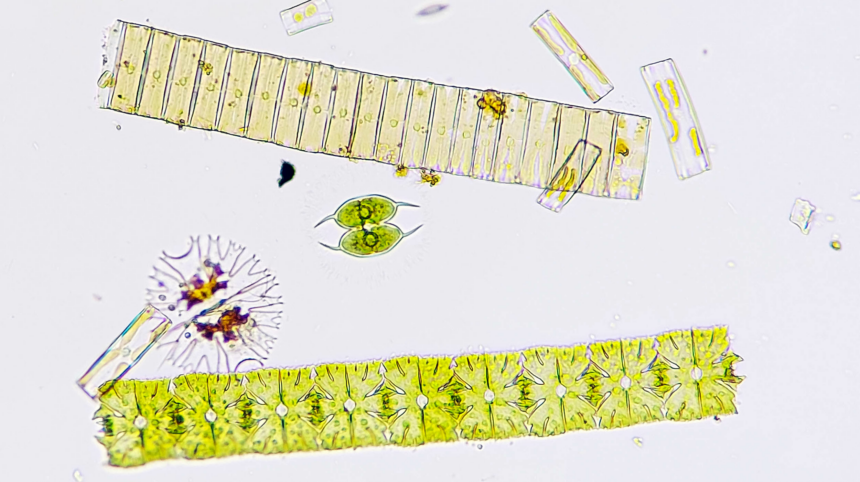
Phytoplankton are tiny, plant-like organisms that float near the ocean surface. Even though they are microscopic, they play a huge role.
These organisms produce a large share of the world’s organic matter by converting carbon dioxide into food using sunlight.
Small marine animals such as krill and snails eat phytoplankton. Fish eat these animals, and larger predators eat the fish. This chain continues until it reaches humans. Because phytoplankton sit at the base of this system, any change in their quality affects the entire ocean.
Scientists already knew that temperature affects how many phytoplankton grow. Now, new research shows that their nutritional makeup is also changing.
A study from the Massachusetts Institute of Technology (MIT) and partner organizations shows that phytoplankton are changing in response to climate conditions.
The research explains that phytoplankton are made mostly of proteins, carbohydrates, and lipids. Right now, proteins form a large part of their structure, while carbohydrates and lipids make up the rest.
As temperatures rise, this balance begins to shift. Warmer oceans lead to less protein and more carbohydrates and fats. This means the food becomes less nutritious, even if it still provides energy.
“We’re moving in the poles toward a sort of fast-food ocean,” said lead author and MIT postdoctoral researcher Shlomit Sharoni. “Based on this prediction, the nutritional composition of the surface ocean will look very different by the end of the century.”
Every living thing depends on macromolecules such as proteins, carbohydrates, and lipids. Proteins help build and repair cells. Carbohydrates provide quick energy. Lipids store energy for later use.
Environmental conditions determine how much of each type an organism produces. In areas with low nutrients but high light, phytoplankton produce more carbohydrates and lipids. In contrast, in colder and nutrient-rich regions, phytoplankton produce more proteins.
“Nearly all the material in a living organism is in these broad molecular forms, each having a particular physiological function, depending on the circumstances that the organism finds itself in,” said Professor Mick Follows from MIT.
This balance is important because animals need protein-rich food to grow and survive.
Climate change affects oceans in several ways. It increases temperatures, melts sea ice, and reduces the mixing of ocean layers. This mixing is important because it brings nutrients from deep water to the surface.
The study shows that ocean surface temperatures may rise significantly by the end of the century. This warming reduces nutrient supply and changes how phytoplankton grow.
With less sea ice, more sunlight reaches the water. As a result, phytoplankton no longer need to produce as many proteins to capture light. Instead, they store more energy as fats and carbohydrates.
The impact of climate change is not the same everywhere. In polar regions, phytoplankton may grow in larger numbers because of increased sunlight. However, their protein content may drop significantly.
At the same time, carbohydrates and lipids increase. These molecules provide more calories but less nutrition. In fact, the energy content of phytoplankton may increase in some regions because lipids store more energy, even though protein decreases.
In subtropical regions, the situation is different. Phytoplankton numbers may decrease due to fewer nutrients. Some may move deeper into the ocean, where conditions are better. In these areas, protein levels may slightly increase, but overall productivity drops.
These changes can affect the entire food web. Many marine animals depend on protein-rich phytoplankton. A drop in protein can reduce growth, reproduction, and survival of species such as zooplankton and fish.
Studies show that animals feeding on low-protein algae produce fewer eggs and grow more slowly. This effect can move up the food chain and affect fish populations and even the human food supply.
“In these regions, you can already see climate change because sea ice is already melting,” said Sharoni. “Our model shows that proteins in polar plankton have been declining, while carbs and lipids are increasing.”
“It turns out that climate change is accelerating in the Arctic, and we have data showing that the composition of phytoplankton has already responded,” Follows said.
“The main message is that the caloric content at the base of the marine food web is already changing. And it’s not clear how this change will move through the food web.”
More calories do not always mean better nutrition. This uncertainty makes it difficult to predict how fish, marine ecosystems, and human food systems will respond in the coming years.
This research shows that climate change is not just about rising temperatures. It is also changing the quality of food in the ocean. Even tiny organisms like phytoplankton can shape the future of marine life.
Scientists also found that these changes may affect how oceans store carbon and support ecosystems. A shift toward more carbon-rich molecules like lipids may change how the ocean handles carbon dioxide.
The ocean may still produce food, but its quality is slowly changing. This hidden shift could have long-lasting effects on ecosystems and human life.
The study is published in the journal Nature Climate Change.
—–
Like what you read? Subscribe to our newsletter for engaging articles, exclusive content, and the latest updates.
Check us out on EarthSnap, a free app brought to you by Eric Ralls and Earth.com.
—–
Phytoplankton are the most crucial ocean food source, and they are losing their nutritional value – Earth.com



Leave a Comment