


If you would like to give to a specific research program or support the work of a particular researcher, contact our fundraising team today.
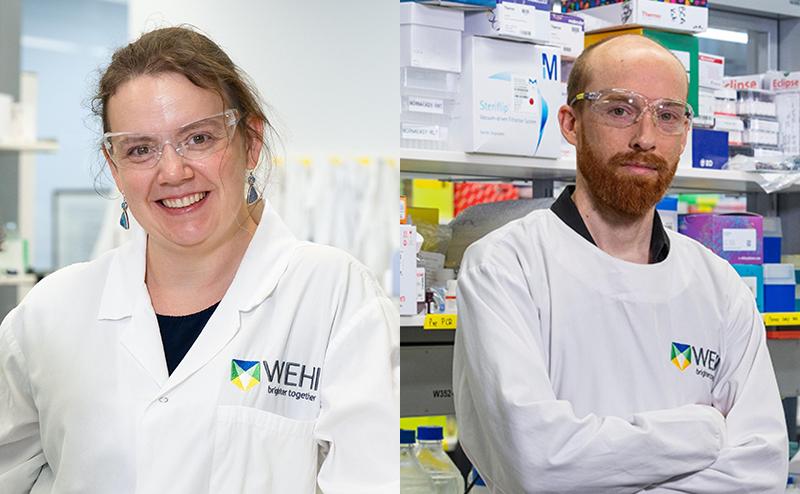
WEHI researchers Associate Professor Alisa Glukhova and Dr Tom Weber have been honoured with prestigious National Health and Medical Research Council (NHMRC) Research Excellence Awards.
The Research Excellence Awards are presented each year to the highest‑ranked researchers following peer review of applications to NHMRC’s grant programs.
Associate Professor Alisa Glukhova, who is funded by the Snow Medical Research Foundation, has been recognised with two prestigious awards for her outstanding research investigating the structural biology of cell-signalling pathways.
The Commonwealth Health Minister’s Award for Excellence in Health and Medical Research recognises the highest‑scoring applicant in the Emerging Leadership Level 2 Investigator Grant round.
As this year’s leading recipient, Assoc Prof Glukhova was also awarded the NHMRC Peter Doherty Investigator Grant Award, which celebrates the top‑ranked researcher across the Emerging Leadership and Leadership categories.
Cells sense and respond to external cues by activating distinct signalling pathways. Assoc Prof Glukhova’s focus is on the Wnt pathway, which is important for embryonic development and helps control how cells grow and specialise.
When this pathway becomes dysregulated in adults, it can trigger abnormal cell division that may lead to cancers including gastric, breast and ovarian, making it a promising target for drug development.
Using structural biology, Assoc Prof Glukhova examines critical stages in this pathway at the molecular level to show how Wnt receptors initiate signalling, and designs antibody-based tools that selectively target Wnt receptors.
The Wnt pathway has potential as a cancer drug target, but its essential role in normal, healthy processes makes it difficult to target safely.
“My vision is to uncover how signals are transmitted through the Wnt signalling pathway and translate these insights into novel cancer therapies,” said Assoc Prof Glukhova, a WEHI laboratory head and Snow Fellow.
“By revealing how this pathway operates in health and disease, this work will help shape much needed strategies for therapeutic intervention.”
Dr Tom Weber received the 2025 NHMRC Marshall and Warren Innovation Award, which recognises the most innovative and potentially transformative Ideas Grant recipient.
His work focuses on the development of novel tools to understand how complex organisms form from a single cell.
Embryonic cells go through short‑lived states and make important fate decisions. These early events have major effects on an embryo’s later development, but they are hard to capture with current technology.
Modern tools like single‑cell RNA sequencing can now measure exactly which genes are active in individual embryonic cells. This has allowed scientists to create detailed maps of embryo development in mice.
However, this data provides only snapshots at specific times. It cannot show which cells are related to each other or how one cell turns into another over time.
Dr Weber is creating a molecular ‘recorder’ called rePEat (Recurrent Prime Editing Accumulating over Time) that encodes lineage and developmental signals directly into the genome.
These DNA recorders keep adding information to one location in the genome, creating a genetic log that is passed down to future cells.
“We can then read and analyse this log using long‑read sequencing, decoding, advanced analysis and computational modelling,” said Dr Weber.
“This technology, applied to mouse embryogenesis, will show a high resolution ‘movie’ of development, revealing how early decisions propagate into tissues and organs.”.
Determining what cells will go on to become is important not just for understanding normal development, but also for identifying when and why things go wrong, leading to disease and disorders.
Your support will help WEHI’s researchers make discoveries and find treatments to ensure healthier, longer lives for you and your loved ones.
We acknowledge the Wurundjeri people of the Kulin Nation as the traditional owners of the land where our campuses are located, and recognise their continuing connection to Country and community.
WEHI is committed to fostering an inclusive workplace where people with diverse identities can flourish in a safe and supportive environment.
By using this website, you agree to our use of cookies in accordance with our Privacy Policy and Terms of use.