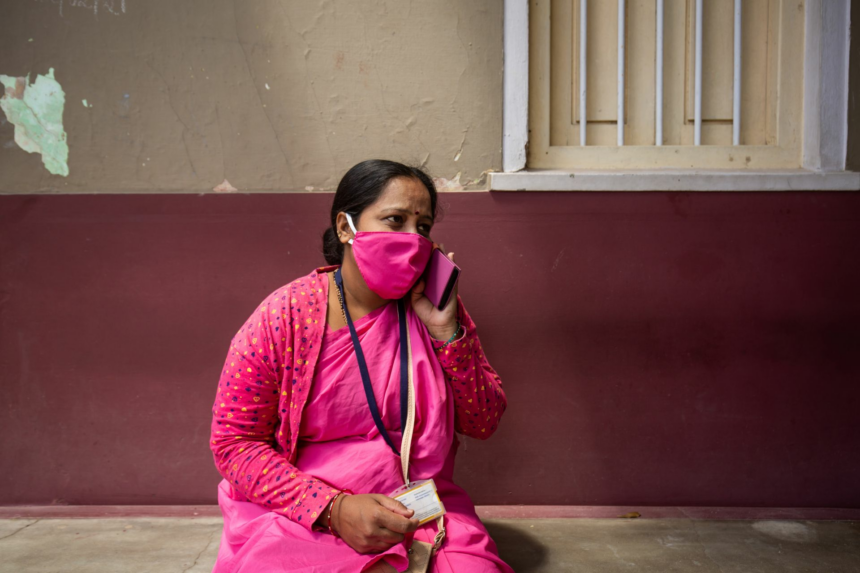
“The mobile phone has been stuck to my ear since the pandemic,” joked Rohini Pawar, 38, a community health worker from Walhe village in the western Indian state of Maharashtra. After hours of field surveys, Pawar returns home to tend to her 7-year-old son’s schoolwork and finish household chores. But her workday isn’t over. She must sit down with her phone — not to text friends or scroll through Instagram reels — but to update supervisors on her work across multiple health department WhatsApp groups and complete mandatory recordkeeping in an expanding list of government apps.
Pawar is an accredited social health activist, commonly called an ASHA worker. She is part of India’s all-women team, over 1 million strong, which forms the backbone of the country’s community health system. ASHA workers track pregnancies, immunizations, nutrition in children and more, each one tasked with overseeing hundreds of cases at a time in her respective village.
Established in 2005 to improve India’s maternal and child health indicators, the program employs married women in villages who have at least a middle school education, and is one of the largest publicly funded community health worker initiatives in the world. Over time, it has expanded to address additional health priorities, including noncommunicable diseases, tuberculosis elimination, family planning, mental health, disease surveillance and, now, the introduction of rural digital health records.
Since the pandemic, a new workload has quietly emerged. The digital transformation, which promised to streamline health care, has instead added an unpaid second shift — this time on the ASHA workers’ phones.
Pawar currently juggles seven different apps, along with numerous WhatsApp groups, Google Sheets and Excel files required by her supervisors. Each platform comes with its own login, formatting rules, update schedule and glitches. “It’s overwhelming and time-consuming,” said Pawar, who was recently hospitalized due to stress-related ailments.
When she was first introduced to digital apps, Pawar — who enjoys making Instagram reels with her friends — welcomed the change. The technology was meant to streamline her work and make payments more transparent. Four years later, the stress was evident. “It has to be done along with maintaining physical records in our registers. There are times I’m working until midnight to complete records both offline and online,” she said.
In September 2021, the Indian government launched Ayushman Bharat Digital Mission, aiming to build a digital health ecosystem — from vaccines to teleconsultation to real-time patient tracking and disease surveillance. In practice, however, this new infrastructure relies heavily on the underpaid labor of front-line health workers like Pawar, who must update rural health records late into the night without proper compensation, government-issued smartphones or regular training.
Most front-line workers spend their own money on phones and internet data plans to meet this digital workload. The system also fails to account for the realities of rural India, where conservative gender norms restrict women’s phone and internet usage, often under the belief that it makes them wayward. This creates a dual burden on the women, who must navigate societal expectations while fulfilling often underpaid work obligations that demand long hours on their devices.
Recordkeeping has always been a crucial part of an ASHA worker’s duties. Traditionally, they maintained handwritten diaries and registers with patient details, but an ever-expanding list of apps, portals and dashboards has been added to that workload. It takes Netradipa Patil, 51, an ASHA worker from Shirol, Maharashtra, almost two days to enter details of 200 patients on Ni-Kshay, an app used for the tuberculosis elimination program. “Very often, you get an error message, forcing us to redo everything again,” she told New Lines.
Patil initially welcomed the “digital flood” that began after the pandemic, just like Pawar. “Since 2022, almost everything has gone digital. Now we do everything twice — once online, and again on paper,” she said. She carries four thick notebooks, called ASHA diaries, wherever she goes, recording all details about beneficiaries before entering the same information into multiple apps.
And as Patil explained, the apps are developed by people far removed from the ground realities of a front-line health worker. The app for creating health ID cards “logs off every 15 minutes for security reasons. This may be a good thing, but given how detailed the process is, the average ASHA worker takes longer than 15 minutes to complete it,” she said. “There’s no save option, so once the app logs off, we need to restart all over again. Can you imagine the time taken?”
For Patil, digital literacy is not a barrier. She runs a YouTube channel on ASHA labor rights. But for many workers, especially those from remote areas with limited education, navigating these tools is challenging. Before the pandemic, training was conducted in person, usually for tasks such as checking blood pressure and monitoring temperature, with facilitators demonstrating each step. Now, most training is delivered via WhatsApp videos, PowerPoint slides or brief online calls, which older workers, or those with limited literacy, often find unhelpful.
Even workers who can manage WhatsApp or YouTube struggle with apps featuring layered menus, English terminology and complex forms. They require regular training and troubleshooting, yet both remain insufficient.
For Kalpana (who only shared her first name), a 53-year-old ASHA worker from Lahar in Madhya Pradesh, the digital shift has been alienating. She has spent decades building trust in her community by counseling adolescents on menstrual hygiene and supporting pregnant women. Today, much of her time is consumed by screens. “When do I help my community if I have to keep doing this work?” she asked.
Kalpana’s frustration is echoed across states. Online training assumes a level of digital literacy that many workers lack. A 2025 Indian government survey found that 64% of rural women in the country cannot perform basic smartphone tasks. Offline troubleshooting is virtually nonexistent, and WhatsApp messages to supervisors often trigger long chains of referrals, none of which address the underlying problem.
In December 2024, when officials in Bihar discovered that health data for nearly 20 million people had not been uploaded, ASHA workers cited inadequate training and technical support as key reasons. “Digital literacy is the biggest issue,” said Dr. Anand Dixit, a senior program officer at Jhpiego, a United States-based nonprofit focused on women’s health. He trains community health workers in Munger, Sheikhpura, Lakhisarai and several other areas across the state of Bihar.
“Even though most ASHAs have studied up to the 8th grade, many cannot read properly. In practice, their sons or husbands often fill out the complex forms for them,” Dixit said. The result is duplication and data errors, sometimes bordering on dark comedy. “I once came across an ASHA worker who mistakenly filled in details for a man who had already died,” he said. “That record still went through the system.”
“You can’t expect an Adivasi [Indigenous] or Mahadalit [an oppressed caste community] ASHA worker who hasn’t been educated much to learn from PowerPoints and guidelines in English or Hindi. You have to speak in her language, in her cultural context, for her to understand,” Dixit said. “The training model is one-size-fits-all, but the workers have different capabilities.” He argued that digitization is built on assumptions that ignore the lived realities of the women tasked with implementing it.
Sunita Rani, an ASHA worker and union leader from the northern state of Haryana, said that only about 3,000 workers with a high school education are able to complete all their digital tasks — this in a state that has over 20,000 ASHA workers. The pressure to upload health records within tight deadlines sometimes leads to dishonesty, she added, particularly because an ASHA worker’s incentives are tied to the completion of these records.
“Some ASHA workers mark false entries, showing a child as vaccinated even if the vaccine wasn’t given,” she said. “Officials above her may also pressurize workers to upload fake data to boost their own performance metrics, and an ASHA has to comply because her payment depends on their sign-offs. This distorts the entire health database.”
The pressure to upload data within tight deadlines has also raised surveillance concerns. In Haryana, ASHA workers were asked to download “MDM360 Shield,” an app with a location tracker that recorded their movements throughout the day. In June 2021, over 20,000 ASHAs protested, refusing to use the phones until the app was withdrawn. “We demanded they take the phones back since we did not want to use such an app,” Rani said. The app was eventually removed.
In Chhatrapati Sambhajinagar district, located in Maharashtra, the app Hajeri, which means “attendance” in Marathi, required ASHA workers to log in multiple times a day with location verification, despite protests from workers, including Patil. In Telangana, workers similarly protested against GPS-tracking requirements in 2025. In both cases, nothing has been withdrawn, and officials offered only feeble assurances.
This constant monitoring is at odds with India’s new data protection framework, Digital Personal Data Protection Rules 2025, which promises enhanced safeguards for how personal data is collected, processed and stored. Experts argue that many safeguards are postponed to 2027, and transparency has been weakened. India has also asked that all new smartphones come preloaded with a state-run cybersecurity app, raising concerns over surveillance and compromised privacy. The order was scrapped after much public outrage. Yet the ASHA workers’ phones are already subject to surveillance tools, about which they are rarely informed, embedded into apps meant for recordkeeping or tracking attendance.
In September 2025, when Patil accompanied a delegation of ASHA workers from several states to the National Health Mission (NHM) office in Delhi, she encountered a shocking oversight. “The senior officials thought we only worked for four hours. Just completing the digital tasks takes that much time. Add field work for surveys, hospital runs with pregnant women and reporting to the primary health center, and most of us end up working for at least six to eight hours most days,” she said.
Mohammed Sadiq Khan, an NHM trainer for ASHA workers since 2005, agreed that the system lacks adequate digital infrastructure. “The biggest problem starts with the lack of a [government-issued] device to work on,” he told New Lines. Senior officials from the NHM did not respond to New Lines for comment.
Most Indian states do not provide phones to ASHA workers. A few exceptions exist. Rajasthan, for example, rolled out a plan to equip over 50,000 workers with Android smartphones, and Maharashtra implemented a similar program in select regions in 2019. However, these efforts remain partial or are plagued with issues like faulty devices, inconsistent rollouts, and phones embedded with intrusive tracking apps that workers eventually returned. All ASHA workers New Lines spoke to in Maharashtra continue to use their own phones for recordkeeping.
In Odisha, Matilda Kullu, 48, received an internet data card from a government-run service provider, but the network barely worked in Sundergarh, a remote district known for coal and iron ore mining. As a result, Kullu and many other ASHA workers had to purchase a second SIM card from private providers to complete their work.
“We pay for that one,” Kullu told New Lines. Data usage can easily be three to four times the $1.15 data allowance they receive monthly. A low-end smartphone costs between $135 and $170, often more than what many ASHA workers earn in a month. (Since ASHA workers are classified as volunteers and don’t have a fixed income, their compensation consists of a stipend of nearly $40 and incentives tied to different tasks. On average, they make between $55 and $165 in a month, if payments reach them on time.) So Kullu uses her daughter’s old phone. “It hangs all the time. Sometimes it takes 20 to 30 minutes to fill one person’s details,” she said. That’s because mobile penetration (and, with it, data speeds) stands at just 59% in the rural areas where ASHA workers operate, lagging far behind urban connectivity.
The digitalization drive has also collided with deeply gendered norms in rural India, where conservative and patriarchal households limit women’s access to technology as a form of control. Only 56% of rural women in the country own a smartphone, and many share devices with husbands or sons. Long hours spent on phones often arouse suspicion at home, prompting questions such as: “Who are you talking to? Why are you online so late? Why do you need to text a man?”
Mahendra Kumar, a social worker and gender rights activist who runs Mitra Bundelkhand, a nonprofit focused on gender awareness among men across Madhya Pradesh and Uttar Pradesh, has witnessed this firsthand. “Family members don’t understand why ASHA workers need to be on the phone constantly, especially because there are no fixed hours for calls. They have to answer the phone if there’s a delivery or an emergency, even at night. It leads to taunts from the family,” he told New Lines.
This intersection of technology and gender norms has also exposed ASHA workers to harassment. A worker’s number is available to everyone in her community. One worker, a widow from Haryana who requested anonymity, was repeatedly harassed during a family planning survey. “Some men from the village would call at odd hours and ask if I had a condom and would catcall me if I passed by on the road,” she told New Lines. “I was scared to move around after dark and stopped going out for a while.” She added that her supervisor in the region ignored her complaint.
In parts of rural Haryana, customs such as wearing a “ghoonghat” (veil) make it difficult for women to use phones outside, leaving them vulnerable to scrutiny and insinuation. “Many villagers believe that women who talk on phones are talking to men and will go astray,” Rani said. The imposition of technology without taking these social structures into account risks deepening inequalities rather than bridging them.
A year ago, Kullu had to leave home at 11 p.m. to visit households across the village and upload beneficiary data on the ABHA app. “I had no choice; the internet worked best at night,” she laughed. “Others did it, too.” But this late-night work comes with no overtime pay or safety safeguards for the women. Villages are often spread across large areas of agricultural land and forest, and Kullu has to walk miles along poorly lit paths, facing the threat of both humans and wild animals.
“There’s also a stigma about women working outside after dark in some families, which leads to friction,” she said. Kullu and her peers eventually protested and decided to halt the work. “It wasn’t worth the risk and the measly incentive involved.”
Despite these challenges, most ASHA workers are known for their sincerity and care in community work. “This work has given me freedom and agency and allowed me to fight for gender rights,” Pawar said. “We don’t mind digital work, provided there is a balance between expectations and timely payments.” For Patil, being an ASHA worker is “more than a job.” “The almost 1,000 people in my community have become family for me,” she said.
During her visit to the NHM office in Delhi, Patil requested that officials responsible for rules and digital mandates come to the field to understand the workers’ challenges firsthand. “Try uploading information in the poor network zones like us; try doing field visits and multiple digital entries on the same day. Only then will you understand that we are not resisting change. We want to work smart, but we need the system to work with us, not against us.”
Become a member today to receive access to all our paywalled essays and the best of New Lines delivered to your inbox through our newsletters.
Will be used in accordance with our Privacy Policy