

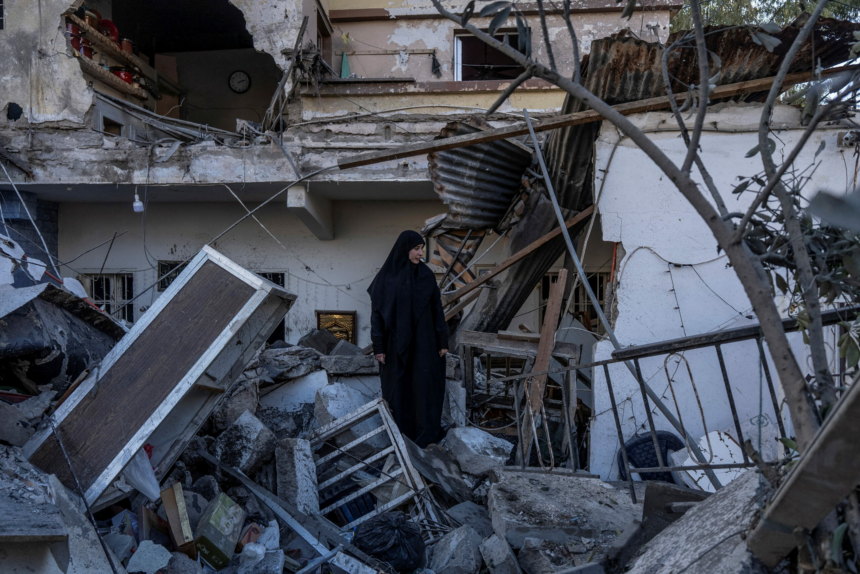
A woman stands among the ruins of her family home, which was destroyed by an Israeli strike, amid escalating hostilities between Israel and Hezbollah, as the U.S.-Israeli conflict with Iran continues, in Tyre, Lebanon, March 24, 2026. REUTERS/Manu Brabo TPX IMAGES OF THE DAY
Donald Trump’s decision to initiate war against Iran threatens to reshape the Middle East’s strategic landscape and force difficult recalculations in Tehran and beyond. How is this war reverberating across the region—and is there a viable path to de-escalation?
Join the Quincy Institute for a timely and in-depth discussion bringing together leading experts to unpack the regional fallout of the war in Iran. This webinar will examine how key Arab states are navigating the crisis—balancing security concerns, domestic pressures, and shifting alliances—while also exploring Tehran’s calculations as the war is increasingly reducing Trump’s options and leverage. What are Tehran’s objectives, constraints, and red lines? How is the new leadership in Tehran weighing escalation versus restraint? And crucially, what diplomatic or political off-ramps might exist to end the conflict before it spirals further?
We will hear from Maria Luisa Fantappiè, head of the “Mediterranean, Middle East and Africa” program at the Italian Institute for International Affairs, Professor Bader Al-Saif of Kuwait University, and Professor Hassan Ahmadian of Tehran University. Quincy’s Trita Parsi will moderate.
The conversation will take place on Tuesday, March 31st from 1:00 – 2:00 PM Eastern Time.
Maria Luisa Fantappiè is head of the “Mediterranean, Middle East and Africa” programme at IAI. She served as special adviser at the Centre for Humanitarian Dialogue in Geneva (2020-2023) and at the International Crisis Group (2012-2020), engaging at the highest level of policy in Europe, the United States and across MENA (Iraq, Jordan, Saudi Arabia, Iran, Qatar, Oman and United Arab Emirates). In 2018, she was seconded by the Italian Ministry of Foreign Affairs to the European advisory mission for security sector reform in Iraq (EUAM). Her research interests include the MENA region, EU foreign policy and great powers competition in this area, conflict prevention and mediation as a well as cultural diplomacy.
Bader Al-Saif is an associate fellow in the Middle East and North Africa Programme at Chatham House. He is the founding president of Al-Saif Consulting, an assistant professor at Kuwait University, and a non-resident fellow at The Arab Gulf States Institute in Washington. He specializes in the Arabian Peninsula, namely its geopolitics, public policy, culture, reform dynamics, transnational trends, and gender studies. Bader has over two decades of experience researching and working in the Arab Gulf states, most notably as a deputy chief of staff to a former prime minister of Kuwait and a senior vice president of the oil and gas sector at Agility. Prior to this, he was a consultant to the Office of Tony Blair.
Hassan Ahmadian is an assistant professor of Middle East and North Africa studies at the University of Tehran and a senior research fellow at the Middle East Scientific and Strategic Studies Center in Tehran. He previously was a Postdoctoral research fellow at Harvard University’s Belfer Center as well as an associate with the Project on Shiism and Global Affairs at Harvard’s Weatherhead Center for International Affairs. His research and teaching work is mainly focused on Iran’s foreign/regional policy and relations, political change in the Middle East, civil-military relations and Islamist movements in the Middle East.
Trita Parsi is co-founder and executive vice president of the Quincy Institute. He is an award-winning author and the 2010 recipient of the Grawemeyer Award for Ideas Improving World Order. He is an expert on US-Iranian relations, Iranian foreign policy, and the geopolitics of the Middle East. He has authored four books on US foreign policy in the Middle East, with a particular focus on Iran and Israel. He has been named by the Washingtonian Magazine as one of the 25 most influential voices on foreign policy in Washington DC for five years in a row since 2021, and preeminent public intellectual Noam Chomsky calls Parsi “one of the most distinguished scholars on Iran.”
The Quincy Institute is a transpartisan “action tank” and communications project, established to challenge the decades-long obsession of U.S. foreign policy decision makers with global military dominance and war.
Get our latest expert foreign policy analysis delivered straight to your inbox, every week