


For generations, Arizona’s firefighters have answered the call, training to run toward danger, not away from it, and preparing for the worst, often with limited resources and information.
But on April 19, 2019, that call resulted in tragedy when eight firefighters responded to a mutual aid request in Surprise for a fire at the McMicken Battery Energy Storage System. Upon opening the container door, flammable gas ignited, causing an explosion that severely injured four firefighters and sent three to the trauma center.
That call changed those responders’ lives forever. It also sent ripples throughout the fire service, changing how responders view emerging technologies such as batteries and leading to increased scrutiny of the battery storage industry.
But the policy effects of McMicken have not been limited to lithium-ion batteries. They have spread to other industries, such as data centers and nuclear reactors, where some have taken advantage of that fear to misattribute risk and slow economic development.
In the City of Phoenix, for example, elected officials have unfairly equated data centers with battery energy storage systems, characterizing their facilities as hazardous and imposing new zoning restrictions based on perceived but unsubstantiated risks.
Now, as interest in new advanced nuclear reactors such as small modular reactors, or SMRs, grows, some are beginning to ask whether local fire departments are prepared, suggesting that responses could resemble McMicken because SMRs are smaller, more advanced, and could be deployed in more locations, like battery energy storage systems.
The idea of responding to a nuclear-related incident does raise legitimate questions. Many fire departments operate with limited budgets, rely on mutual aid agreements, and do not have the advanced hazmat or radiological certifications necessary to respond to a fire at a nuclear site.
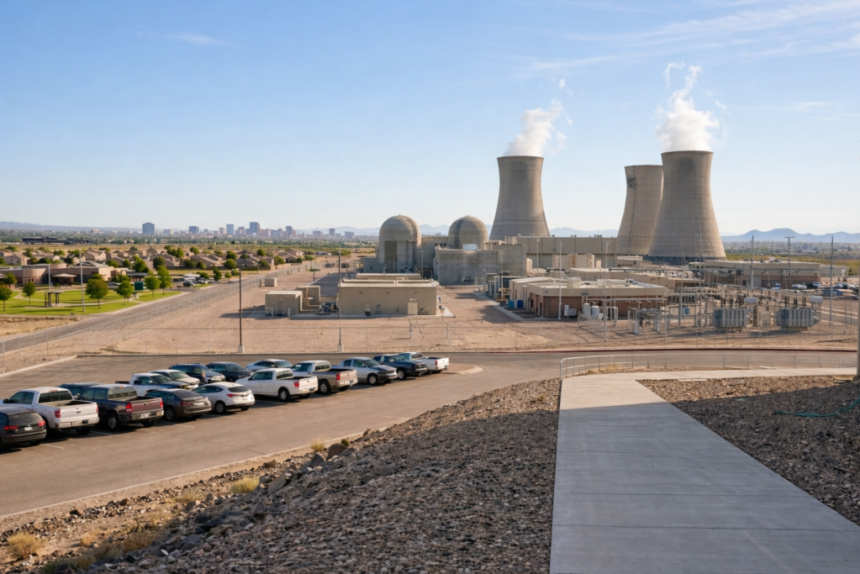
Add to that the fact that Arizona has not built a new nuclear plant in more than 40 years, since Palo Verde Nuclear Generating Station was constructed in the mid-1980s. Since then, entire generations have come and gone without ever having to think about the rigorous permitting requirements new nuclear plants must undergo to ensure public safety. And outside Maricopa County, most departments have never had to consider it at all.
But the evidence is clear: if a new SMR were sited in a rural county, no firefighter would be expected to walk into an unknown chemical or radiological hazard for which they were not prepared, as happened at McMicken.
First, SMRs are not the Cold War-era systems people associate with radioactive release or nuclear fallout. Advanced reactor designs like TerraPower’s Natrium reactor, X-energy’s Xe-100, and Oklo’s Aurora use passive safety features that make them effectively ‘meltdown-proof’ and ‘walk-away safe,’ virtually eliminating the risk of high-pressure explosions and radioactive plumes.
Second, the thermal runaway events that occur at battery energy storage systems can present a more immediate and unpredictable hazard for first responders than fires at most nuclear sites, with the potential for intense fires, toxic gas release, and complex response conditions.
Third, the regulatory requirements for new nuclear sites are far more stringent than those for many other technologies, including lithium-ion batteries, which can be located virtually anywhere within a municipality and rely on local jurisdictions for emergency response in ways that nuclear plants simply cannot.
The idea of responding to a nuclear-related incident does raise legitimate questions. Many fire departments operate with limited budgets, rely on mutual aid agreements, and do not have the advanced hazmat or radiological certifications necessary to respond to a fire at a nuclear site.
But if a new SMR were sited in a rural county, no firefighter would be expected to walk into an unknown chemical or radiological hazard for which they were not prepared, as happened at McMicken.
We have rules already on the books. Federal law mandates dedicated, on-site emergency response teams, requires nuclear facilities to be located well outside population centers, and makes clear that local firefighters are not expected to handle on-site incidents.
In other words, unlike lithium-ion battery facilities, SMRs are designed and regulated so that the burden of emergency response does not fall on local fire departments.
As we consider the deployment of new energy technologies, we must also consider the benefits. Nuclear plants contribute millions annually in local tax revenue, which provides critical funding for local fire departments, including new fire trucks, upgraded fire stations, and state-of-the-art training facilities. They also provide hundreds of good-paying jobs, including for local fire departments and districts in rural areas.
The events that occurred at McMicken in 2019 were a tragedy and should never have happened. But they should also not be allowed to tarnish the reputation of nuclear energy or obstruct the deployment of these innovative new reactor designs.
With these new designs, Arizona’s fire departments and districts are being given an opportunity to benefit. Let’s take advantage of that.
The rules are in place. The technology is safe. And the benefits are real. Let’s not let misplaced comparisons stand in the way of nuclear energy’s opportunity to thrive.
Michael Carbone is a Republican member of the Arizona House of Representatives representing Legislative District 25 and serves as House Majority Leader. Follow him on X at @MichaelCarbone. Representative Walt Blackman is a Republican member of the Arizona House of Representatives serving Legislative District 7 and is Chairman of the House Government Committee. Follow him on X at @BlackmanForAZ.
The U.S. Environmental Protection Agency this week finalized a ruling that shields the Phoenix-Mesa region from a more stringent federal air quality classification, delivering a significant win for Arizona businesses…
Andy Tobin There has been a lot of interest and focus by Arizona policymakers on the environmental virtues of nuclear energy. They are absolutely right: nuclear power is a clean-energy marvel. As a former Corporation…
From off-road vehicles built for Arizona’s rugged terrain to partnerships that support small businesses, public safety, and workforce development, Polaris Inc. has established itself as a leader in innovation and…
Get updates on the most important news delivered right to your email. Fully personalized options. No SPAM. Unsubscribe anytime.
Get updates on the most important news delivered right to your email. Fully personalized options. No SPAM. Unsubscribe anytime.
Chamber Business News wants to connect with you. Follow us, tweet, share, post, comment… however you get social is the perfect way to connect.
Terms of Use | Privacy Policy
Copyright © 2020 Chamber Business News – a project of the Arizona Chamber Foundation | Made by Highnoon.
Get updates on the most important news delivered right to your email. Fully personalized options. No SPAM. Unsubscribe anytime.
Chamber Business News wants to connect with you. Follow us, tweet, share, post, comment… however you get social is the perfect way to connect.
Sign up below to subscribe to “Dry Heat” our weekday email with top news stories. No SPAM ever & unsubscribe anytime.
When it comes to fire, SMRs are not lithium-ion batteries – Chamber Business News


Leave a Comment