


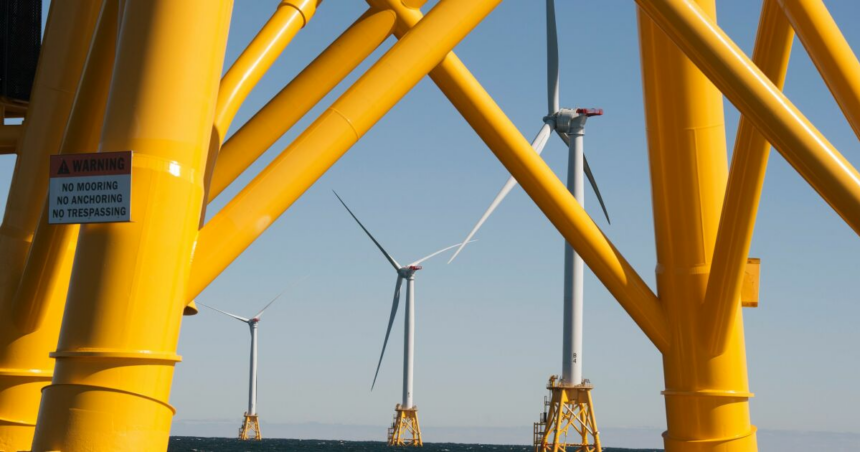
The Trump administration announced a deal on Monday with French energy giant TotalEnergies to shift investment away from America’s offshore wind industry and into oil and gas instead. Industry analysts say the agreement threatens to undermine business confidence in the United States by exerting unprecedented executive power to influence the private sector.
Under the deal, TotalEnergies said it will recover nearly $1 billion the company and its partners paid the federal government for offshore wind leases off the coasts of North Carolina and New York. TotalEnergies pledged to invest an equal amount of money in U.S. oil and gas production, as well as a liquified natural gas plant in Texas.
Additionally, TotalEnergies pledged not to develop any new offshore wind projects in the U.S., saying such investments aren’t in the country’s interest.
“The Trump administration has created a new playbook for how a sitting president can constrain energy resources or policies it opposes,” says Timothy Fox, a managing director at ClearView Energy Partners, a research firm.
By intervening to stop investments that President Trump personally opposes, the administration risks chilling infrastructure spending across the economy, not just in offshore wind, says Leslie Abrahams, deputy director of the Energy Security and Climate Change program at the Center for Strategic and International Studies.
“This new dimension of policy uncertainty can make it so that we have fewer infrastructure projects that happen more slowly and are more expensive,” Abrahams says.
The White House referred comment to the Interior Department. The department cited a news release in which Interior Secretary Doug Burgum said the agreement with TotalEnergies “is yet another win for President Trump’s commitment to affordable and reliable energy for all Americans.”
At an energy conference in Houston this week, TotalEnergies Chief Executive Patrick Pouyanné called the deal a win-win for his company and the U.S. government. TotalEnergies said in a news release that it has found offshore wind projects in the U.S., unlike those in Europe, “are costly and might have a negative impact on power affordability for U.S. consumers.”
TotalEnergies had already paused its offshore wind activities in the U.S. soon after Trump was re-elected.
Evan Vaughan, executive director of the Mid-Atlantic Renewable Energy Coalition, an industry group, said in a statement that the administration’s deal with TotalEnergies was “disappointing but sadly not surprising.”
With power demand rising faster than it has in decades, “we need every energy source available to deliver affordable, reliable, and secure energy for American consumers,” Vaughan said.
The Trump administration has prioritized the use of fossil fuels while trying to limit construction of renewable energy projects. Trump is especially hostile toward wind energy, railing against the industry after he lost a fight with an offshore wind project near one of his golf courses in Scotland more than a decade ago.
The Interior Department announced the TotalEnergies deal months after a federal judge struck down an executive order that had halted approvals for new wind energy projects in federal lands and waters. The administration had also tried, unsuccessfully, to stop construction of five offshore wind projects that were already under development along the East Coast, citing national security concerns that the Defense Department had allegedly raised.
Referring to the agreement with TotalEnergies, Abrahams says, “Through this deal, the administration is demonstrating that they understand that they can’t go through the courts to accomplish what they want.”
It’s unclear if similar deals are in the works, wind industry experts say. Companies are sitting on more than a dozen leases in federal waters that could be sites for future wind projects, says Nick Krakoff, a senior attorney at the Conservation Law Foundation, which has been heavily involved in permitting offshore wind projects.
Given Trump’s opposition to wind energy, some of those companies could “seek a payout from the administration,” Krakoff says. However, TotalEnergies may have been uniquely positioned for a deal, he adds, since the company already has a huge oil and gas business that it could shift investment to.
While the Trump administration and TotalEnergies have claimed offshore wind is a bad investment in the U.S., organizations that manage electric grids along the East Coast have said new offshore wind projects in the region are vital to ensuring electric reliability and to meeting growing power demand.
Now, the industry’s future in the U.S. is uncertain.
“Project developers and financiers may be wary of investing in a capital-intensive sector with such demonstrable, high election risk,” says Fox of ClearView Energy Partners. “Even if you have a next president who says, ‘We love offshore wind,’ you may be wondering, ‘Will there be another Trump-like opposition thereafter?'”
But Fox says the entire energy industry stands to suffer as the sector becomes more politicized and federal policy swings more and more dramatically from one administration to the next.
“When you’re building a power plant or thinking about oil production, you’re thinking not just about the current administration, you’re thinking about the next couple of decades,” Fox says. “And the pendulum swing is a real policy risk.”
Copyright 2026 NPR
Have a tip for the WESA newsroom? Email news@wesa.fm.