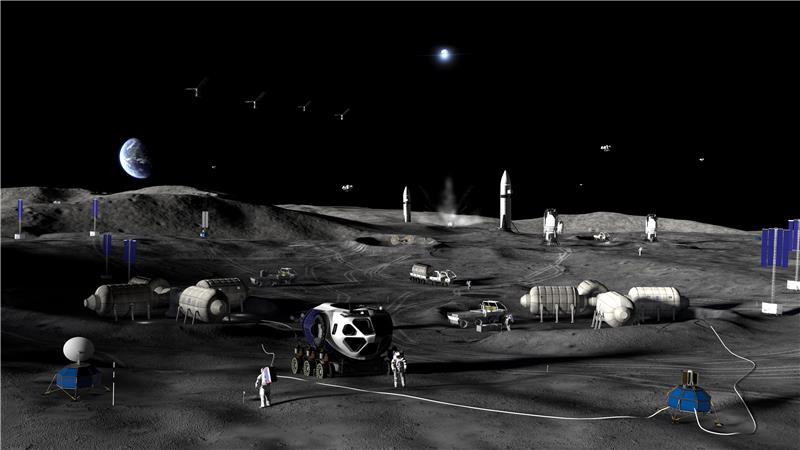
NASA says it is committing to building a permanent Moon base, as revealed at an event on Tuesday where the agency highlighted significant changes to its Trump-era space goals.
As competition with China for dominance in space heats up, the Trump administration is prioritizing the US return to the lunar surface—this time with the intention of staying.
At Tuesday’s “Ignition” event, the space agency also said it is pursuing expanded privatization efforts, some of which are focused on plans for replacing the International Space Station.
“NASA is committed to achieving the near‑impossible once again, to return to the Moon before the end of President Trump’s term, build a Moon base, establish an enduring presence, and do the other things needed to ensure American leadership in space,” said NASA Administrator Jared Isaacman this week.
“This is why it is essential we leave an event like Ignition with complete alignment on the national imperative that is our collective mission,” Issacman added.
A major component of NASA’s plans, the Artemis program, received an update and mission restructuring just weeks ago. Before the revision, the Artemis III mission was expected to return humans to the lunar surface; however, that milestone has now been shifted to Artemis IV, currently targeted for 2027.
The Ignition event also offered a glimpse further into the future, outlining plans beyond Artemis V. These include increasing the cadence of crewed missions using lower-cost, reusable, commercially procured systems, to land on the Moon approximately every six months—and potentially more frequently over time.
“Today, we are aligning NASA around the mission. On the Moon, we are shifting to a focused, phased architecture that builds capability landing by landing, incrementally, and in alignment with our industrial and international partners,” NASA Associate Administrator Amit Kshatriya said this week.
The centerpiece of the Ignition event was the unveiling of a three-phase plan to construct a permanent Moon base. As part of this strategy, NASA will pause its Lunar Gateway project—originally intended as a lunar-orbiting space station—and shift its focus to a direct surface-based installation. The agency also plans to repurpose existing hardware where possible and work with international partners to meet evolving mission goals.
The first phase, Build, Test, Learn, will focus on technology demonstrations and early exploration, including power generation, communications, navigation, and surface operations. In the second phase, Early Infrastructure, NASA will apply those lessons to develop semi-habitable systems supported by regular logistics. The final phase, Enable Long-Duration Human Presence, will involve the deployment of more robust infrastructure to support a sustained human presence on the Moon.
Low Earth orbit missions will continue alongside this renewed lunar focus. A key element of this transition involves phasing out the International Space Station (ISS) and shifting toward commercial space stations. NASA is currently gathering input on how best to manage this transition. Current plans include developing a government-owned module that would initially attach to the ISS before detaching for independent operation once commercial platforms are fully operational. The agency is also introducing funding opportunities aimed at stimulating growth in the low Earth orbit economy.
Building on recent advances with the James Webb Space Telescope and the Parker Solar Probe, NASA plans to launch the Nancy Grace Roman Space Telescope later this year to study dark energy and the structure of the universe.

In 2028, NASA has two missions planned for other regions of our solar system, including the Dragonfly nuclear-powered rotorcraft mission to Saturn’s moon Titan, and the European Space Agency collaboration, the Rosalind Franklin rover, which will search for signs of past life on Mars.
NASA is also planning to launch its first nuclear-powered interplanetary spacecraft, Space Reactor-1 Freedom, which will carry a payload of aerial vehicles destined for Mars. This mission is expected to serve as a key test for deep-space exploration beyond Jupiter, where solar power becomes less effective.
In total, the realignment moves NASA closer to aligning with commercial space interests and toward long-term missions, away from the brief, publicly funded scientific jaunts of past decades.
On Tuesday, Issacman added that while many of NASA’s plans are looking several years out, the pressure is on to set the pace for the space agency’s future efforts, some of which will have a more immediate impact.
“The clock is running in this great‑power competition,” Issacman said, “and success or failure will be measured in months, not years.”
Ryan Whalen covers science and technology for The Debrief. He holds an MA in History and a Master of Library and Information Science with a certificate in Data Science. He can be contacted at ryan@thedebrief.org, and follow him on Twitter @mdntwvlf.