


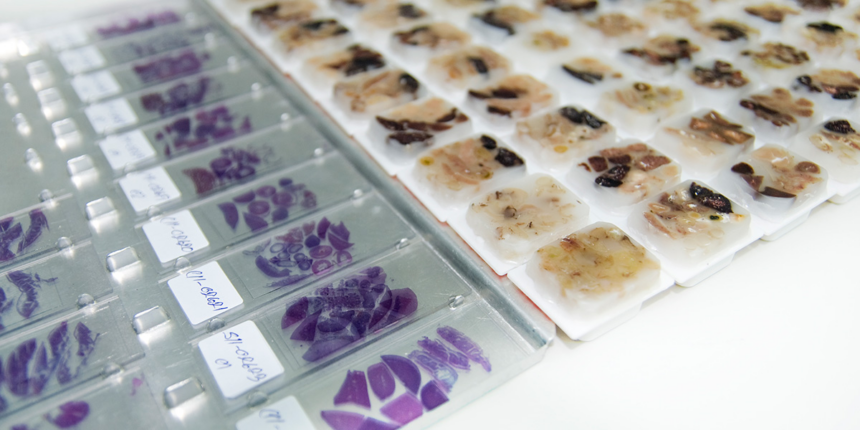
Formalin-fixed paraffin-embedded tissue, or FFPE, is a valuable resource for proteomic studies needed to drive clinically relevant insights. However, obtaining patient-derived samples in sufficient numbers to represent different disease subtypes while also accounting for variables such as age and sex, poses a significant challenge.
To meet this challenge, Moe Haines, John Thorup, Michael Gillette, Shankha Satpathy and others in the Carr lab at the Broad Institute of MIT and Harvard presented an optimized workflow for enhanced proteomic analysis of FFPE samples. They published their findings in Molecular & Cellular Proteomics. In this workflow, they use a combination of pathology, guided dissection, Adaptive Focused Acoustics sonication, digestion and liquid chromatography-tandem mass spectrometry to identify up to 10,000 unique proteins and 11,000 fully localized phosphorylation sites in FFPE tissue. This work demonstrates the ability to derive biologically relevant results from clinically derived tumor samples and offers a significantly reduced overall processing time, thus widening the scope of analysis. This provides a useful avenue for more thorough proteomic analysis of preserved biological samples.
Become a member to receive the print edition four times a year and the digital edition monthly.
Lydia Smith has a B.S. in molecular cell biology and a minor in chemistry, which she received from California State University, Long Beach. She is continuing on to receive her Ph.D. in microbiology and immunology at the University of Utah and is a volunteer contributor for ASBMB Today.
Enter your email address, and we’ll send you a weekly email with recent articles, interviews and more.
Researchers unveiled isoform-specific targets on heat shock protein 90 which may be beneficial in therapeutic development.
Whole-blood proteomics identifies more than 3,000 host and 160 fungal proteins during cryptococcal infection, offering potential biomarkers for faster diagnosis and improved monitoring without invasive spinal taps.
Researchers have defined interactions between an innate immune protein and two of its known binding partners. They identified potential areas of crosstalk between the two binding interactions.
Researchers found that glutathione metabolism plays a central role in the pathogenesis of rare disease methylmalonic aciduria using a novel multiomics approach.
Kyoto University researchers developed UniScore, a new tool that uses a target-decoy method to filter false positives in proteomic searches, helping scientists set thresholds and improve reliability when analyzing complex protein data.
Researchers at the Weizmann Institute of Science developed a novel single-cell approach that facilitates the study of proteins surrounding lung cancer cells.