


Every so often, a new set of economic buzzwords enters — or reenters — the zeitgeist. This spring, terms like the “K-shaped economy” and “stagflation” are having a moment.
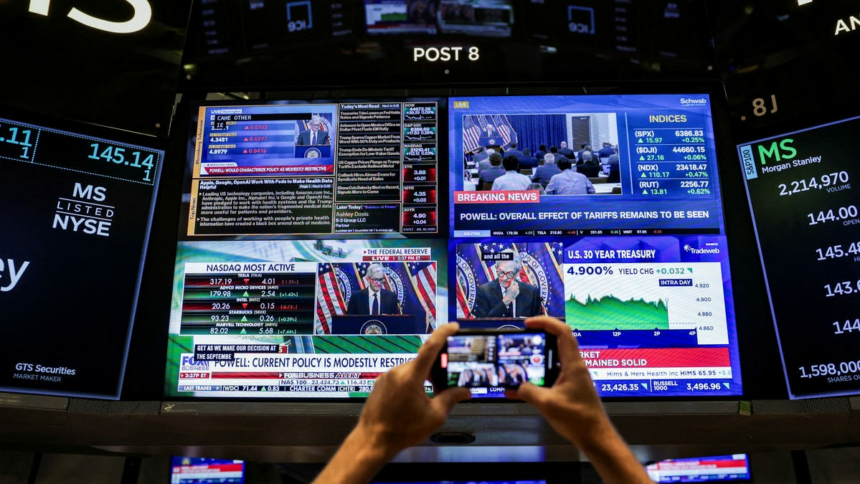
They shape how politicians, pundits, and the media discuss the economy, but their nuances and real-world implications are often lost in the discourse. Stagflation fears, for example, are surfacing as oil prices spike due to the U.S.-Israel war against Iran, reigniting inflation worries. Even Federal Reserve Chair Jerome Powell said he reserved the term for a “more serious set of circumstances” than what the nation faces today.
“I always have to point out that that was a 1970s term when unemployment was in double figures, and inflation was super high,” Powell told reporters on March 18. “That’s not the case right now.”
Still, such phrases capture real concerns about elevated prices, a slowing job market, and a widening gap between high-income and low-income households, but jargon can also obscure what economic developments mean for everyday Americans.
USA TODAY asked experts which terms are defining the U.S. economy in 2026. Here are some of the most common, and a few to keep in mind for the future:
Feeling broke in a steady economy? Here’s what’s happening
One of the terms with the most buzz, a “K-shaped” economy, is one in which some groups or sectors pull ahead financially, while others fall behind.
It’s also used to describe the post-pandemic recovery, when high-income earners typically saw their wealth and assets’ values increase. In contrast, many low-income earners with few or no investments struggled to keep up as prices rose faster than their paychecks.
Household wealth remains concentrated at the top, with the highest-earning households driving a larger share of consumer spending, while lower-income households make purchases but account for a smaller proportion of total spending.
“The notion that it’s a ‘K’ makes it sound like low-end spending is going down. …But that nuance of the proportion of the total gets lost,” Head of U.S. Economics at Truist Mike Skordeles said, adding he prefers the term “two-speed economy.”
Stagflation represents a scenario in which the nation faces rising inflation, rising unemployment, and stagnant economic growth all at once.
It’s the Federal Reserve’s worst-case scenario as it attempts to balance its dual mandate of low unemployment and stable prices. The U.S economy is not there yet, but economists see some warning signs.
Bureau of Labor Statistics data revealed that in February, the unemployment rate ticked up to 4.4%, still generally considered healthy but higher than a year ago. CPI inflation came in at 2.4% year-over-year, a figure that did not capture the jump in oil prices driven by the war that some analysts expect will push the number higher in March.
Meanwhile, the Bureau of Economic Analysis found core PCE inflation, which excludes food and energy prices, rose to 3.1% in January – its highest level in more than a year. And on March 13, the agency revised its fourth-quarter estimate of GDP growth to 0.7%, down from 4.4% in the previous quarter.
Supply shocks are large and often sudden shifts in the availability of a good. They’re uncommon, Skordeles said, but the United States has faced several in recent years.
During the pandemic, car production slowed due to factory closures and supply chain disruptions, though people kept buying vehicles. Lower supply and steady demand pushed prices higher. It’s classic supply-and-demand economics.
Today, the halting of traffic in the Strait of Hormuz, which typically carries about 20% of the global oil supply, has pushed oil prices — and ultimately gas prices at the pump — higher worldwide.
For months, analysts have dubbed the U.S. labor market a “low-hire, low-fire” environment, meaning companies are neither quick to let go of employees nor eager to bring many new ones on board.
“I don’t think companies really know the impact of AI on employment either,” Thrivent Chief Financial and Investment Officer David Royal previously told USA TODAY. “They’re not ready to let people go, but they don’t want to hire a bunch of people because they’re not sure they’re going to need them.”
Job gains have been concentrated in sectors like health care, social assistance, and private education, meaning those looking for work outside of those industries often face a more difficult search.
Workers have noticed, clinging to their jobs in fear they won’t find another.
Feeling stuck in a job you don’t want? You’re not alone. Here’s why
One of the most common words used to describe U.S. economic conditions over the past year has been “uncertain.”
Evolving tariff policy, an unclear timeline for the ongoing war with Iran, stock-market volatility, a rise in AI adoption, the 2026 midterm elections, and worries about potential asset price corrections down the road make the future hard to predict for economists.
“There’s a lot of economic uncertainty, market uncertainty, political uncertainty, and it’s all coming together right now, and we just don’t have the normal breadth of growth or strong foundations for the growth story that we would like to have had going into this sort of situation,” ING Chief International Economist James Knightley said.
Skordeles defines a haven as “a place to run and hide.”
They’re typically investments including U.S. Treasury bonds, physical gold, and defensive stocks, or shares in companies that provide consumer staples, he said.
Given persistent uncertainty, investors have flocked to all three over the past year. Bankrate Financial Analyst Stephen Kates said for the average consumer looking for a haven in today’s environment, high-yield savings accounts and certificates of deposit are good options.
“For the average person going into something that not just is safe, but feels safe because you understand it and it’s comfortable, I think those two fit the bill,” Kates said. “Banks, FDIC insurance, relative guarantees on that money – that can be one of the most beneficial safe havens.”
“Affordability” and “the affordability crisis” are terms that shaped political campaigns in 2025 and continue to do so in 2026, as Americans struggle to afford groceries, healthcare, and housing.
The University of Michigan’s consumer sentiment index in November dropped to 51, one of its lowest levels on record. While it has climbed back up since, the survey’s preliminary March results showed it fell to 55.5, its lowest reading of 2026.
“A big portion of this is perception. It’s not that people are wrong. Things do cost more than they used to,” Kates said. “Price levels are far higher than they were prior to COVID or even midway through COVID, and those price changes happen so rapidly that people are still anchored to those old prices. They remember and they’re sour about it, and it’s hurting people.”
American dream meant upward mobility. Now, it means stability.
The federal funds rate is the interest rate banks charge to borrow from each other overnight. The Federal Reserve’s Federal Open Market Committee sets a target range for the rate eight times each year, based on economic indicators such as inflation and the unemployment rate.
That range serves as a benchmark for interest rates across the country, including for auto loans, mortgages, student loan debt, credit card debt, and savings accounts. Higher rates can help tame inflation and allow savers to earn more interest on their accounts, while lower rates can help stimulate the economy by decreasing borrowing costs.
At its last meeting on March 18, the committee opted to hold it steady at a range of 3.5% to 3.75% as officials weighed the economic impact of the war. President Donald Trump made persistent calls for lower rates, which would help reduce interest on the national debt, but Powell has made clear the Fed makes its decisions based on data, not the president’s preferences.
While the stock market is typically labeled a “bear market” when prices are falling or a “bull market” when prices are rising, some analysts say the market in early 2026 looks more like a “kangaroo market,” where stock prices jump up and down, often driven by sentiment or the latest news.
An easy way to remember the difference is to think about the animals’ actions. A bear swipes its paws down when it attacks, while a bull thrusts its horns upward. A kangaroo hops.
Skordeles said if there is one thing people are talking about today that they will still be talking about in a year, it’s job growth — or the lack thereof.
“The six-month average is a minus 1,000. …We’re basically staying black,” he said, adding 12 months from now, economists will be “talking about job growth, not about the Strait of Hormuz, and it’s likely that it will have re-accelerated by then.”
Knightley is keeping an eye on private credit.
“This opaqueness as to where this funding is coming from, who owns it, what’s the actual quality of this stuff?” Knightley said. “We just don’t know really with real certainty, and that is a risk.”
Kates said the term “Social Security” will soon need to reenter the national conversation, as the Congressional Budget Office now expects the Old-Age and Survivors Insurance Trust Fund, one of two funds used to pay Social Security benefits, will be depleted in 2032, a year earlier than projected.
Reach Rachel Barber at rbarber@usatoday.com and follow her on X @rachelbarber_
From 'K-shaped' to 'stagflation.' What economic buzzwords mean for you – USA Today


Leave a Comment