

An app that analyzes cough sounds offers an ingenious way to screen for one of the world’s deadliest infectious diseases.
An app that analyzes cough sounds offers an ingenious way to screen for one of the world’s deadliest infectious diseases.
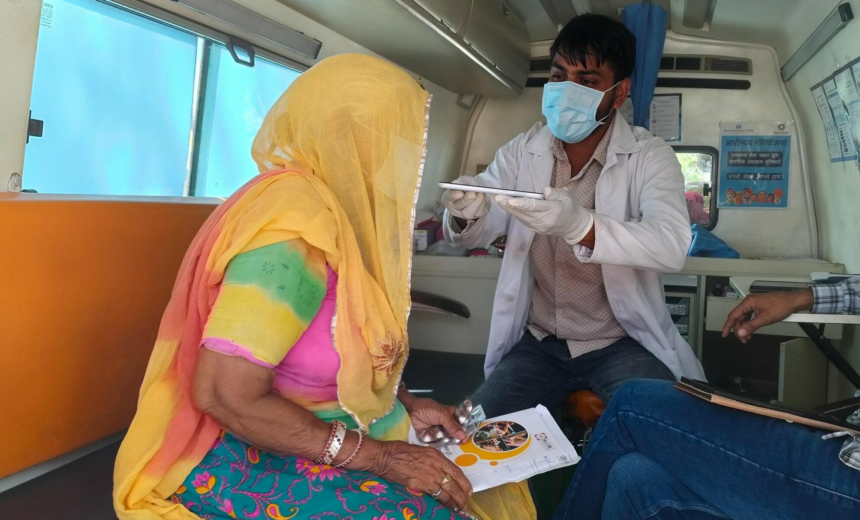
In Behror, a hot, dusty town in Rajasthan, people queue outside a free mobile medical van. Most have come with minor complaints, but every now and then, there’s a patient who complains of a persistent mysterious cough and unexplained weight loss, or has been in contact with someone who has tuberculosis. In such cases, the standard protocol is a TB screening in a hospital or lab.
“For many who come to our mobile medical units, this means taking time off from work, or forgoing a day’s wages,” Deepa Bajaj, president of Child Survival India (CSI), the NGO which operates the mobile units, says. “Many just won’t do it.”
The data bears this out. The National TB Prevalence Survey of India (2019 to 2021) found that as many as 63.6 percent of those who had TB symptoms simply did not seek medical help. From a community health perspective, failure to screen for one of the world’s deadliest infectious diseases is disastrous. TB is both preventable and curable. Yet it kills more than a million people each year, despite global eradication goals and decades of public health campaigns.
In India, which contributes a quarter of the global TB burden, the government aims to screen at least 90 percent of individuals who face a higher risk of TB. Yet fewer than 8 percent are actually screened, research by the Indian Council of Medical Research – National Institute of Epidemiology (NIE) has found.
Back in Behror, the mobile medic has a partial solution. All patients who are contacts of TB patients, elderly, or have risk factors (such as undernutrition, low socio-economic status, occupational exposure, smoking and alcohol use) are asked basic questions about their symptoms and made to cough three to four times into an app called Swaasa® on a cell phone. Within 30 seconds, the app assesses whether the cough is just a scratchy throat — or needs to be further assessed for chronic obstructive pulmonary disease (COPD), asthma or tuberculosis. Bajaj says that CSI medics, who have used the app to screen over 800 patients, find it useful: “We show the patient the results on the app which suggest they’re at a higher risk, and this makes it easier to motivate them to go to the chest clinic,” she says.
The idea of Swaasa (“breath” in Hindi) grew out of a conversation that co-founder Narayana Rao Sripada had with a community medicine specialist in India about the need for a low cost and easily scalable screen for lung disorders. A techie by training, Sripada began working on an app that could do this using machine learning.
In some ways, his big idea had several precedents. The world over, India included, public health initiatives use AI to read and analyze lung x-rays and ultrasound images to screen for TB. Similar tech is used to screen for other ailments too: A review of 81 studies found that AI-based systems can effectively screen for diabetic retinopathy and improve early detection of vision-threatening complications. In rural Kenya, deep learning models have been developed to detect parasitic worms that cause serious illnesses. But one key factor sets Swaasa apart: While these systems analyze images or text, its model was trained to analyze actual cough sounds.
Research shows that every cough has a signature, and can therefore be used as a diagnostic tool. For example, multiple, forceful coughs can indicate asthma or bronchitis, while multiple weak coughs can indicate pneumonia. Sripada, who spent months listening to people cough in hospital settings in the south Indian city of Hyderabad, identified several conditions — such as widened or narrowed airways, inflamed lining of the bronchial tubes, fluid in air sacs and scarring in lungs — and developed a machine learning model that flagged the cough sounds associated with them. In 2017, with Venkat Yechuri and Manmohan Jain, he launched the Swaasa app and the for-profit company Salcit Technologies.
Users can download Swaasa, and for as little as $1.50 per test (there are special rates for community health providers), the app assesses their risk of respiratory disease in a matter of seconds. Jain points out that this is a far cry from traditional screening mechanisms like spirometry (a common test measuring lung volume and airflow rate), which require specialized equipment and trained professionals that low-resource settings in India and much of the Global South lack. Swaasa can make at least 360 assessments on a single charge and also works in areas with poor network connectivity. Sripada adds that it can do one million assessments a day, and can be scaled to 500 million.
With a growing database of normal and aberrant cough sounds, the app can screen for a variety of respiratory diseases other than TB, including asthma and COPD. Jain says that it can “tell with around 89 to 90 percent accuracy if there is a respiratory issue.” A study in 2025 compared the diagnoses made by the app with those of a pulmonary physician and found that Swaasa correctly predicted respiratory issues in 87.32 percent of those cases. And of course, the AI will get better with use, which is why the founders are excited about collaborating with Google’s HeAR AI model, which has been trained on millions of audio samples, for this. The app has been recognized as a Class B medical device in India, but awaits FDA approval.
At the Centre for Community Medicine in Delhi’s All India Institute of Medical Sciences, Professor Rakesh Kumar ran early tests on Swaasa. “The unique selling proposition of Swaasa is that you can scale it, and scale it very fast. You can screen a large number of people in a very short span of time with a reasonable sensitivity,” he says. He notes that the app produces very few false negative results, meaning it rarely misses cases of respiratory diseases. He suggests that Swaasa can be invaluable as a support tool for community health workers in conducting active case finding for TB. “It reduces the number of x-rays needed as only the individuals the app flags get tested, thus saving time and valuable resources,” he says. “It is particularly good at identifying asymptomatic patients!”
Over 400,000 individuals have been tested on the Swaasa app so far, and it has a monthly usage of over 5,000. Other pilot screenings for TB are underway in several states, including Andhra Pradesh in southern India, and Bihar in Central India. Salcit is collaborating with India’s first AI-enabled government hospital and incubation center in Uttar Pradesh to use the Swaasa app for large-scale respiratory health screening initiatives in 2026. The NGO Healing Fields’ community health entrepreneurs — who provide accessible, affordable primary health care by connecting patients in their villages to qualified doctors through telehealth consultations — are undergoing training to use Swaasa in villages in Bihar, Uttar Pradesh and Jharkhand. The app has also been used to diagnose Covid-19, a promising development in the technology’s extended application to primary health care settings. Helfie, an Australian company, is developing a health AI to check for over 20 conditions, and has licensed Swaasa to screen for respiratory disorders.
But Sripada is after bigger numbers. He is frustrated with the barriers to more widespread use – and more scientific validation. The app is designed for use and interpretation by health care providers, but they have not been easy to convince: “Cough is a new marker, a new way of testing that they’ve not learned in their regular curriculum,” Jain explains. This is likely to change, as several AI and machine learning technologies which use auditory markers like snores and other sleep sounds, wheezes and cough patterns are now available. Of these, the Australian app to support sleep apnea, SleepCheckR, has even received FDA clearance as a medical device. Data privacy is another challenge. Jain states that they specifically do not collect any personally identifiable information, and that they cannot tell who has made the cough sounds. However, as the app is commercially available, customers (so far, mostly hospitals, NGOs and insurance companies) can decide how to use the app and data within the existing government privacy policy framework.
Meanwhile in Behror, there has not been a single positive risk assessment on the Swaasa app all day. This means money and time savings not just for the state’s overworked health system, but for individuals, too. But there is more. “The app is saving patients the cost of traveling to a faraway hospital, and possibly forgoing a day’s wages,” Kumar points out.
Join the Reasons to be Cheerful community by supporting our nonprofit publication and giving what you can.
This is what motivates Jain, who knows that their health startup and Swaasa are unlikely to be commercial successes. For him, the fight against TB is personal. “My mother was a chronic asthma patient. At a young age, she developed asthma, and then tuberculosis. Throughout her life she suffered, and she died at a young age,” he recalls. He also contracted TB at 19, and was cured after over a year of treatment. “TB is a silent killer, and so many continue to die without receiving the treatment I was lucky to get,” he says. “If using cough sounds eventually becomes part of the standard screening protocols, it will be a legacy to be proud of.”
Learn more about the ways that AI is revolutionizing health care.
Over the last two decades, Geetanjali Krishna has traveled across India to report on the environment, climate change and global health. She co-founded The India Story Agency, a cross-border media collaborative with London-based journalist Sally Howard in 2020. One of 10 journalists across the world chosen for the Solutions Journalism Network’s LEDE fellowship 2023, and awardee of the Global Health Security Grant 2021 by the European Journalism Centre, her recent bylines can be found in The British Medical Journal, Reasons to be Cheerful, bioGraphic, BBC Future and Business Standard.
In a country where social stigma and fear often delay diagnosis, an app that teaches women to perform self-exams is revolutionizing health care.
Artificial intelligence tools have the potential to prevent thousands of heart attacks every year — if researchers can meet the technology’s challenges.
In the Indian state of Assam, solar-powered boats serve as mobile hospitals for the remote communities along the Brahmaputra River.
Our smart, bright, weekly newsletter is the uplift you’ve been looking for.
Listed below are all the stories you’ve bookmarked. If you clear your cookies or switch to another browser or device, this list may disappear.
We don’t use any cookies that spy on you, sell your information or spam you. Read our privacy policy here. More info and adjust your cookies settings here Cookie settings
Find out why over 120,000 people receive Reasons to be Cheerful’s newsletter every week. Sign up today!