


By Democracy Docket
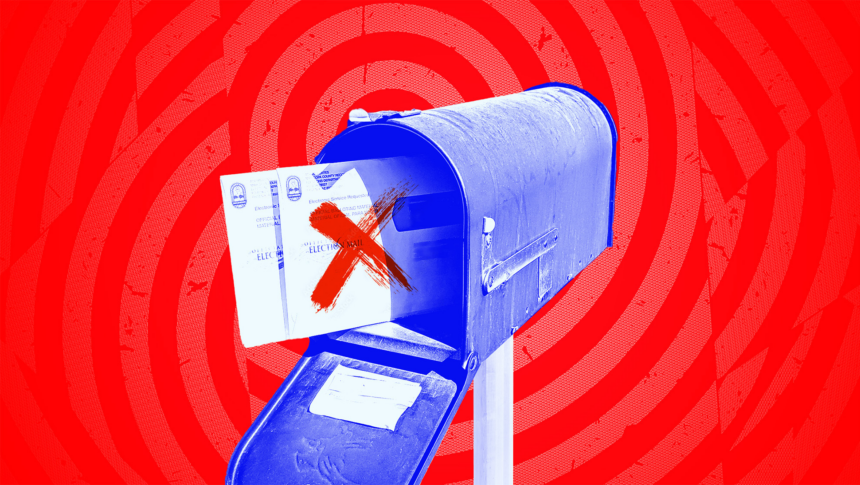
The U.S. Supreme Court heard oral arguments Monday in Watson v. Republican National Committee (RNC), which will determine whether states will still be allowed to count mail ballots that were sent on or before Election Day but arrive after it.
The RNC is challenging a Mississippi law offering a five-day grace period for late-arriving ballots mailed by Election Day. It argues that the law is preempted by longstanding federal laws that set “the Tuesday next after the first Monday in November… as the day for the election” for federal elections.
If the justices side with Republicans here to strike down grace periods, it would make mail voting much harder not only in Mississippi but also in the 13 other states with grace periods for mail ballots.
The case is squarely part of the broader GOP effort, led by President Donald Trump, to restrict mail voting, out of a belief that it helps Democrats. And there are fears that in-person early voting could be next.*
The legal question boils down to: When does someone vote? Is it when the ballot is submitted — whether placed in a drop box or a mailbox — or is it when it’s received by election officials?
See our coverage below:
Join 350,000 readers who rely on our daily and weekly newsletters for the latest in voting, elections and democracy.
12:12 p.m. ET:
Stewart’s cooking. Mississippi Solicitor General Stewart has quickly run through and criticized many of the arguments made by Clement and Sauer. It’s a much stronger performance than his start. “This is ultimately a federalism case,” Stewart said as he concluded. “The question is whether, as I think Justice Jackson put it, did Congress in 1845 block states from adopting a practice that no one had reason to consider at the time. Congress wasn’t thinking about it. It didn’t decide that. It didn’t wall states off from doing that.”
And, with that, oral arguments in Watson v. RNC are concluded. Thanks for following along with us!
–Jim Saksa, Reporter
12:10 p.m. ET:
Well, that was quick: Sauer’s now done and Stewart is back up for a quick rebuttal. Sauer spoke for around 15 minutes.
–Jim Saksa, Reporter
Sotomayor digs into DOJ: Justice Sotomayor takes issue with the DOJ’s selective quoting of specific definitions of Election Day.
“I am a little upset — not a little, a lot upset — by many of the statements in your brief quoting historical sources out of context,” she said.
This is hardly the first time that Trump’s DOJ has been accused of making false or misleading statements in legal briefs.
–Ashley Cleaves, Legal Content Editor
12:05 p.m. ET:
Conservatives used to believe in judicial humility: Solicitor General Sauer has argued that various cases argued in state courts around the time Congress passed the Election Day Statutes (1845, 1872 and 1914) grappled with the definition of voting in voter fraud cases. Those courts largely agreed that voting requires both the act of casting a ballot and receipt by officials. But Justice Jackson again asks: Why does that matter?
Congress has not acted to prevent states like Mississippi from using grace periods, so clearly Congress has no problem with it. If Congress thinks votes need to be received by Election Day to count, they could change the law. It’s a question for the elected branches, not unelected judges.
–Jim Saksa, Reporter
12:02 p.m. ET:
DOJ denies early voting is in danger: U.S. Solicitor General D. John Sauer, arguing in support of the RNC, affirms: “We agree with both sides that early voting is still acceptable.”
If nothing else, this could complicate any future effort by the Trump DOJ to go after early voting under a similar argument about Election Day — which, again, can’t be ruled out. But the DOJ’s position appears to conflict with that of one of its top officials: Assistant Attorney General Harmeet Dhillon, who heads up the department’s Civil Rights Division.
“Election day means Election DAY,” Dhillon posted on social media in reference to this case.
Kari Lake, now a Trump administration official, has gone further.
“No more of this election month nonsense,” she has posted. “It’s time we make Election Day a DAY again.”
-Zachary Roth, Managing Editor
11:57 a.m. ET:
So long, Paul: Clement spoke for roughly 53 minutes, just a smidge longer than he was scheduled for. Up now is U.S. Solicitor General D. John Sauer arguing on behalf of the United States.
–Jim Saksa, Reporter.
11:55 a.m. ET:
Congress has MEGA powers: Justice Jackson again notes that members of Congress read the news, are presumably aware of grace period laws like Mississippi’s and they haven’t passed a law against it.
“They are obviously aware that there are states that are doing this, and they have not spoken to it. They have not specifically precluded it,” Jackson said, adding that the Make Elections Great Again (MEGA) Act was introduced in the House earlier this year with provisions that would ban late grace periods. The fact that Congress has not passed that law means it has not yet acted in the Election Day statutes to limit or forbid grace periods (or early voting, for that matter), she argues.
–Jim Saksa, Reporter
Clement tries again to wall off early voting: Justice Barrett again asks Clement why his position doesn’t ban early voting. Clement says it’s because with early voting, there isn’t the issue of ballots potentially changing the outcome of an election when they come in after Election Day and the concerns about fraud this would raise.
He doesn’t explain why, election denier rhetoric aside, ballots coming in after — rather than before — Election Day should be more likely to raise fraud concerns.
–Zachary Roth, Managing Editor
11:53 a.m. ET:
What about Purcell? Republicans argue that the Purcell doctrine — the principle that federal courts should avoid altering election rules close to an election — does not apply to this case. Clement says that a ruling in June upholding the Fifth Circuit “would give [states] plenty of time” to adjust.
–Maya Bodinson, Researcher
History v. herstory? Justice Barrett is “trying to figure out how to think about the history” here. There are good policy reasons, she said, for states to treat Election Day as a deadline for the receipt of ballots. But “is there any reason to think that these laws were adopted because of a concern about preemption by federal law, as opposed to just: this is a really good policy?”
Clement responded that the idea of late-arriving ballots counting simply was “unthinkable” to lawmakers at the time. But that raises the question of early voting, Barrett said.
This is maybe the clearest indication that Barrett, a swing vote, might side with upholding Mississippi’s laws.
–Jim Saksa, Reporter
11:50 a.m. ET:
GOP says anti-fraud roots of election day still relevant today: Republicans argue that federal statutes establishing a uniform election day were originally enacted to combat voter fraud and bolster public confidence in election outcomes at a time when ballot-box stuffing was a serious concern. That anti-fraud purpose, the GOP claims, remains just as relevant today.
That framing echoes years of Republican conspiracy theories that cast doubt on election outcomes whenever late-counted mail ballots narrowed or erased GOP leads.
–Maya Bodinson, Researcher
11:48 a.m. ET:
Sore Losers: Republicans say the losers wouldn’t accept a result upended by late-arriving ballots counted under states’ post-election deadlines.
–Ashley Cleaves, Legal Content Editor
Perception is reality: Clement cites the arguments of 19th century Senator Charles G. Atherton in the debate around the 1845 Election Day Statute, saying that even perceptions of fraud undermine public confidence in elections. This line has been repeated for years now by conservatives arguing to make it harder to vote… even though the only thing driving down confidence in elections has been the right wing’s repeated attacks and baseless claims about widespread fraud.
The argument is, essentially, “the only way to restore the good name of elections, which we have repeatedly defamed for our political gain, is to make elections more favorable to us.”
–Jim Saksa, Reporter
11:40 a.m. ET:
GOP warns of a slippery slope: If states have unfettered discretion to decide when mail ballots must be received, then where does it end? And what prevents those deadlines from expanding indefinitely? Republicans caution that the consequences could be significant.
–Maya Bodinson, Researcher
11:35 a.m. ET:
GOP says states cannot decide elections before – or after – election day: Republicans argue that Supreme Court precedent supports their interpretation of federal election statutes.
They rely primarily on Foster v. Love, a case in which SCOTUS invalidated Louisiana’s open primary system because it allowed a congressional candidate to win outright in an October primary, thereby finalizing the election prior to the federally designated date. Now, the GOP argues that the same logic applies here: just as states cannot structure elections so they are effectively decided before election day, they also cannot extend them beyond that day by counting ballots that arrive afterward.
–Maya Bodinson, Researcher
Electoral Count Reform Act: Justice Kagan brings up the Electoral Count Reform Act of 2022, a law that was passed to prevent another January 6 by eliminating the ambiguities about how much discretion Congress has to count, or not count, the electoral votes received by the states. The law refers to a “period of voting” and allows states in dramatic circumstances to extend voting. Doesn’t that imply that Congress never meant to say “Election Day means election day?”
No, Clement responds. That only refers to early voting, which he is fine with.
–Jim Saksa, Reporter
11:33 a.m. ET
Kagan goes there: Justice Kagan asks how it is that Clement and his side are not taking issue with early voting. She says the implications of his argument appear to clearly do so.
That’s a point that we’ve stressed repeatedly in our coverage of the case.
Clement responds that an election merely must be “consummated” by election day. That’s why early voting is fine but late-arriving ballots aren’t. Though Clement suggests, in an ominous aside, that others have found that there is a “pretty good argument that early voting is problematic.”
It’s not far-fetched to suggest that, if the GOP wins this case, they will be coming for early voting next.
–Zachary Roth, Managing Editor
Kagan can’t even: Kagan does not buy Clement’s differentiation between early voting (fine) and grace periods (bad). “Every time you try to state what your rule is, it seems to me it’s a rule that prevents early voting,” Kagan said. “You’re basically saying there are two things that have to happen, and they have to happen on election day, and it’s the casting of the vote and the receipt of the vote.”
–Jim Saksa, Reporter
11:30 a.m. ET:
1872 defines Election Day: Alito says Election Day is the day when “almost everything takes place.” He asks which historical date defines Election Day. Clement says 1872, when Congress established that ballots had to be cast and received into official custody.
–Ashley Cleaves, Legal Content Editor
War! What is it good for? Interpreting congressional statutes, apparently. Clement has focused on practices during the Civil War and World War II to argue that states understood that all ballots must be in state custody by the end of Election Day to count. If there was going to be a grace period, it would have happened while we were busy fighting the Nazis.
–Jim Saksa, Reporter
11:23 a.m. ET:
Clement having a time: Clement is widely considered one of the best lawyers in the business among the Supreme Court bar, and that’s on display here. Compared to Stewart, who was being interrupted left and right by the justices, Clement is almost delivering a soliloquy. He’s arguing not just in complete sentences, but complete paragraphs.
–Jim Saksa, Reporter
11:20 a.m. ET:
Chicago catches a stray: Clement argues that it’s good Mississippi’s law doesn’t depend on postmarks on the ballots, arguing there are problems with postmarks as an indicator of when the ballot was submitted. “The main post office in Chicago stays open 24/7, so when all the other polls close in Illinois, or every other state, at 8 p.m., the post office is still open till midnight,” Clement said. “I’m not here to say that there could ever be voting fraud in Chicago, but…”
–Jim Saksa, Reporter
11:15 a.m. ET:
War among the states: Clement has argued that absentee voting practices during the Civil War support his position that election day requires the votes to be delivered to election officials. During that war, some states deputized military officers as election officials. But Justice Sotomayor asked about the states that didn’t deputize officers as state officials, but simply allowed them to collect ballots from their men in the battlefield. “What do we do with Rhode Island?” Sotomayor asked. Nevada also had a similar law.
Clement says that while they might not have taken an oath, the officers were “cloaked with governmental authority,” and that is different from today’s common carriers who deliver ballots after Election Day in Mississippi.
–Jim Saksa, Reporter
11:10 a.m. ET:
Election Day is a deadline: Clement argues that historical practice confirms election officials must receive ballots by Election Day. He claims that when Congress established a uniform national election day in 1845 and 1872, voting was conducted almost entirely in person, meaning that voters’ ballots were both cast and received by election officials at the same time. He also claims that early absentee voting systems, particularly those adopted for soldiers during the Civil War, likewise required ballots to be received by election day.
–Maya Bodinson, Researcher
Early voting is not a problem: Republicans say early voting is permissible under federal law. In making this argument, he is breaking from some conservative legal hawks, who have argued for a single election day, potentially eliminating early voting
–Ashley Cleaves, Legal Content Editor
11:07 a.m. ET:
NEXT: The justices are done with Mississippi, and we’re moving on to the three attorneys arguing to strike down the grace period law. First up: former U.S. Solicitor General Paul Clement for the Libertarian Party of Mississippi. He’s splitting the argument with attorneys for the RNC and the U.S. solicitor general’s office.
–Jim Saksa, Reporter
KBJ to the rescue? Justice Jackson is really coming to Stewart’s aid here, astutely pushing him toward what she calls compelling historical evidence that an election is considered over once all ballots have been cast, not necessarily received.
It feels like Mississippi’s law might get a more effective defense if Jackson were arguing for the state.
–Zachary Roth, Managing Editor
11:00 a.m. ET:
Why are we talking about recall? Justice Jackson raises a great point. If you paid attention to the rhetoric ahead of this case, it was all about what defines Election Day and whether states can define it. But it seems the conservative justices have been fixated on hypothetical ballot recalls for most of the morning.
–Ashley Cleaves, Legal Content Editor
Hypothetical confusion: Justice Jackson is “a little confused” about Gorsuch’s hypotheticals and Alito’s other policy questions. “The question, I think, is whether Congress has precluded the states from making those calls,” she said.
Stewart agrees, saying that when Congress wants to be prescriptive, it can be. Congress wasn’t explicit so there’s no reason to pre-empt the states here.
–Jim Saksa, Reporter
10:58 a.m. ET:
Going Long: The oral argument has gone on now for roughly 50 minutes. Stewart was scheduled to have 30 minutes. It’ll be interesting to see whether the justices go long again when the law’s challengers come up.
–Jim Saksa, Reporter
Barrett grills Stewart: Justice Barrett is a key swing vote here. And, ominously, she is grilling Stewart on whether his definition of “finality” — when a ballot can be considered cast — would apply to ballots received before election day. She’s suggesting that he’s using an inconsistent standard, undermining his argument that a ballot is final when mailed.
–Zachary Roth, Managing Editor
10:55 a.m. ET:
Perceived Stolen Elections? Kavanaugh asks about the concern that with postal voting — and particularly late-arriving ballots — there is potential for the candidate who looked like they were winning on the night of Election Day to then seem like they are losing the next morning as those mailed ballots are counted.
“The longer after election day, any significant changes to totals take place, the greater the risk that the losing side will cry that the election has been stolen,” Kavanaugh said, quoting NYU Law professor Richard Pildes. “One, is that a real concern? Two, does that factor into how we think about how to resolve the scant text and maybe conflicting, or evolving, history here?”
Stewart notes that there’s been little actual fraud. So the question is about the perception of fraud. Stewart clarifies that Congress’s Election Day statutes were designed to stop double voting — someone voting in one state’s early election and another’s later election. “People can be, you know, unhappy when a result flips,” Stewart said “I think Congress may be able to take measures to address that, but I think there’s no good evidence that Congress was doing that beyond preventing double voting.”
–Jim Saksa, Reporter
10:48 a.m. ET:
Post-Pandemic Post-Election Deadlines: Mississippi’s extended ballot receipt deadline law is fairly new. They changed their law to accommodate voting during the COVID-19 pandemic. Kavanaugh asks how they are supposed to interpret that. Mississippi claims it’s an example of dynamic election administration which the states can do.
-Ashley Cleaves, Legal Content Editor
Gorsuch won’t let go: We’re now a few minutes past 30 minutes, so going a bit long. Gorsuch is again recalling his hypothetical about ballot recalls. If a state allowed mail-in ballots to be recalled before they arrive at the election office, that “potentially wouldn’t be a final decision on election day, right?” Gorsuch asked.
But even if there is a law prohibiting recalls — which Stewart says Mississippi has — “How would it ever be enforced?” Gorsuch wondered. “How is the state to know, and how is even a common carrier carrying an envelope to know, whether that is a ballot that needs to be recalled, and who are you going to prosecute?”
Suffice it to say, Gorsuch is leaning toward striking down Mississippi’s grace period.
–Jim Saksa, Reporter
10:43 a.m. ET:
Sotomayor responds to Alito: One of the quirks of oral arguments is that the justices talk to each other through questions to the poor lawyer before them, often when it seems like they feel the attorney hasn’t done a great job responding. Sotomayor just did that in response to Alito’s gripes about “election month.” She asked whether that was a policy question, and Stewart agreed. “If there is a policy question to be had, the entities to decide that are the states and Congress, not the courts, correct?” Sotomayor continued, eliciting another grateful-sounding “That’s right, your Honor” from Stewart.
–Jim Saksa, Reporter
10:40 a.m. ET:
As usual, no evidence of fraud: Stewart, the Mississippi solicitor general, notes that the U.S. Department of Justice has made the need to stop fraud central to its support for the GOP’s argument.
And yet, says Stewart: “They haven’t cited a single example of fraud from post-election-day ballot receipts.”
–Zachary Roth, Managing Editor
Is history on Mississippi’s side? Mississippi argues that historical practice confirms that the federal election statutes were enacted to ensure that voters across the country cast their votes by the same day, not to dictate when ballots must be received. According to the state, Congress adopted a uniform national election day in the 19th century to prevent states from holding federal elections on different dates and influencing one another’s results.
–Maya Bodinson, Researcher
Early Voting? Justice Alito repeats a conservative line of argument against not just late-arriving mail ballots, but also the practice of early voting. “We don’t have Election Day anymore. We have election month, or we have election months,” Alito laments. “I mean, the early voting can start a month before the election. The ballots can be received a month after the election.”
“By setting Election Day, the Congress set the final choice day, and that’s the key thing — final choice day,” Stewart responds.
–Jim Saksa, Reporter
10:37 a.m. ET:
Conservatives questioning: “Your position does require some difficult line-drawing problems and maybe that’s inevitable,” Justice Alito introduces another line of questioning with some skepticism for Stewart. Along with Alito, Gorsuch and Thomas sound very unlikely to support Mississippi’s law so far. We haven’t heard from Chief Justice John Roberts yet, and Barrett has been less obvious about where she stands.
–Jim Saksa, Reporter
States have discretion over counting: Mississippi affirms that they believe a state can choose when the voter’s final choice has to be counted.
–Ashley Cleaves, Legal Content Editor
10:33 a.m. ET:
“FedEx is not an election official.” Justice Gorsuch rejects Mississippi’s argument that ballots are effectively submitted to election officials once placed in the mail.
–Maya Bodinson, Researcher
Total Recall: Gorsuch offers another skeptical hypothetical. Imagine a close race, a large number of ballots are being mailed. “Then the day after the election, a story breaks that one of the lead candidates engaged in an inappropriate sexual escapade, or perhaps is concluding with a foreign power — again, not far fetched, I think,” Gorusch said. “And the competing candidate immediately goes on the airwaves and urges voters to recall their ballots and to tell the common carriers not to deliver them.”
So, what then? Stewart says Mississippi law doesn’t allow that recall, which irks Gorusch, who says he has not seen in the record any rule or law saying that.
–Jim Saksa, Reporter
10:30 a.m. ET:
A scandalous recall? Justice Gorsuch offered a spicy hypothetical about whether voters can recall their ballots if a sex scandal upends an election. Mississippi says that would be unlawful. Gorsuch says that he doesn’t find an answer in state law.
–Ashley Cleaves, Legal Content Editor
Congressional intent? If the question is whether Congress pre-empted the states and meant to say Election Day is the day ballots must be received by, then why did Congress also allow late ballots with the Uniformed And Overseas Citizens Absentee Voting Act (UOACAVA)? Justice Ketanji Brown Jackson raises this question, and Stewart accepts her help. “I think that’s exactly right,” he replied. “UOCAVA is maybe the best example where Congress was told that about a dozen or so states have post election day ballot receipt laws.”
–Jim Saksa, Reporter
10:25 a.m. ET:
The importance of mail voting: Democracy Docket founder Marc Elias wrote about this case back in November:
“Democracy Docket’s origin story is rooted in making mail-in voting work for voters,” Elias wrote. “Two weeks after Democracy Docket launched in 2020, I wrote about the need to ensure that voters casting ballots by mail were not disenfranchised. I outlined four specific protections that states should adopt to safeguard the voting rights of their citizens.”
“That piece — Four Pillars to Safeguard Vote By Mail — became an instant rallying cry for the pro-democracy movement. Within weeks, it inspired lawsuits to implement the “four pillars” and a political effort to educate voters about the risks that their ballots could be rejected.”
As Marc suggests, protecting mail voting has been central to the pro-voting movement in recent years. This case strikes at the heart of it.
–Zachary Roth, Managing Editor
10:23 a.m. ET:
How long is too long to accept mail ballots? Alito asks what the limit should be for accepting ballots after Election Day.
–Ashley Cleaves, Legal Content Editor
With friends like these… Stewart is having trouble articulating the argument of Voice Vets Foundation, an intervenor in the case supporting Mississippi. He is repeatedly trying to differentiate his arguments and theirs. “I think my friend’s arguments…” he has had to say a few times. Voice Vets asked to split the argument — meaning they’d be able to argue as well — but the court denied them.
–Jim Saksa, Reporter
10:18 a.m. ET:
Skeptical: Justice Gorsuch is not letting Mississippi Solicitor General Stewart off the hook, hammering a hypothetical about what would qualify as casting a ballot under the state’s theory — that a ballot is cast when you submit it into the mail. Why not a video of you filling out the ballot, then? So no need to even send the ballot in. Stewart is struggling, leading Justice Sotomayor to jump in.
–Jim Saksa, Reporter
Justice Barrett challenges Mississippi’s claim, suggesting ballots aren’t final when mailed: Justice Barrett pushed back on Mississippi’s claim that a ballot becomes final once it is mailed, arguing that U.S. Postal Service procedures allow voters to recall mail within a certain time period.
–Maya Bodinson, Researcher
10:10 a.m. ET:
Some conservatives challenge Mississippi’s stance: Justices Clarence Thomas, Amy Coney Barrett and Neil Gorsuch are asking whether Mississippi’s argument would allow a state to accept ballots that are given to a neighbor, or even a notary public, ahead of an election, then not mailed until after the election, and received within five days after Election Day. After all, the voter has made a choice ahead of the election, they suggest.
Whatever the merits of the hypothetical, it suggests that all three justices may be skeptical of Mississippi’s argument.
–Zachary Roth, Managing Editor
When is an election? Mississippi starts off by saying that when voters mark and submit their final choice via a mail ballot, they do so by Election Day. This puts them in line with federal law. The justices ask when exactly that choice becomes final.
–Ashley Cleaves, Legal Content Editor
10:09 a.m. ET:
We’re off: Oral arguments began a few minutes after 10 a.m., with Mississippi Solicitor General Scott Stewart arguing that Congress has implicitly allowed states to accept mail-in ballots after Election Day for decades. “The question is whether Congress in 1845 blocked that practice. The answer is no. The Election Day statutes adopt a simple rule. States must make a final choice of officers by Election Day,” Stewart said.
–Jim Saksa, Reporter
10:08 a.m. ET:
Mississippi says voters only need to mark and submit their ballots by election day: Mississippi argues that the plain text of federal statutes confirms that mail ballots do not need to be received by election day. According to the state, the statutes set the day of the federal “election” and the ordinary meaning of an election is the final choice of an officer by voters. Mississippi argues that voters make that choice when they mark and submit their ballots to election officials, not when election officials later receive the ballot.
–Maya Bodinson, Researcher
10:00 a.m. ET:
High stakes at SCOTUS: The stakes of today’s oral argument could hardly be higher. If the U.S. Supreme Court sides with Republicans, tens of millions of voters who rely on mail voting could be at risk of disenfranchisement. Nearly one in three Americans — about 31%, or roughly 48 million voters — cast their ballots by mail in the 2024 general election. Currently, 14 states and Washington, D.C. allow mail ballots postmarked on or before election day to be counted if they arrive within a set grace period, and 17 states provide similar receipt windows specifically for military and overseas voters. In total, a ruling affirming the Fifth Circuit and siding with the GOP could invalidate mail-in ballot receipt laws in roughly 31 states and Washington, D.C.
–Maya Bodinson, Researcher
9:30 a.m. ET:
Check out our past coverage on the issue:
*Vet Voice Foundation are respondents supporting petitioner in this litigation and are represented by the Elias Law Group (ELG). ELG Chair Marc Elias is the founder of Democracy Docket.
President Donald Trump ordered Republicans to refuse any deal to fund the Department of Homeland Security (DHS) unless Democrats agree to pass the SAVE America Act.
We depend on your support to keep bringing you the latest information and insight on the fight for democracy – always free and available for all. After all, we can’t fight for the future of our democracy unless we know what’s happening.
Democracy Docket is the leading digital news platform dedicated to information, analysis and opinion about voting rights and elections in the courts.
© Democracy Docket, LLC 2026