


Iranian President Masoud Pezeshkian says US threats to strike Iran's energy infrastructure show "desperation", adding the Strait of Hormuz is "open to all except those who violate our soil"
On Saturday President Trump threatened to "obliterate" Iranian power plants if the Strait was not opened within 48 hours – the waterway is vital for global oil shipping
New strikes have been reported in Iran's capital, Tehran, the BBC's Persian Service has been told
One person has died and more than 160 have been injured in Iranian missile strikes on Israel in the past 24 hours, emergency services say
Saudi Arabia and the UAE also say they intercepted missile attacks this morning
Edited by Rorey Bosotti, with reporting from BBC Persian and teams across the Middle East Joe Inwood
World news correspondent
The suggestion that Iranian missiles could – theoretically – reach European capitals will no doubt cause concern for the continent.
“It complicates the job of missile defence across that area,” says Justin Crump of intelligence company Sibylline. “It certainly focuses thinking of European capitals.”
There are, however, important caveats.
Iran will have a very limited stock of these missiles. Launching them takes time, making them vulnerable to US and Israeli strikes.
On top of that, Crump says they are incredibly inaccurate at the sort of range needed to target Europe.
For him, the key lesson from the attempted strike on Diego Garcia may not be about the capability of the missiles, but of the forces firing them.
“Iran is still able to surprise the US and Israel after three weeks of bombing. Their forces may be degraded, but they are not on the ropes."
The secretary-general of Nato says the alliance is "looking into" Israel's claims that Iran now possesses missiles capable of targeting European capitals.
On Saturday, the Israel Defense Forces (IDF) said Tehran now has missiles capable of reaching "London, Paris or Berlin".
Mark Rutte tells CBS's Face the Nation that Nato "cannot confirm that at the moment" – but adds that if it were proved to be true "it is more evidence that what the president is doing (…) is crucial".
"What we know for sure is that they are very close to having that capability," but he adds that "whether this [is the] case with the UK base, Diego Garcia, we are still assessing".
If it is true, however, "it means they already have that capability. If it is not true, we know they are very close to having that capability." Ghoncheh Habibiazad
Senior reporter, BBC Persian
Iranian Foreign Minister Abbas Araghchi writes on X that the "Strait of Hormuz is not closed", adding: "Ships hesitate because insurers fear the war of choice you [the US and Israel] initiated – not Iran."
He also says that "no insurer – and no Iranian – will be swayed by more threats".
Araghchi adds that "Freedom of Navigation cannot exist without Freedom of Trade. Respect both – or expect neither".
Reza Pahlavi, the exiled former crown prince of Iran, has posted on social media calling for Iran's civilian infrastructure to be protected in the war.
"Iran's civilian infrastructure belongs to the Iranian nation and is the asset of a free Iran's future. The Islamic Republic's infrastructure is a machine of repression and terror, deployed to prevent that future from being realised," he writes on X.
"I ask President Trump and Prime Minister Netanyahu to continue targeting the regime and its apparatus of repression, while at the same time preserving Iran's civilian and vital infrastructure, which our people need to rebuild the country."
Pahlavi has in recent months encouraged an uprising by Iranians and the overthrow of the government.
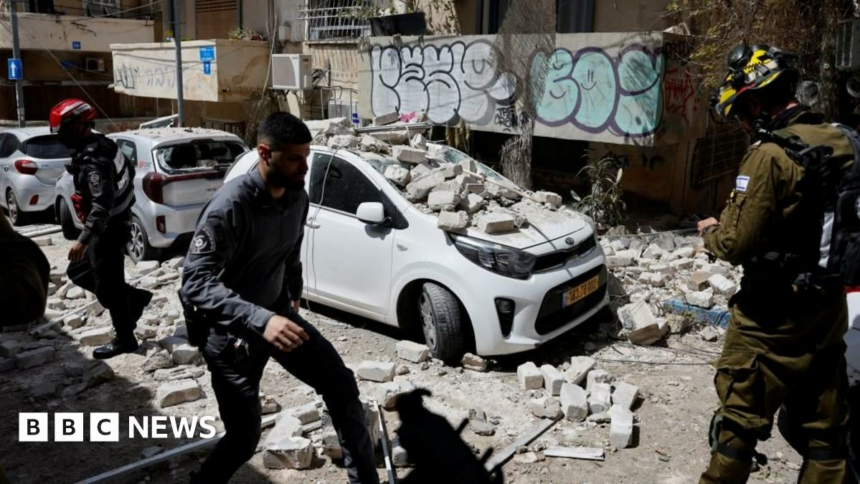
Emergency workers have been searching through the damage at the site of an Iranian missile which hit a residential area in the southern Israeli town of Dimona on Saturday night.
The town is located 13km (8 miles) away from the site of Israel’s nuclear facilities in the Negev desert. Paramedics at the Magen David Adom ambulance service say dozens of people have been taken to hospital.
This video can not be played
BBC at the scene of an Iranian missile strike on a residential area in Dimona
We've just received an update from the Israeli emergency service, Magen David Adom (MDA).
It says that one person has been killed following a missile strike – a man in his 60s, who was injured by shrapnel.
MDA adds that crews have provided medical treatment to 164 people in the past 24 hours, including 150 that are physically injured and 14 with symptoms of anxiety.
Twelve people are in serious condition with injuries from shrapnel and blasts, 20 are in moderate condition and 88 are in mild condition, the agency says.
Since the beginning of the war, MDA says it has provided treatment to 1,576 people. A total of 16 people have died from missile strikes, including 15 who were killed at the scene and one who later died of their injuries in hospital.
Anna Lamche
BBC News
Yesterday evening, the Israel Defense Forces said that Iran now has "missiles that can reach London, Paris or Berlin".
The claim, shared on X, came after reports that Iran had unsuccessfully fired ballistic missiles at the Diego Garcia US-UK military base, which is about 2,350 miles from Iran's southern coast.
An Iranian missile would need to travel about 2,700 miles to reach London.
Today, Housing Secretary Steve Reed said there was "no specific assessment that the Iranians are targeting the UK – or even could if they wanted to".
Dr Sidharth Kaushal, a senior research fellow at the Royal United Services Institute, tells the BBC: "Missile range is an elastic thing – in that if you put a lighter warhead on a missile, you can extend its range."
He says that while it is "probably accurate" that Iran has missiles capable of reaching the UK, it is "not the most pressing threat" because these weapons are inaccurate at long distances and would have to travel through very well-defended airspace to reach the UK.
"The big question is: So what? If you can launch a small number of conventionally-armed ballistic missiles over well-defended airspace… and they're quite inaccurate at very long ranges… what would the Iranians be trying to achieve?"
How far would a missile have to travel from Tehran to reach Europe's capitals?
Iran continues to fire drones at Saudi Arabia, the Saudi defence ministry says.
The ministry has published a number of posts on social media over the course of the day, saying drones have been shot down and intercepted over the country's eastern region.
The total number of drones reported since 05:45 local time (02:45 GMT) is nine. Ghoncheh Habibiazad
Senior reporter, BBC Persian
We've just heard that new strikes are happening in Tehran, Iran's capital.
Iranian news outlets are reporting that air defences have been activated in east Tehran.
In a statement on X, Iranian President Masoud Pezeshkian says that US threats against Iran show "desperation."
He writes: "The illusion of erasing Iran from the map shows desperation against the will of a history-making nation.
"Threats and terror only strengthen our unity. The Strait of Hormuz is open to all except those who violate our soil. We firmly confront delirious threats on the battlefield." Gabriela Pomeroy
Live reporter
Ahmadiel Ben Yehuda says there is damage to his ceiling and windows after a missile hit nearby
Ahmadiel Ben Yehuda lives a two-minute walk from the street where an Iranian missile hit the Israeli town of Dimona.
“I was on the steps to the bomb shelter when the missile hit, we were underground but I could feel the shockwaves come down, it pierced my ears," he tells me.
"There is damage to all the houses in our community – many collapsed ceilings and windows blow in – including in my own house."
Ben Yehuda says he went to visit the street where the missile landed and "the entire area is just devastated, including a kindergarten". He knows several people whose apartments were completely destroyed.
"I felt horror. I just can’t believe the power of what a missile can do to concrete, to see the devastation is hard to comprehend.”
The Israel Defense Forces says it struck an Iranian military base and a weapons production and storage facility in its latest round of strikes on Iran.
In a message on Telegram, they say that overnight they "targeted sites used by security bodies subordinate to the Iranian regime for the production and storage of weapons".
They also say they targeted a weapons production site for the IRGC air force.  Hugo Bachega
Middle East correspondent, in Lebanon
The IDF has been instructed to destroy bridges over the Litani River in Lebanon this week
Many Lebanese fear that Israel is attempting to cut off Lebanon’s south from the rest of the country ahead of a possible large-scale invasion, and that displaced families will not be able to return to some of those areas.
One million people have already been forced to flee their homes because of the war and entire communities are in ruins.
More than a thousand people have been killed across the country since the start of the conflict.
Israel insists it is targeting Hezbollah. But the United Nations human rights chief has criticised Israel’s actions in Lebanon, saying some may amount to war crimes.
Lebanese President Joseph Aoun says that Israel's attacks on bridges in the south of his country are a "prelude to a ground invasion", Lebanon's National News Agency reports.
In a statement, he condemns "Israel's targeting and destruction of infrastructure and vital facilities in southern Lebanon, particularly the Qasmiyeh bridge over the Litani River and other bridges."
The statement adds that the attacks "represent a dangerous escalation and flagrant violation of Lebanon's sovereignty, and are considered a prelude to a ground invasion".
He calls on the international community to "take immediate measures to deter Israel from carrying out this attack". Jacob Phillips
Live reporter
A woman looks out from her destroyed apartment in Tehran
Iran says it will "completely close" the Strait of Hormuz if US President Donald Trump follows through on his threat to "obliterate" its power plants. Here's the latest update on the war in the Middle East:
You can hear from our correspondent Sebastian Usher at the scene of the strike in Dimona in the video below:
This video can not be played
'A direct hit' – BBC visits Israeli town after Iranian strike
Iranians have accused Donald Trump of "stoking the fire" by threatening to strike Iran's power plants if the Strait of Hormuz does not reopen.
A woman in her 40s in Tehran tells BBC Persian that "all water, electricity and gas supplies will be cut" if Trump attacks.
A man in his 20s in Tehran adds that he fears there will be power outages and the banking system may crash if attacks increase. "They’re stoking the fire so much that they go beyond the red lines and restrictions," he says.
"Last year, during the 12-day war, we did not have water for three weeks," says a woman in her 20s who is also in Tehran. "This was far worse than the war for me."
"The only way the mullahs will leave is if we are hit by a nuclear bomb," says another man in his 20s who is in Rasht, in the north of Iran.
He says "it is not really comprehensible" that Trump will hit power plants but thinks it is unlikely the US will "hit us badly".
US Treasury Secretary Scott Bessent says that Donald Trump is leaving "all options on the table" in the war in the Middle East.
"Sometimes you have to escalate to de-escalate," Bessent tells NBC News after being pushed on whether the US is ramping up its attacks despite Trump saying he was considering "winding down" the Iran war.
Pressed on whether US troops could be put on Iran's Kharg Island, Bessent says the US had a very successful bombing campaign on the island and repeated that "all options are on the table".
He also says that Trump has "very clear goals" in the war with Iran: Destroying Iran's navy and air force, its missile capability and its ability to replenish its weapons. He adds that the US will also make sure that Iran can never have a nuclear weapon.
Bessent also says that most of the Iranian strikes are "lone wolf activities" and that two missiles fired at a UK-US base in Diego Garcia in the Indian Ocean were "out of desperation".
More now from the IRGC statement on the Strait of Hormuz.
They say that if the US follows through on threats to target Iranian energy, it will close the Strait and not re-open it "until our destroyed power plants are rebuilt".
Additionally, the IRGC says that it will target power plants, energy infrastructure, and IT in Israel "widely". It also says that it will target "any similar companies in the region" that have American shareholders.
"The power plants of the countries in the region that host American bases will be our legitimate targets," the IRGC adds.
"We did not start the war and we will not start it now, but if the enemy harms our power plants, we will do everything to defend the country and the interests of our people," it says.
In a statement broadcast by Iranian media, the Islamic Revolutionary Guard Corps (IRGC) says it will "completely close" the Strait of Hormuz if the US targets Iranian energy infrastructure.
Trump earlier threatened to "obliterate" Iran's power plants if the Strait was not opened within 48 hours.
The director general of the International Atomic Energy Agency, Rafael Grossi, tells CBS's Face the Nation that he hopes to "re-establish" discussions between Iran and the US about Iran's nuclear programme.
"I've been having important conversations here at the White House, and also with Iran. There are some contacts, and we hope to be able to re-establish that line," he tells the BBC's US news partner.
Asked if there was the possibility that a deal could be reached, Grossi says that "while there's a negotiation, there's always a possibility of an agreement".
Separately, Grossi says that while he has not spoken to Donald Trump directly, he is aware that the US president is supportive of diplomacy.
"We continue this effort. I think the essence of this is that in the bleakest hour, we should never lose hope," Grossi adds.
Copyright © 2026 BBC. The BBC is not responsible for the content of external sites. Read about our approach to external linking.
US power plant threats 'show desperation', says Iran president as strikes continue across Middle East – BBC



Leave a Comment