By Jozef Andrew Kosc on March 20, 2026
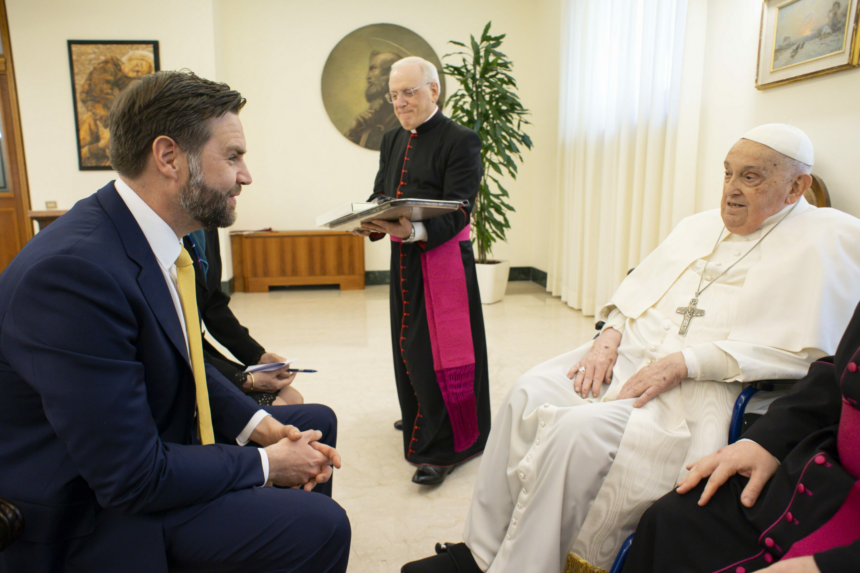
Anyone following American politics today will see the remarkable and dizzying array of references to Catholicism, Catholic theology, and Catholic moral and social principles. Prelates speak directly to politicians, as when the US Conference of Catholic Bishops condemned the violent excesses of ICE deportations. In turn, politicians, industry leaders and commentators appeal to Catholic social and political thought. These references are hardly subterranean. Consider, for example, J.D. Vance’s explicit use of the Augustinian and Thomistic concept of ‘Ordo Amoris’ (rightly-ordered love) to justify the Trump administration’s more draconian immigration policies. Or libertarian tech giant Peter Thiel’s recent plea for American technological advancement and the deregulation of artificial intelligence, wrapped up in the complex language of traditional Catholic eschatology. For many months, influencers and commentators of all stripes have drawn on competing Catholic sources to either condemn or support the Trump administration’s ardent support for Israel’s various wars in the Middle East. Increasingly, Catholicism has become both the medium and the message of contemporary American political discourse. Indeed, all hot button debates today—over immigration, the welfare state, foreign policy, environmentalism and gender—can be described as mere footnotes to Catholicism, modern instantiations of age-old theological debates.
How did an outsider religion of French, Italian, Polish and German immigrants—once viewed suspiciously by the Founding Fathers as foreign interference—become the dominant cultural mode of much of the Washington power elite, industry leaders and the literati? There are many reasons for this turn. Some will point to the decline of the once-hegemonic mainline Protestant churches in elite culture, a gap that has been readily filled by Catholicism’s vibrant intellectual tradition. Related to this is the growth of religion among the highly educated, the well-to-do, as well as Gen Z. A key feature of this story is undoubtedly the desire for re-enchantment of public life, an inevitable backlash to the social ennui and atomism one finds so well-described in Charles Taylor’s A Secular Age. Here, I will highlight another reason.
Catholicism is at once culturally familiar, intellectually robust, and most importantly, politically diverse. Within its storied corridors, across centuries of history, one finds the entire spectrum of political and ideological opinion, bolstered by nothing less than the supreme pathic and ethic authority of morality, religion, and (occasionally) the Vicar of Christ himself. “[I]n every age, we see her members entertaining, frequently adopting and even blessing, but always ultimately discarding, the current orthodoxies”, writes Monsignor A.N. Gilbey (a popular English priest of the last century, now experiencing a renewal of interest in his writings). “The Church will work in and through a social or political or even an ideological system as long as she can and then, when it appears to be strangling her or when she is in danger of being identified with it, she will shake herself free.”1 To illustrate this point, Gilbey recalls how, as a young seminarian at the turn of the 20th century, he was warned that “the next Pope but five is now a member of the Balilla” (Mussolini’s fascist youth organization), “[j]ust as at this moment the next Archbishop of Westminster but five is being indoctrinated in all the orthodoxies of the welfare state in a state school.” Because of this inherent diversity of thought, today’s politicians and commentators can draw from a multitude of traditional Catholic authorities to provide intellectual girth for competing policies, opinions, biases and prejudices.
Consider the ever-growing cultural and political influence of those on the anti-liberal or post-liberal right. Here we find a motley crew of neo-monarchists, throne and altar integralists, genuine fascists like the Groyper movement, as well as more serious and thoughtful post-liberal public intellectuals like Adrian Vermeule and Patrick Deneen. These and others on what can broadly be called the ascendent heterodox right find fruitful engagement with a long-established continental European tradition of pre-modern Catholic political thought. In France, since the Revolution, and during the long 19th century, and in Germany under Otto von Bismarck’s Kulturkampf (1871-7), liberal political reforms were used to justify the state seizure of Church properties and the expulsion of entire religious orders. The Papacy’s century-long rhetorical battle with liberalism occurred in response to this milieu, producing no less than four popes (Gregory XVI, Pius IX, Pius X, and Pius XI) who criticized political pluralism, separation of church and state, and the cultural effects of secular modernism. Indeed, Pius IX had once “declared that the Church had no need to come to terms with the nineteenth century.”2 The tenets of political integralism, arising in France under Charles Maurras and the Action Française movement, are now frequently espoused by Congressional staffers overheard over drinks at Washington’s popular Butterworth’s restaurant (frequented by Steve Bannon, and co-owned by right-wing journalist Raheem Kassam).
Liberals too can find their positions bolstered by the Catholic social thought tradition. Only a few years before Pope Gregory XVI decried separation of church and state in Mirari Vos (1832), the same arguments were used to push forward the Roman Catholic Relief Act (1829) across the English Channel, granting civil rights to Catholics for the first time since Elizabeth I. Catholic supporters of liberalism from this era include such giants as Cardinal Manning and Lord Acton. Later, free market liberalism was theologically vindicated in a series of papal encyclicals, Mater et magistra (1961), and Populorum progressio (1967). These texts interpret the task of economic development as the virtuous will of God, and signaled a break from previous skepticism of capitalism. American classical liberals have long cited these texts, as well as Catholic teachings on subsidiarity and localism. There is more than a hint of this perspective in today’s Silicon Valley libertarians and techno-optimists like Peter Thiel, calling for economic innovation to lift us up to conditions “a little lower than the angels” (Hebrews 2:7).
There remains also a certain type of influential conservative Catholic who harkens back to Cold War visions of a divinely inspired Pax Americana. Though this discourse often falls flat for younger Americans, it too has its storied predecessors. During the 20th century, St. Paul VI and St. John Paul II recognized the merits of a political liberalism that halted in its path the dual threats of fascism and communism. Behind the Iron Curtain, Christian political movements—spurred by St. John Paul II’s historic visit to Poland in 1979 and the Monday Demonstrations in East Germany—precipitated the demise of the Soviet Union. Far from being a purely ideational alliance, the links between the institutional Church and Reagan’s transatlantic Imperium Libertatis ran very deep. Reagan’s CIA director, Bill Casey, was a prominent member of the Catholic Knights of Malta and a daily Mass participant, while the broader connections between the US intelligence community and the Catholic Church of the 1980s are well-established. Other histories have shown how Reagan moved great funds through the Vatican Bank, under the watchful eye of St. John Paul II, and into the hands of Solidarity freedom fighters in Poland. Once-prominent American political theologians like Waldemar Gurian, a disciple of Jacques Maritain, were known to argue that, in the fight against Marxism, the US was “not imperialist enough.”4 Today, we hear echoes of this mode of thought in the ruminations of public intellectuals like Bishop Robert Barron, who has taken up charge against the allegedly ‘communist’ policy agendas of Alexandria Ocasio-Cortez and Zohran Mamdani.
Finally, it is obvious that those on the progressive left are pregnant with Catholic ideations and sources. Much of this influence comes directly from the Papacy itself. Recently, the Vatican made a splash by declining to participate in Trump’s Board of Peace initiative to oversee the end of the Gaza conflict. The official justification provided by Rome was the United States’ attempt to usurp the rightful role of the UN in overseeing peace-building and crisis management. The not-so-subtle subtext was a clear condemnation of the Trump administration’s brazen style of unilateral geopolitics. A few days later, Pope Leo XIV publicly rejected J.D. Vance’s personal invitation to participate in America’s 250th anniversary celebrations on July 4th. The pontiff’s reply—that he was instead spending the day with refugees—was a made-for-politics moment, greeted warmly by opponents of the Trump administration. That both the Pope from Chicago and the Vice President are American Catholics is instructive; both represent radically different instantiations of Catholic social and political thought.
The principal allure of relying on Catholic themes, ideas, and authorities today to advance political interests is also the root of much discord and division; there is no singular universal Catholic political prescription, there never has been, and there never will be. The observed history of Christianity teaches this; those institutions that once served the interests of man are perverted and, in another age, or another place, make victims of man. The Roman Empire was first oppressor before it became the bulwark of Christendom. The system of feudalism, under which Christian culture flourished in the High Middle Ages, eventually gave rise to corruption and civil strife during the 14th century (Barbara W. Tuchman, A Distant Mirror: The Calamitous 14th Century, Alfred A. Knopf, 1978). “The mistake is ever to attach undue importance to the process and above all to imagine it final and enduring—to think that the Church has at last found the ideal material framework in which to express the unchanging truth”, writes Gilbey. “This is a temptation which assails equally, let us say, those who idealise the achievements of the thirteenth century and those who idealise the aggiornamento of today.” Many centuries earlier, St. Augustine similarly rejected “the assumption that any slice of secular history, of any nation, institution or society, could have an indispensable place in the historical realisation of God’s purpose.”3
Much of the use and misuse of Catholic social and political thought today, taken anachronistically and out of historical context, is depressing. No appeals to ancient encyclicals can ever excuse the return of racism, anti-Semitism, neo-imperialism, or authoritarianism, all of which strike violently against the doctrinal core of Catholicism. A distinction must always be made between what Gilbey calls unchanging doctrinal “fundamentals” versus social-political “accidentals” (or “inessential trappings”). Much of the contemporary discourse is also, quite plainly, absurd (who can seriously posit that the decrees of Pope Boniface VIII in 1302 A.D. are a valid policy platform for the 21st century?). The Vatican itself would reject the grotesque enormities of contemporary integralist thought. And yet, despite these challenges, for many Catholics (including this author), there remains something deeply amusing and heartening about the fact that all American political discourse today is footnotes to Catholicism. Some seventeen hundred years ago, the religion of outsiders, of the oppressed, and of the marginalized, had somehow managed to creep into the halls of the great and the good under Constantine I and Licinius. Today, in many quarters of Washington, it has done so again.
1. We Believe, Bellew Publishing Company Limited, 1994: p. 251
2. Gilbey, We Believe, p. 252
3. R. A. Markus, Saeculum: History and Society in the Theology of St. Augustine, Cambridge University Press, 2007 [1970]: p. 157.
4. James Chappel, Catholic Modern: The Challenge of Totalitarianism and the Remaking of the Church, Harvard University Press, 2018: p. 167.
Providence is the only publication devoted to Christian Realism in American foreign policy and is primarily funded by donors who generously help keep our magazine running. If you would care to make a donation it would be highly appreciated to help Providence in advancing the Christian realist perspective in 2025. Thank you!
Events & Weekly Newsletter Sign-up
Get Your Providence Mug and Pin!
Support Providence‘s mission of arguing for Christian realism and receive a Providence mug and/or pin!
With a $25 donation, we will send you a Providence pin, and with a $50 donation, you will receive a pin and a mug.
Related articles
Sean Patrick Calabria
February 13, 2026
Jordan J. Ballor
February 3, 2026
Mark V. Vlasic
December 25, 2025
Michael Lucchese
November 25, 2025
J. Daryl Charles
July 17, 2025
Receive expert analysis in your inbox.
Institute on Religion and Democracy
1023 15th Street NW, Suite 200
Washington, DC 20005
Visit
Connect
© 2026 The Institute on Religion and Democracy. All rights reserved.