


Home
What's the word?
Test your knowledge with our new weekday mini crossword
By Helen Branswell
April 14, 2026
Infectious Diseases Correspondent
Helen Branswell
Helen Branswell covers issues broadly related to infectious diseases, including outbreaks, preparedness, research, and vaccine development. Follow her on Mastodon and Bluesky. You can reach Helen on Signal at hbranswell.01.
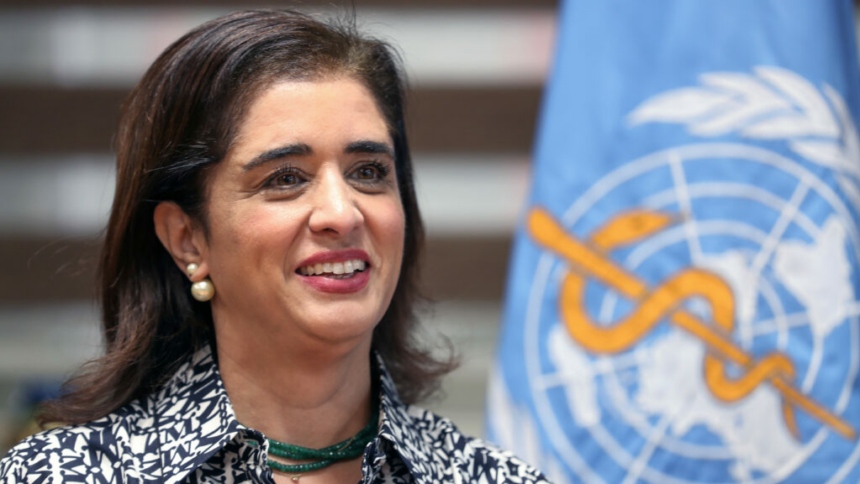
Hanan Balkhy has a lot on her plate these days.
Balkhy is the director of the World Health Organization’s Eastern Mediterranean region, an entity that includes several of the countries caught up in the conflict between the United States, Israel, and Iran. The problems it has been posing — not just to individuals’ health and safety but to entire health care systems — are robbing her of sleep.
Advertisement
Balkhy is also one of the people whose name is mentioned when chins start wagging about who will enter the race to be the next director-general of the WHO. The second and final term of the current director-general, Tedros Adhanom Ghebreyesus, ends in the summer of 2027, but the process to select his successor will officially begin later this month or sometime in May, when Tedros issues a call for nominations.
The nomination period will close in September or October, so Balkhy still has some time to decide whether she wants to be considered. But in reality, she is going to have to make that tough decision — one that might require her to take an administrative leave from her current role — during an enormously difficult period for her region.
In a recent interview with STAT, Balkhy spoke of her thinking about entering the race, the conundrum Washington will pose for people vying to be the next director-general, and the challenges her organization, known in the WHO world as EMRO, is facing because of the war in Iran and beyond.
Some background on Balkhy first. She is a pediatrician from Saudi Arabia who studied at King Abdulaziz University before doing a pediatric residency at Massachusetts General Hospital and a pediatric infectious diseases fellowship at the Cleveland Clinic Foundation and Case Western Reserve University. Prior to being elected EMRO regional director in early 2024, she served as the WHO’s assistant director-general for antimicrobial resistance for about five years.
Advertisement
The interview, which took place before last week’s announcement of a ceasefire, has been lightly edited for length and clarity.
Can I just get a bit of basic information to start? Your native country is Saudi Arabia, isn’t it?
Yes, indeed.
You studied in the United States. Do you have dual citizenship?
Yes. I was born in the U.S., actually. But I’m Saudi.
The process of selecting a new WHO director-general will be starting soon. You’re mentioned as someone who might enter the race to be the next DG. Will you?
For me, running, I think at this point, it’s not 100% clear. I have such a very busy region, and I’m very focused on my current work.
There’s talk that this could be EMRO’s turn to hold the director-generalship. I know the position doesn’t formally rotate among the WHO regions, but I would think that if there is that feeling, there may be pressure on you to put your hat into the ring.
The two regions that have never had a director-general are EMRO and SEARO [WHO’s South-East Asia Regional Organization]. But I think it’s a bit of a gentleman’s agreement.
Do you have a target in your mind about when you’ll need to decide by? Mid-summer? Or is there just so much going on that you’re maybe going to have to play it by ear?
I think the latter, absolutely. There’s just so much going on. And then, in reality I think any regional director, if we were to run, you can only make your candidacy better by just doing a good job in what you’re doing.
Global health experts expect candidates for the director-generalship will likely feel the need to travel to Washington to meet with administration officials, even though the U.S. has formally withdrawn from the WHO and will have no vote.
Do you have any thoughts on that? It could be a fraught thing; other countries might resent seeing candidates kowtowing to D.C. at this point.
Because of its talent, because of its science acumen, because of its scientists, the U.S. CDC, its NIH, its academia, the U.S. has been of extreme value to global public health in general. And it’s really been difficult for all of us to see the U.S. step away.
Advertisement
Of course people need to be going to the U.S. and D.C. and Beijing. We have to go everywhere, and we have to keep our communications open all the time. We only lose if we don’t communicate.
We want the U.S. to come back. We want all of our member states to be at the table. Absolutely, yes. And I would bet a million dollars that every candidate will be doing it, whether they say it or not.
Let’s talk about your region. The implications of what’s going on there are being felt globally, but nowhere more than in your region. Of the many concerns you must have, what is front of mind?
What worries me at this specific moment is a further escalation into full-blown nuclear, biological, or chemical warfare. That’s what keeps me up at night.
So we’re doing everything we can to make sure that we have all the pieces in place to be able to provide the support that the member states of the region need and also to make sure that we’re in good communication with other regions, because of the 21 countries involved in this current conflict, 16 or 17 are in EMRO, but there’s a few others in the EURO region. [Editor’s note: Though located in the Middle East, Israel is in WHO’s European region.]
The second thing that worries me is if this leads to attacks on desalination sites. This would be an utter disaster; 70% to 100% of the several countries in this region fully rely on desalination plants. So if they were hit, then you’re talking about no water to drink, no water to cook, no water to grow crops.
If that actually happens, the immediate implications would be mass migration. So you’re talking about chaos, crowdedness, displaced populations. Already we have 3.2 million displaced people in Iran and over a million in Lebanon. In a region of 750 million people, one in every seven individuals is already in need of humanitarian assistance.
In Dubai, we have our most critical humanitarian center; a lot of the emergency kits and support to countries under conflict go through the Dubai hub. And when the airspace got shut down, millions of dollars worth of medical supplies had to stop. It’s coming back, slowly.
Advertisement
WHO’s emergency supplies distribution system was effectively shut down, because the airspace was closed?
Exactly. We had to look for alternatives, which we did. The government of the United Arab Emirates has worked really hard with us, and also to ensure that those flights do continue as much as they can, and also finding alternate routes. Put that on top of the closure of the Strait of Hormuz, and the increase in the cost of energy, in gas, in oil.
So that has been my life for the past month or so, thinking about all of these complexities.
I know I’m running out of time. Is there something we haven’t spoken about that you’d like to address? Something that’s not getting enough attention in the global health sphere that you’d like to shine a light on?
I’m mindful, as a regional director of EMRO, of the discussions on the global health architecture and how that restructuring will deal with long-term issues as well as health emergencies.
Things take time, and if we really want to build robust systems, we have to invest, even in the midst of a humanitarian response.
Helen Branswell
Infectious Diseases Correspondent
Helen Branswell covers issues broadly related to infectious diseases, including outbreaks, preparedness, research, and vaccine development. Follow her on Mastodon and Bluesky. You can reach Helen on Signal at hbranswell.01.
Understand how science, health policy, and medicine shape the world every day
Your data will be processed in accordance with our Privacy Policy and Terms of Service. You may opt out of receiving STAT communications at any time.
Angus Chen
Advertisement
Ed Silverman
Ed Silverman
By Jason Mast
By Jason Mast
By Andrew Joseph
Share options
X
Bluesky
LinkedIn
Facebook
Doximity
Copy link
Reprints
A decade of reporting from the frontiers of health and medicine
Company
Account
More